When genealogists research a death, they usually have a mental checklist: death certificate, obituary, tombstone and (maybe) a probate file or will.
But funeral home records are often left off that list. Though not always easy to find—most, after all, were created by private businesses rather than government offices—they can confirm death and burial details. And they also often identify relatives, signal membership to a church or fraternal organization, and even show who paid the bill.
Funeral Home History
Before funeral homes became the standard, death was usually handled within the home and community-led care for the deceased started immediately after death. Families washed and prepared the body, laid out their loved one in the front parlor of the home (hence–“funeral parlor”) and held wakes or visitations in their home. Neighbors, relatives, religious leaders and local craftsmen all played a role (cabinetmakers often built the coffin). The family handled much of the mourning work themselves because death, as awful as it is, was still part of domestic life.
This began to change in the nineteenth century. Undertakers emerged as people who would provide coffins, transportation to the cemetery and other burial services. Many early undertakers came from trades connected to death care, especially cabinetmaking, because someone had to make the coffin.
The Civil War pushed American funeral practices towards professionalization as thousands of soldiers died far from home and families wanted their bodies returned for burial. While embalming had existed earlier, it wasn’t as common, but became more utilized during the war because it allowed bodies to be preserved for transport.
By the late nineteenth century, more undertakers entered the profession through embalming and body preparation rather than cabinetmaking, and funerals moved out of the family parlor into the undertaker’s parlor of funeral establishment. Funeral businesses also became more formal and began to keep account books, ledgers, burial permits, contracts and correspondence as they handled more of the practical and ceremonial work surrounding death.
This shift matters for genealogists, as the more professionalized funeral care became, the more paperwork it created. A death that once may have been handled mostly by the family and community later involved an undertaker, embalmer, cemetery, clergy member, newspaper, railroad, county official, and, of course, a bill payer.
What are Funeral Home Records?
Also called “undertaker records,” “mortuary records,” or even “account books,” funeral home records include a variety of documents that tracked the everyday operations of a private business. As such, they reflect the administrative and business concerns of the funeral home–as well as the services they provided to a family.
Depending on the funeral home, these records can be quite detailed, documenting work performed by a funeral director from the time arrangements began until the deceased’s burial or cremation:
- Services provided
- Payment requests and receipts
- Burial arrangements
- Transportation details
- Burial permits
- Correspondence with family members
In short: Funeral home records were created to help employees coordinate with families, cemeteries, clergy and other people and organizations while fulfilling their legal and logistical roles in the end-of-life process.
Details in Funeral Home Records
Created by various individual businesses, funeral home records do not have the same uniformity as you’d expect in other documents. Some funeral homes kept detailed ledgers, while others kept only basic account information. You might find:
- Deceased’s full name
- Dates and places of death and burial
- Age or birth date and birthplace
- Names of the spouse, parents, other relatives and pallbearers
- Residence
- Occupation
- Cause of death
- Cemetery or burial plot information
- Clergy or church involved
- Name of person who arranged and/or paid for the funeral
- Itemized funeral expenses
- Transportation details (if the body was moved from one place to another)
Some also wrote the deceased’s obituary that was published in a newspaper or filed for their death certificate with a government office. That means their records may preserve information that appeared in other death-related records—perhaps with additional detail.
Pay attention to even the small details. Was a body shipped from another city or state? What religion or denomination held the service? Was the person who paid for the funeral related to the deceased? Like the best genealogy records, funeral home records can turn a date on a timeline into rich context about a person’s life.
As with any record, you shouldn’t automatically treat funeral home records as correct. The information in them usually came from a family member, friend or neighbor—who may or may not have had accurate knowledge about certain aspects of a person’s life. Be especially wary of birthplace, parents’ names, and exact age, and verify all information with other sources.
Example: Elizabeth M. Lee’s Funeral Home Record
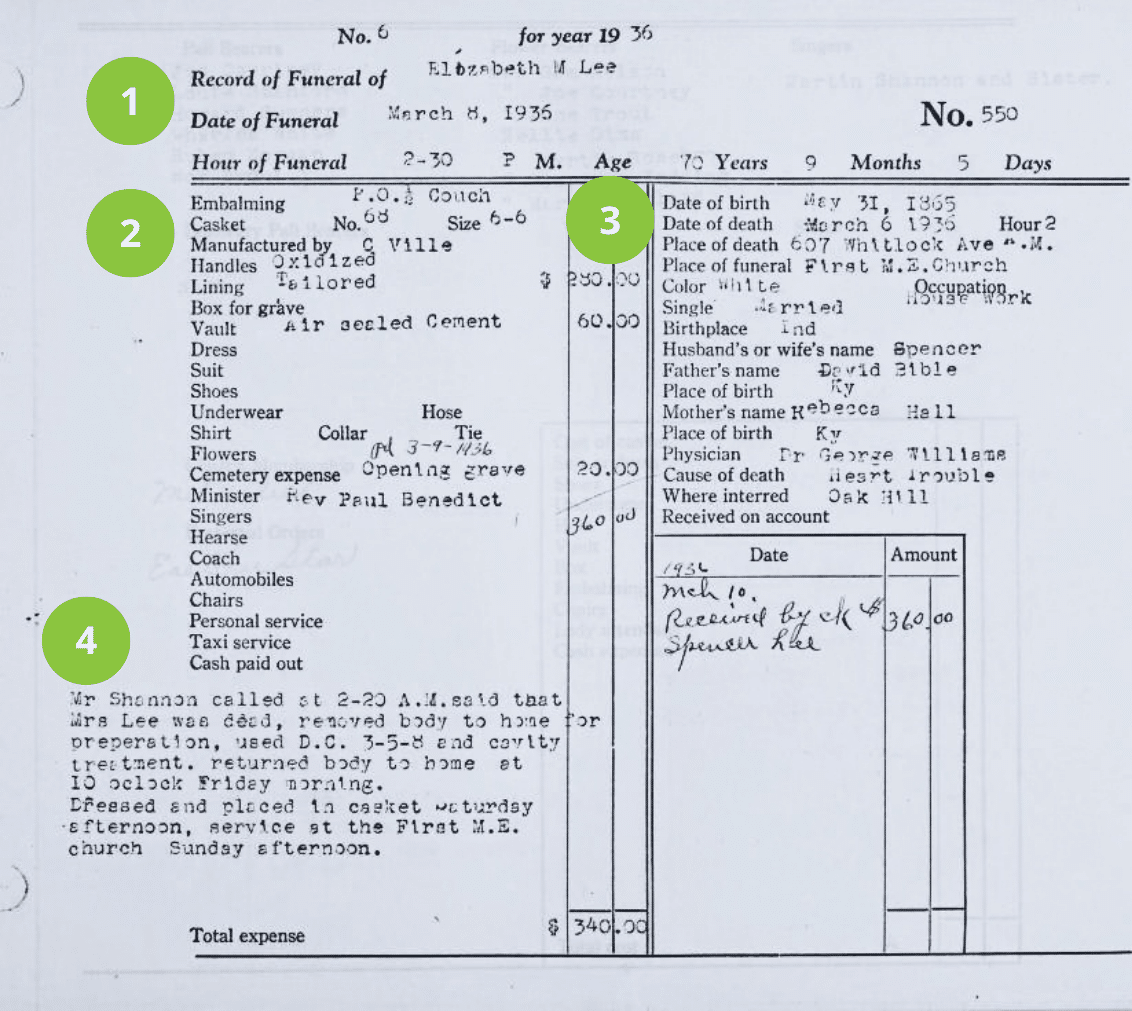
Funeral home record for Elizabeth M. Lee, 1936. From Crawfordsville, Ind., mortuary records, Jan. 5, 1921–Feb. 22, 1945, volume 3, part 1. Image 67/861. www.archive.org/details/crawfordsvillein31unse.
- A funeral home record predictably includes information about the deceased’s memorial arrangements, even specifying the hour. This record for Elizabeth M. Lee also includes her age down to the day, providing an incredible level of detail.
- Don’t disregard information about services provided and payment. In this case, Elizabeth’s husband paid for the services via a check.
- This column includes a variety of other details, many of which aren’t technically relevant to the funeral: date of birth, marital status, color/race, occupation, names of spouse and parents (including mother’s maiden name and parents’ birthplaces), and name of physician. Also listed are place of death and funeral, cause of death, and place interred.
- The undertaker wrote a narrative summary of where Elizabeth’s body went after her death (including when the home received news of it) and what treatments were used to care for it.
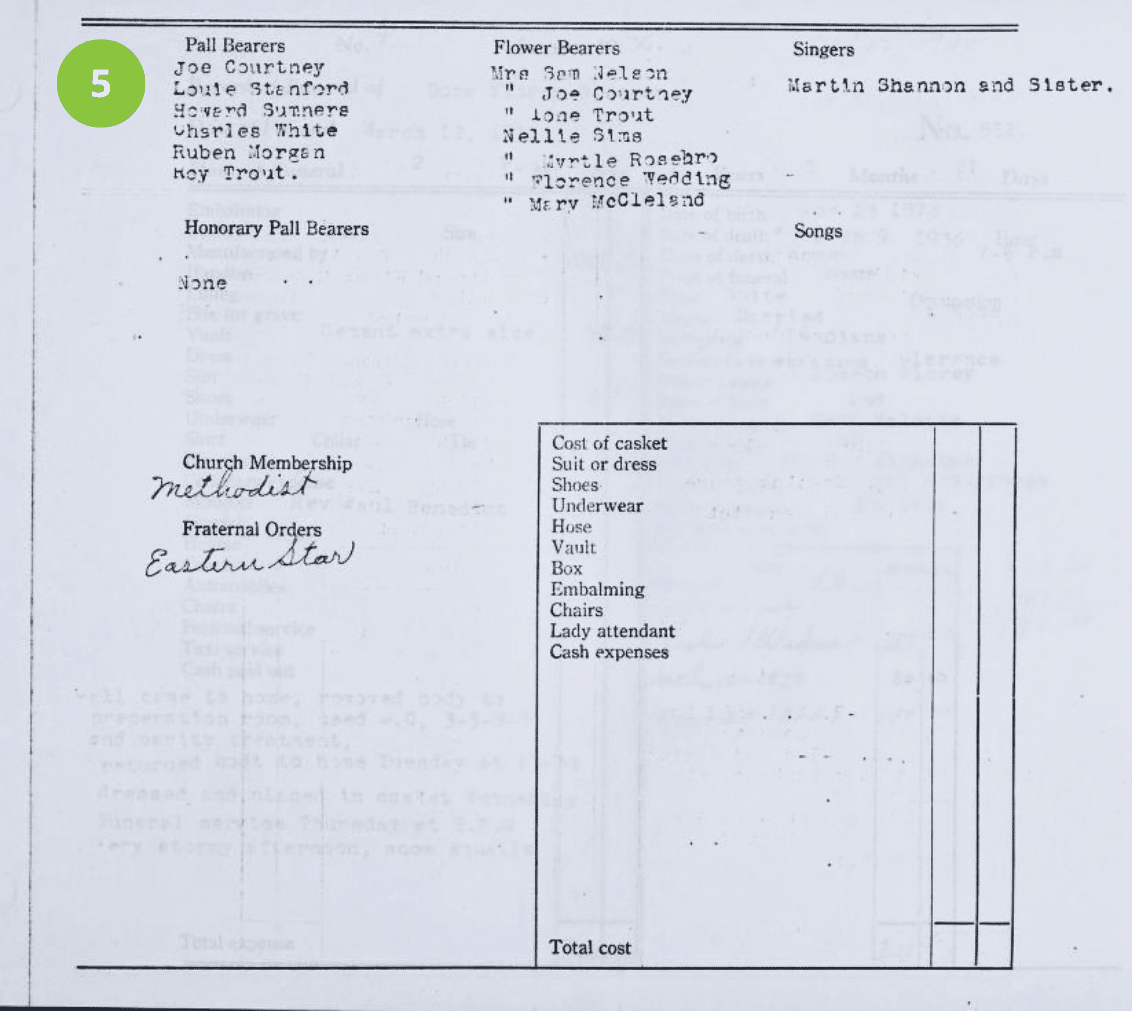
- The second page adds even more detail: pallbearers, flower bearers and even singers. A short section below mentions faith tradition (Methodist) and fraternal order membership (Order of the Eastern Star, a group related to the Freemasons). The latter point to church records, fraternal records, newspapers and “clusters” of people in the community.
Accessing Funeral Home Records
Because funeral homes are private businesses, the records they kept are not as consistently available online as (for example) death certificates. Some stayed with the funeral home, while others were donated to libraries or archives. Still others were lost when a business closed, merged or changed ownership.
Identifying the business
That said, start with the documents you already have. Death certificates, obituaries, cemetery records and funeral cards all may name a funeral home or undertaker. Obituaries, in particular, often include the name and address of a funeral home in the last few sentences on memorial arrangements.
If you’ve struck out with those sources, research what funeral homes were near your ancestor’s home. Many families (even today) choose a close business, giving you a good place to start. Contemporary city or business directories can help.
Keep in mind that funeral homes were historically family-run businesses. But many have closed, merged or been purchased by larger companies. Look for references to any closures or acquisitions in newspapers or local histories.
Once you have a funeral home’s name, determine if it’s still in business; a Google search may be enough. In some cases, records moved to the successor business. In others, they were donated to a local repository or, unfortunately, lost.
Requesting original records
If the home still exists, contact it directly and ask whether old records survive and if staff are available to help you search for a person. Be specific and polite; these are active businesses, not research libraries. Staff members are often working with families in the midst of a recent loss.
Whenever possible, make sure your request includes:
- Deceased’s full name
- Date of death and place of death
- Residence
- Burial place
- Name of funeral director or undertaker
- Your relationship to the deceased, especially for more-recent deaths
Also indicate which kind of record you’re seeking. Avoid asking them to send “everything they have.”
Each home or company can set its own record-access policy: Some may be willing to help with a search, but others may allow records only to close relatives (or deny requests altogether). Others might not keep records older than a certain number of years.
Looking for records online
If the funeral home isn’t still in business, widen your search. Check with local archives, public libraries, university special collections, historical and genealogy societies, and chapters of the Daughters of the American Revolution. Any of those organizations might be familiar with the home or have received its records at some point.
Those same local organizations may have even abstracted funeral home records and published them in a book. Look for titles (as well as any indexes or manuscript collections) at free sites WorldCat, FamilySearch and the Internet Archive or at subscription sites such as Ancestry.com and MyHeritage.
Some societies—as well as USGenWeb—have abstracted or indexed collections on their websites. For example, the Huntington County (Ind.) USGenWeb has an index of records from the H. Brown and Sons Funeral Home. And “PERSI” (the Periodical Source Index) at the Allen County Public Library can help you find any articles from society publications.
Carefully read the description of any online collection you find. Not every database with the words funeral home in the title will have original ledgers or account books. For example, Ancestry.com’s “U.S., Cemetery and Funeral Home Collection, 1847-Current” is actually created from published obituaries, not cemetery or funeral home records. (Many of those obituaries were, however, found on funeral home websites.) That can still be useful, but it’s not the same thing as an original funeral home record.
Funeral Home Record Substitutes
Unfortunately, not every funeral home’s records survived. If you can’t locate funeral home records, there are several other sources that can help reconstruct the same events and answer many of the same research questions.
Death Certificates: Official death records frequently mention the funeral home or funeral director (or undertaker) that handled the arrangements. They often include information about if and when a body was transported from the place of death.
Obituaries and Death Notices: Besides announcing a death, these often identify a funeral home, list the date and location of services, name surviving relatives, and indicate where the deceased was buried. Local papers may have published multiple notices, and often the funeral director was in charge of submitting these to the newspapers.
Cemetery Records: Burial registers, plot purchase records (including deeds), grave opening permits and others may document the final disposition of the deceased and identify the person who arranged or paid for the burial.
Church Records: Like civil death records, these can provide alternate details about the person’s death and funeral services (assuming they were held at a place of worship or presided over by a clergyman).
Probate Records: Estate records sometimes include invoices for the funeral, receipts or reimbursements for funeral expenses–especially when those costs were paid out of the deceased’s estate.
Other substitutes might be found in your own archive or at a local society: funeral programs, memorial cards, condolence books, service books, receipts or correspondence.
A version of this article was published in the September/October 2026 issue of Family Tree Magazine.
Related Reads



Author

Katharine Korte Andrew MS/LIS is a digital editor for Family Tree Magazine and professional genealogist.