
Disclaimer: This article contains numerous references to murder, including murder of children. Reader discretion is advised.
Searching your roots can be deeply personal. An ancestor or other family member may hold a special place in your heart—a connection profound enough to provide clarity about yourself.
But what happens when your research turns up something so unexpected, tragic or shocking that it defies explanation?
In my research, I made a horrifying discovery: I had a serial killer in my family tree.
In this article, I’ll share what lead to my uncovering of this shocking story. Along the way, I’ll share tips for how you can research the “black sheep” in your own family—and how to handle the emotional fallout.
Finding a Killer
As a young genealogy hobbyist, I wanted to understand the roots of my great-grandmother—the mother of my paternal grandmother, Loree (Vincent) Wendt. When I was a child, Loree shared several fond memories of her mother Minnie Vincent (my great-grandma Minnie) and her family in Nebraska.
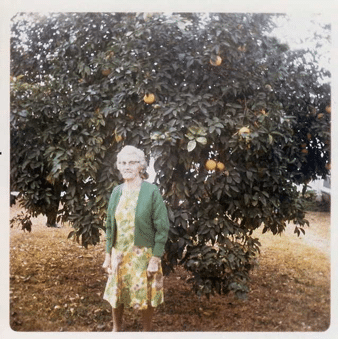
According to Loree, Minnie was loving, hard-working and funny. But that warm personality contrasted with a rough upbringing. Minnie’s mother (Maria) died in childbirth when Minnie was just 7 years old. As a result, Minnie and her siblings lived with other families for a period of time until her father, William Sidel, remarried.
In fact, William married twice more. Shortly after Maria’s death, he was med to a widow named Clara Sternecker; the arrangement apparently wasn’t a happy one, as it lasted for just eight days. His third—and lasting—marriage was to Marie Mick in 1898.
What Loree didn’t know was that Minnie had a half-sister: my half-great-grand-aunt, Della (Sidel) Sorenson. I first discovered Della, born in 1897 in Howard County, Neb., after finding Minnie on Find a Grave. A distant relative had created profiles for both Minnie and Della, and the information there was properly sourced.
Della’s own Find a Grave profile was, to say the least, shocking. I couldn’t believe what I saw on my computer monitor; her profile was replete with details about her crimes, which included seven murders.
I felt sick to my stomach—and even a sense of shame. How could I have such a person in my family tree? Before I could go through a kind of “genealogical grieving process” (from denial to acceptance of this terrible truth), I wanted more proof.
As it turns out, I didn’t have to search far.
Della’s Confessions
On 18 April 1925, 28-year-old Della Sorenson of Dannebrog, Neb., was arrested for seven murders: those of her first husband, her mother-in-law, two of her own daughters, and three other children.
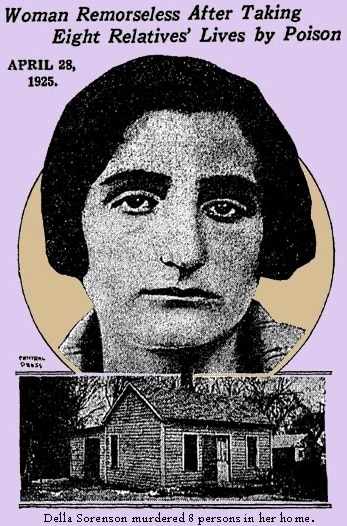
The sensational story went “viral” and was printed in newspapers across the county. A few days after her arrest, the Phonograph of St. Paul, Neb., published her chilling confession. From it, we can piece together a timeline.
Della married Joseph Weldam in 1915. A Mrs. Wetzel Cooper, identified as Della’s sister-in-law, came to visit the couple at their home a few years later.
“I had it in for Mrs. Cooper,” Della said. “[She] was always running down my reputation. And to get even with her, I decided to kill three of her children.”
Cooper brought her daughter Viola, the first of those ill-fated victims, on a 1918 visit. Della confessed to spiking Viola’s chocolate with strychnine, a chemical used in pesticides and later as a preferred poison of the killer in Agatha Christie’s first Hercule Poirot novel. Viola died shortly after.
Then, in 1920, Della injected a fatal dose of strychnine into the medicine bottle of her mother-in-law, Wilhemina Weldam. At the time, Weldam lived with Della and Joe; Della called her “feeble and childish and a burden on my hands” that she wanted out of the way.
Della next turned on other members of her household. Her daughter Minnie had “St. Vitus’ dance,” a contemporary name for either rhematic chorea or Huntington’s disease. Both can cause involuntary movement, and severe cases can lead to mental illness and brain damage.
Della struggled to tolerate Minnie’s symptoms. “I could do nothing with her,” Della said. “She ate and tore the clothes off the bed; put her hands on the hot stove; could not talk; and suffered terribly.”
As a solution, Della sought to “relieve her suffering” by putting strychnine into a glass of Minnie’s water. “Soon as the child died, I had a feeling of elation and happiness,” she said in her confession. “Then, after thinking of what I had done, I had a feeling of fear and tried to hide what I had done.”
Soon after, Della and Joe had a fight that led to his murder as well. Della bought strychnine from a drug store using her own name, then poisoned Joe’s medicine twice and burned the bottle in the stove to destroy the evidence.
Two years later, Cooper again visited Della’s home with her children. Della poisoned Cooper’s four-month-old son Clifford in August, then did the same to Cooper’s daughter Bessie in October. Clifford died, but Bessie recovered.
“Every time I gave strychnine to one of Mrs. Cooper’s children, I said to myself, ‘Now I am going to get even with you,’” Della said. Leaving no ambiguity as to her motives, she added, “When I bought this poison, I had an idea that I was going to kill someone.”
Della’s final two confirmed murders were of infants: her own 1-year-old daughter Deloris [sic] and a baby girl named Ruth Brock.
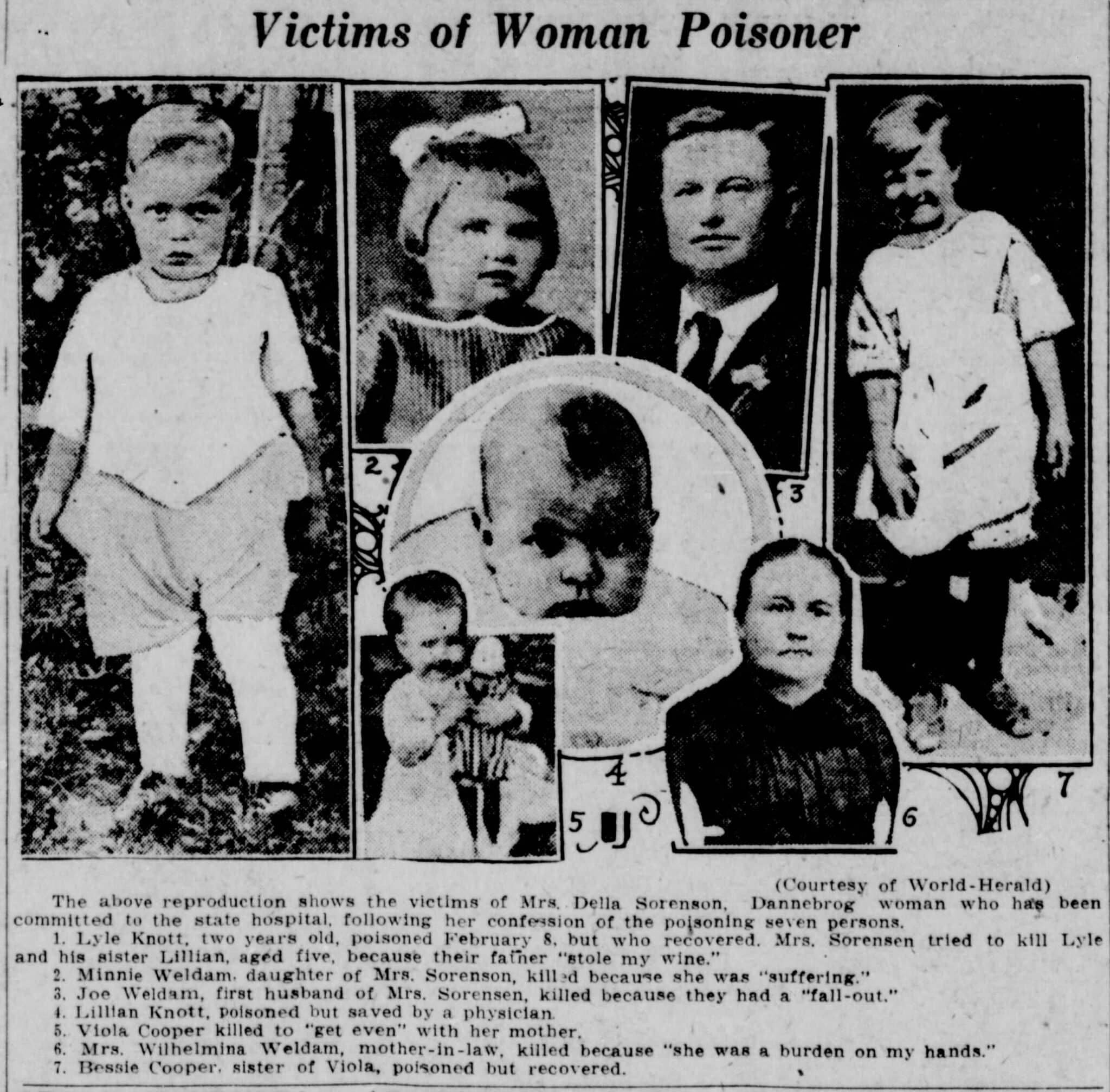
Della’s confession left out some additional crimes: the attempted murders of her second husband (Emmanuel Sorenson); her stepmother, Marie (Mick) Sidel; and a few other children in the area. The children’s survival in the latter case led to an investigation and her arrest in 1925.
Needless to say, the chilling details of Della’s crimes are deeply disturbing. Her dark motivations were often rooted in petty revenge (for “running down my reputation”) or simple annoyance (stating her daughter Deloris “made me nervous and irritable” and was “continuously crying). Most alarmingly, she admitted to twisted feelings of happiness immediately following the murders.
At the time of her arrest, Della claimed to feel remorse for her actions and hoped to be “cured” in a hospital before returning to her surviving children. Indeed, a judge deemed her “insane due to homicidal mania” and not fit to stand trial. She was committed to a state hospital in Hastings, Neb., where she died in 1941.
Family Secrets
My late grandmother Loree was quite the storyteller—and an open book about family history. Given that she never told me about her serial killer half-aunt Della, I don’t believe Loree knew about her. Other evidence supports this:
- Photos: I received a photo of Della as a girl from Loree. Near Della was a question mark—Loree, at a minimum, didn’t recognize Della.
- Age: Loree was just 7 years old when Della was arrested—and hadn’t been born when William and Marie (his third wife) severed ties with Della. It’s unlikely Loree would have met Della (or, given the circumstances, to have even heard of her).
- Oral history: A living family member related a memory to me of Minnie having a heated phone call with someone, shouting in German. On the other line was her (and Della’s) father, William. Distraught, Minnie apparently chose not to visit the subject with Loree.
Thus it seems that William and Minnie both knew about Della’s crimes but kept the story from Loree. When he learned of Della’s arrest, William told the Omaha Bee that she was “the meanest girl that ever lived.” According to William, he and Marie had been estranged from Della since Della’s wedding in 1915. “She has brought her three brothers and three sisters much shame,” he said. “The rest of the family is respected in the county.”
Discretion, then Disclosure
For years, I put off sharing this ominous story about Della. Though she was a collateral relative of mine (rather than an ancestor), my repulsion morphed into major reluctance to share the tragic story even with the general public.
It wasn’t until later that I presented Della’s unique story at a genealogy conference. Despite its dark nature, the presentation was well-received. And, because the murders had occurred (by that point) more than 100 years ago, I felt comfortable enough to discuss them in lectures—as well as this article.
Shame and “Black Sheep” Ancestors
If members of your family tree caused irreparable harm, you might have feelings of shock and shame. I certainly did after learning about Della Sorenson’s crimes.
But, in the context of family history, their actions are in the past. No matter the harm they caused, you’re not responsible for their behavior. Nor are you guilty by association with them.
Everyone will process tragic stories like Della’s differently. It took time, but I was able to set aside the horror that I’d internalized and come to a place of acceptance. The end result was my initial feels of shock evolving into sheer disgust at the extent and brazenness of her crimes.
In short: You’re not alone if you “black sheep” journey has been emotionally turbulent.
Further Mysteries
A question remained: Who was Della’s biological mother?
As a reminder, William married three times: to Minnie’s mother, Maria, through 1893; briefly to Clara Sternecker that same year, and to Marie Mick from 1898. Della was born in 1897, potentially putting her birth in a gap of William’s timeline.
After Della’s arrest, William described Marie as her stepmother; that seemingly rules out Marie. Reasonably exhaustive research in church records and other documents didn’t provide a conclusive identity for Della’s mother—only that she wasn’t one of William’s three wives.
A new discovery could yield further clues. After all, many brick walls in my personal and professional research have been broken by timely findings. The truth reveals itself at the moment it’s supposed to.
An answer would certainly be welcome. Perhaps it would help me achieve some sense of additional closure given the case’s truly horrifying circumstances.
Regardless, Della Sorenson, the serial killer and black sheep of the family, will forever retain her ominous place in my family tree.
Researching Your Own “Black Sheep”
Ask yourself: What do you already know about this black sheep? Have you performed an extensive online search?
Online historical newspapers can often yield clues or major breakthroughs about such persons of interest, as was the case with my research into Della Sorenson. Unsual cases like hers may have been published in newspapers not just locally, but across the country. I found articles that helped me piece together her story in databases such as Newspapers.com and GenealogyBank.
In other cases, you may need to “read between the lines” in records to find evidence of a possible black sheep ancestor. Notice every detail, and ask yourself questions: Why is a relative conspicuously absent from their parent’s will or obituary? Did someone live in a prison or other penal institution during a census?
A version of this article was published in the November/December 2026 issue of Family Tree Magazine.
Related Reads