At the heart of the story, the Odyssey, an epic poem attributed to the ancient Greek author Homer, is a story about a man trying to return to his family. Odysseus spends 10 years fighting in the Trojan War and another 10 trying to return to Ithaca, his wife, son and aging father. While monsters, shipwrecks and angry gods dominate the poem, family relationships drive nearly every part of the story.
The Odyssey is more than just an ancient poem about adventure, but its characters also belong to an enormous interconnected network of mortal kings, legendary heroes, Titans, Olympian gods, nymphs and monsters.
Mythological Genealogy
Anyone who’s researched their own family history knows that records sometimes disagree and Greek mythology is no different. Family history isn’t limited to historical records, as throughout history, people have used genealogy to explain their identities, inheritances, political legitimacy and cultural values. And Greek mythology does the same thing: Ancient communities developed competing traditions that connected local rulers and heroes to prestigious ancestors or gods, which strengthened a family’s reputation and helped explain the extraordinary qualities of later descendants.
Ancient authors frequently preserved different versions of the same family relationships. Homer’s Odyssey preserves one version of Odysseus’ family, while later Greek and Roman writers add new relatives, alternative parents and additional children. As a result, there is no single, universally accepted family tree.
Instead of indicating that one version of a mythological genealogy is necessarily “correct,” these differences show that mythology evolved over centuries through oral storytelling before being written down. Much like our own family lore passed down through oral history.
Meet the Family: Who Was Odysseus?
Odysseus was the legendary King of Ithaca, a small island kingdom off the western coast of Greece. His ancestry connected him to both mortal kings and the gods. He was known for his intelligence, guile, persuasive speaking, talent for deception, and versatility, all of which explains him being known by the epithet of “Odysseus the Cunning.” Tradition credits him with the Trojan Horse, which allowed the Greeks to sneak into Troy and end the Trojan War.
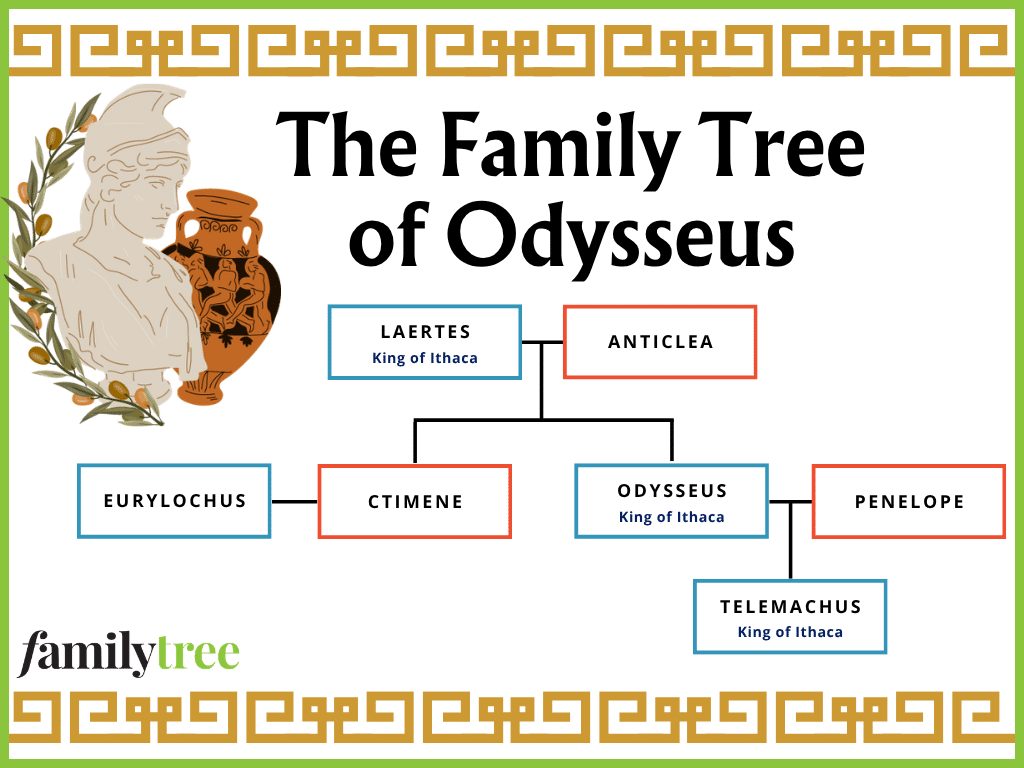
In Homer’s account, Odysseus was the son of Laertes and Anticlea. Through them, he inherited connections to royal families, legendary heroes and the Olympian gods.
Odysseus also had a sister named Ctimene. While she is only briefly mentioned in the Odyssey; her marriage is an important connection within Odysseus’ own crew. Ctimene married Eurylochus of Same, who accompanied Odysseus on his journey home from Troy.
As family historians, we might ask if the brother-in-law relationship adds another layer to the disagreements between Odysseus and Eurylochus. He challenges Odysseus’ decisions several times during the journey, including when he encourages the starving crew to kill the sacred cattle of the sun god Helios. Those actions here contribute to the destruction of Odysseus’ final ship and the deaths of the remaining crew, including Eurylochus.
Laertes and the paternal line
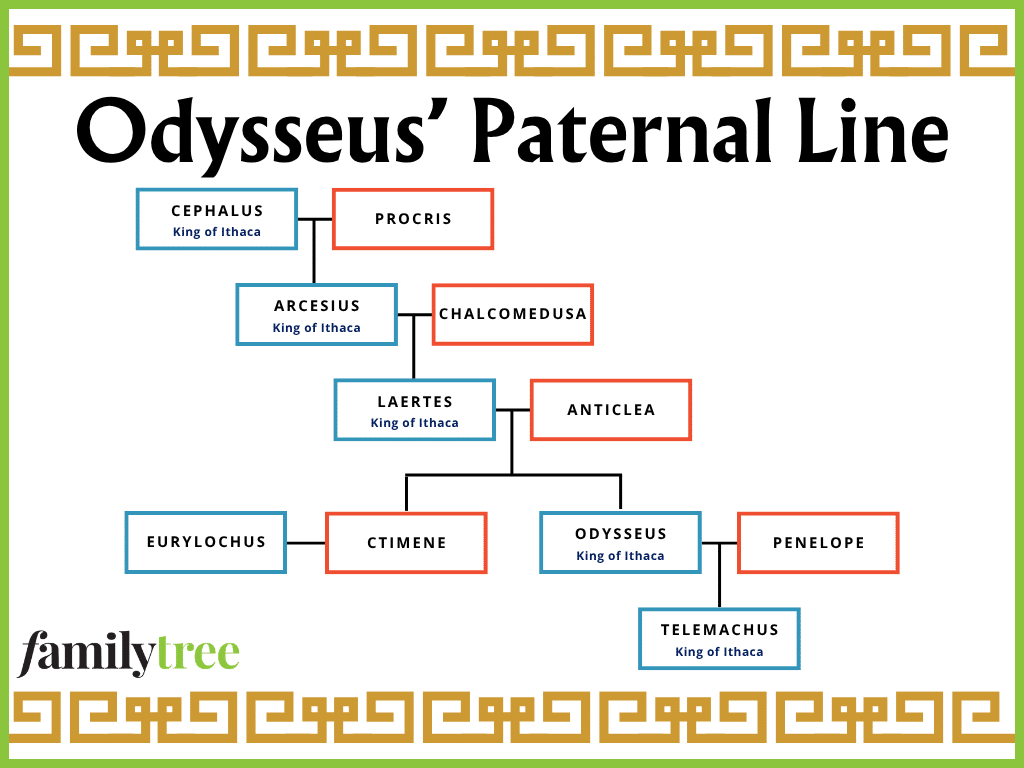
Odysseus’ father, Laertes, was the King of Ithaca before him. Laertes was also an Argonaut and participant in the hunt of the Calydonian Boar. While Odysseus is gone, Laertes stays away from Odysseus’ home, keeping to himself on his farm and overcome with grief of his son’s absence.
Laertes was the son of Arcesius, and Arcesius’ ancestry varies between ancient sources. Some traditions name Arcesius as the son of Cephalus, a famous hunter favored by the gods, and Procris, an Athenian princess. Other traditions say that Arcesius was the son of Zeus. Similar to the challenges faced by many genealogists: Ancient sources don’t always agree. So the identities of Odysseus’ paternal grandparents are a matter of debate.
Laertes’ reunion with Odysseus near the end of the Odyssey is one of the poem’s most important family stories. After Odysseus returns to Ithaca and defeats the suitors competing for his wife, Penelope, Odysseus visits his father. He initially hides his identity from Laertes, who he finds lonely and grieving. But he eventually reveals who he is by describing the orchard trees that Laertes had given to him when he was a child. In this story, Odysseus proves his identity through shared memories, inherited land and knowledge that was shared between two generations.
Was Laertes really Odysseus’ father?
Although Homer identifies Laertes as Odysseus’ father, some other traditions offer an alternative genealogy. According to Aeschylus’ lost tragedy and other accounts, the legendary king Sisyphus seduced Anticlea before she married Laertes, making Sisyphus Odysseus’ biological father.
Sisyphus was famous for his deceit and ability to outwit others (including the gods). He was famed as the “craftiest of men.” Sisyphus was condemned in the Underworld to roll a massive stone uphill forever, only for it to fall back down each time he approached the top because he cheated death. Thus, pointless or never-ending boring activities are sometimes described as “Sisyphean.”
The story of Sisyphus’ fathering Odysseus may have developed as another attempt to explain Oddyseus’ cleverness. Rather than inheriting his intelligence through only his maternal lineage, Odysseus would have received it from both sides of his family. There is no indication in the Odyssey that Homer accepted this version.
Anticlea and the family of Hermes
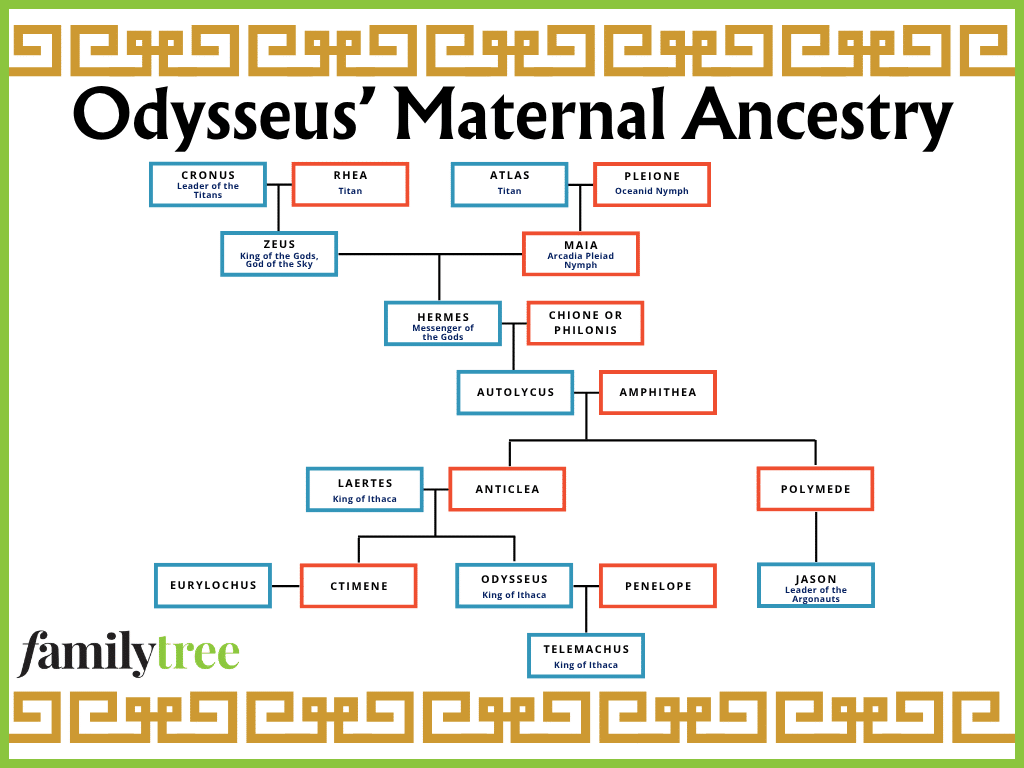
Odysseus’ mother was Anticlea, daughter of Autolycus. Many stories suggest that while Odysseus was given his royal inheritance by Laertes, his legendary intelligence and cunning behavior came from his maternal grandfather Autolycus.
Autolycus was known as a master thief, liar and expert of deception. According to mythology, these talents were passed down to him through his father: the Olympian god Hermes.
Hermes was the emissary and messenger of the gods, and known as “the divine trickster.” He served as the patron of travelers, merchants, heralds, orators and thieves. He was known for his speed, ingenuity and ability to cross boundaries between the mortal and divine worlds (aided by his winged sandals).
According to myth, Hermes granted Autolycus the ability to steal without being caught and alter the appearance of stolen livestock in order to avoid detection. Ancient Greeks would have recognized that Odysseus’ gift for crafting clever schemes, such as the Trojan Horse and other escapes during his journey home from the war, fit within this family tradition.
Odysseus and his mother in the Underworld
Anticlea died while Odysseus was away from Ithaca. Odysseus didn’t learn of her death until he traveled to the Underworld and encountered her spirit.
Their meeting in Book XI of the Odyssey is one of the poem’s most emotional scenes. Anticlea tells Odysseus that Penelope remains faithful, Telemachus continues to protect his inheritance and Laertes lives in sorrow in the countryside. She also tells him that she died from grief and longing for her son while he was at war. Odysseus tries to embrace his mother, but each time her spirit slips through his arms.
Penelope and the House of Sparta
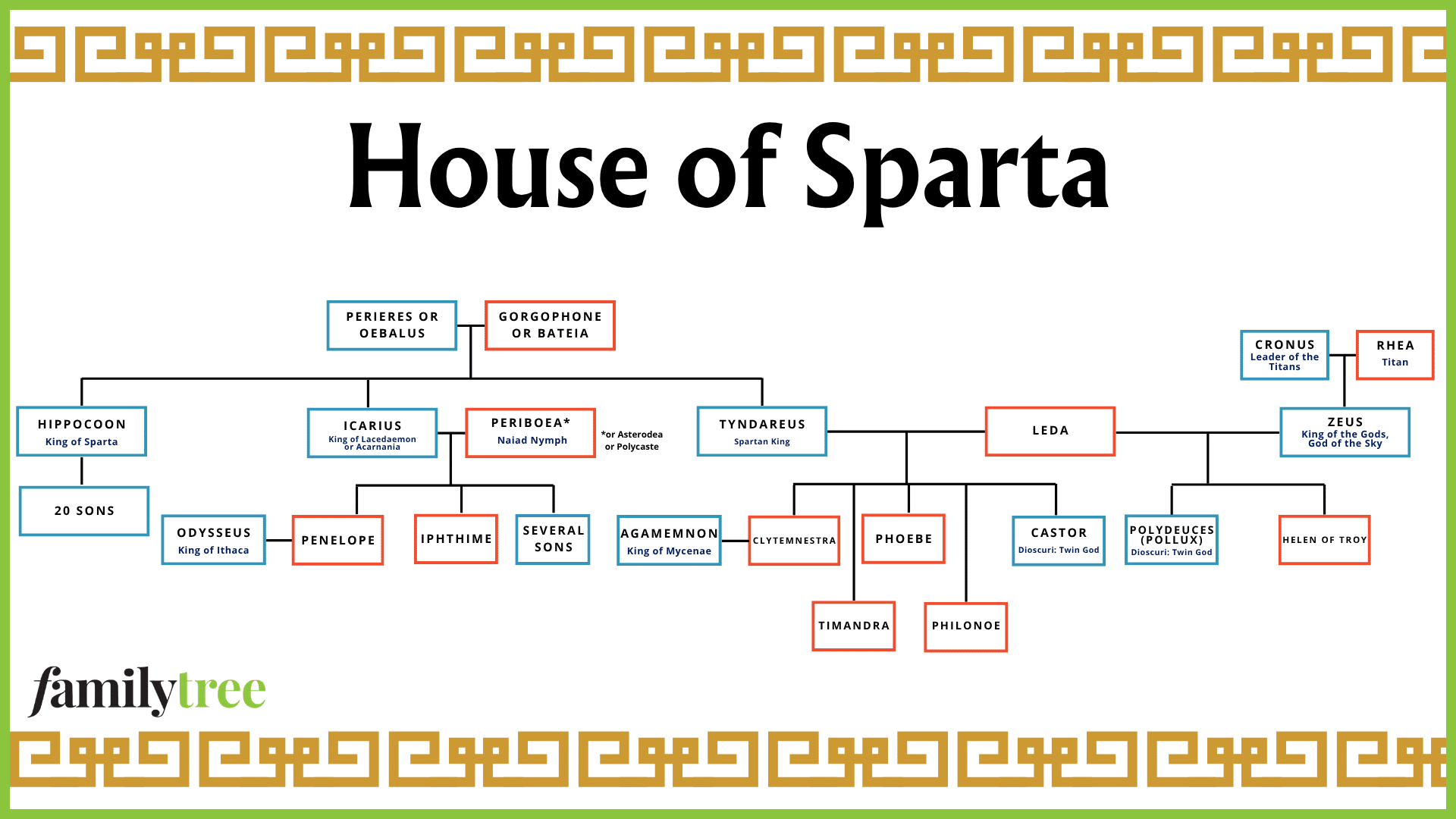
Odysseus married Penelope, whose family was also distinguished and connected to several of the most important figures of the Trojan War. Most traditions identify her father as Icarius, a Spartan prince, and her mother as Periboea (sometimes called Polycaste in other sources) or Asterodea.
Icarius was generally described as the brother or close relative of Tyndareus, king of Sparta.
That relationship made Penelope a cousin of some of Greek mythology’s most recognizable figures, including:
- Helen of Troy (in some traditions, a step-daughter of Tyndareus), whose departure for Troy caused the war
- Clytemnestra, the wife of Agamemnon
- Castor
- Polydeuces, known the the Romans as Pollux
Penelope’s family connects Odysseus directly to the household at the center of the Trojan War.
Penelope’s relationship to Helen is an important contrast. Helen’s marriage and disappearance helped launch the Trojan War, while Penelope’s faithfulness to her marriage helps restore order after it. For 20 years, Penelope resists pressure to declare Odysseus dead and marry one of the many suitors occupying their home on Ithaca.
Like Odysseus, Penelope relies on deception throughout the Odyssey. She promises to choose a new husband after finishing a burial shroud for Laertes, but secretly unravels her work each night. Her intelligence suggests that cunning behavior wasn’t limited just to Odysseus’ side of the family.
Telemachus: The Next Generation
According to Homeric tradition, Odysseus and Penelope had one son: Telemachus. By the beginning of the Odyssey, he is approaching adulthood and has grown up without his father. While he spends most of the Odyssey searching for any news of his missing father, Telemachus also takes control of the household, protecting Odysseus’–and ultimately his–inheritance.
Telemachus’ story is one many genealogists undertake: searching for information about the generations before them. In the first four books of the Odyssey, Telemachus, under the instructions of Athena (who accompanies him during the quest), spends his time trying to gain information of his father. He visits men who fought alongside his father, asks them to recount what happened at Troy and tries to understand the man whose name and inheritance he carries.
Telemachus also struggles to establish his legitimacy, as suitors occupy his family’s property, undermine his authority and threaten Odysseus’ royal line. When Odysseus finally reveals himself to Telemachus, the two work together to defeat the suitors of Penelope, allowing Telemachus to step into his role as heir to Ithaca.
Later myths after Homer’s Odyssey expanded Telemachus’ story. Various ancient writers claimed that Telemachus married different women, including Circe’s daughter or Circe herself. However, these traditions were from centuries after Homer and conflict with one another.
Odysseus’ Other Children
Homer focuses on Telemachus as Odysseus’ only son, but later mythological traditions attributed several additional children to him.
The most famous was Telegonus, usually described as the son of Odysseus and the enchantress Circe. According to the lost epic poem known as the Telegony, Telegonus grew up on Circe’s island and later traveled to search for his father. When he reached Ithaca, he failed to recognize it and began raiding the island out of starvation after being shipwrecked. Odysseus and Telemachus defended their city and in the ensuing fight, Telegonus accidentally kills his own father.
After discovering Odysseus’ identity, Telegonus carried his body back to Circe’s island and in one of mythology’s stranger family arrangements, Telemachus then married Circe, while Telegonus married his father’s widow, Penelope. According to this myth, Penelope and Telegonus have a son, Italus, who gave his name to Italy.
Circe’s family
Circe wasn’t just a sorceress living on a distant island, but a member of a powerful family. She is usually identified as the daughter of Helios, the sun god, and Perse, one of the Oceanids. The Oceanids were daughters of the Titan Oceanus and Tethys.
Circe’s siblings or close relatives included several figures from other Greek myths, including Aeëtes, the king of Colchis and father of Medea, and Pasiphäe, the wife of King Minos and mother of the Minotaur.
Odysseus spends a year with Circe after she transforms members of his crew into pigs, though she later restores them back to men and becomes an important adviser to Odysseus. She tells him how to reach the Underworld and warns him about the dangers ahead on his journey.
Additional children are attributed to Odysseus and Circe, as well as Odysseus and the nymph Calypso.
Calypso and the family of Atlas
The nymph Calypso also belonged to an older generation of gods. Homer calls her the daughter of Atlas, the Titan condemned to hold up the heavens.
Odysseus becomes stranded on the island of Ogygia where Calypso detains him for seven years against his will, promising him immortality if he would stay with her. Odysseus refuses because he still wants to return to Penelope and Ithaca. Eventually, after the intervention of other gods, Calypso was forced to let Odysseus go.
While Homer didn’t name any children of Odysseus and Calypso, other accounts do.
Other writers named additional children of Odysseus and Circe or the nymph Calypso:
- Latinus, associated with the heroes of the Trojan War (son of either Circe or Calypso)
- Cassiphone, notable for killing her half-brother and husband (in some traditions) Telemachus (daughter of Circe)
- Rhomos, said to have founded Rome (son of Circe)
- Ardeas, said to have founded the city of Ardea (son of Circe)
- Anteias, said to have founded the city of Anteia (son of Circe)
- Nausithous (son of Calypso)
- Nausinous (son of Calypso)
The Family Tree of the Greek Gods
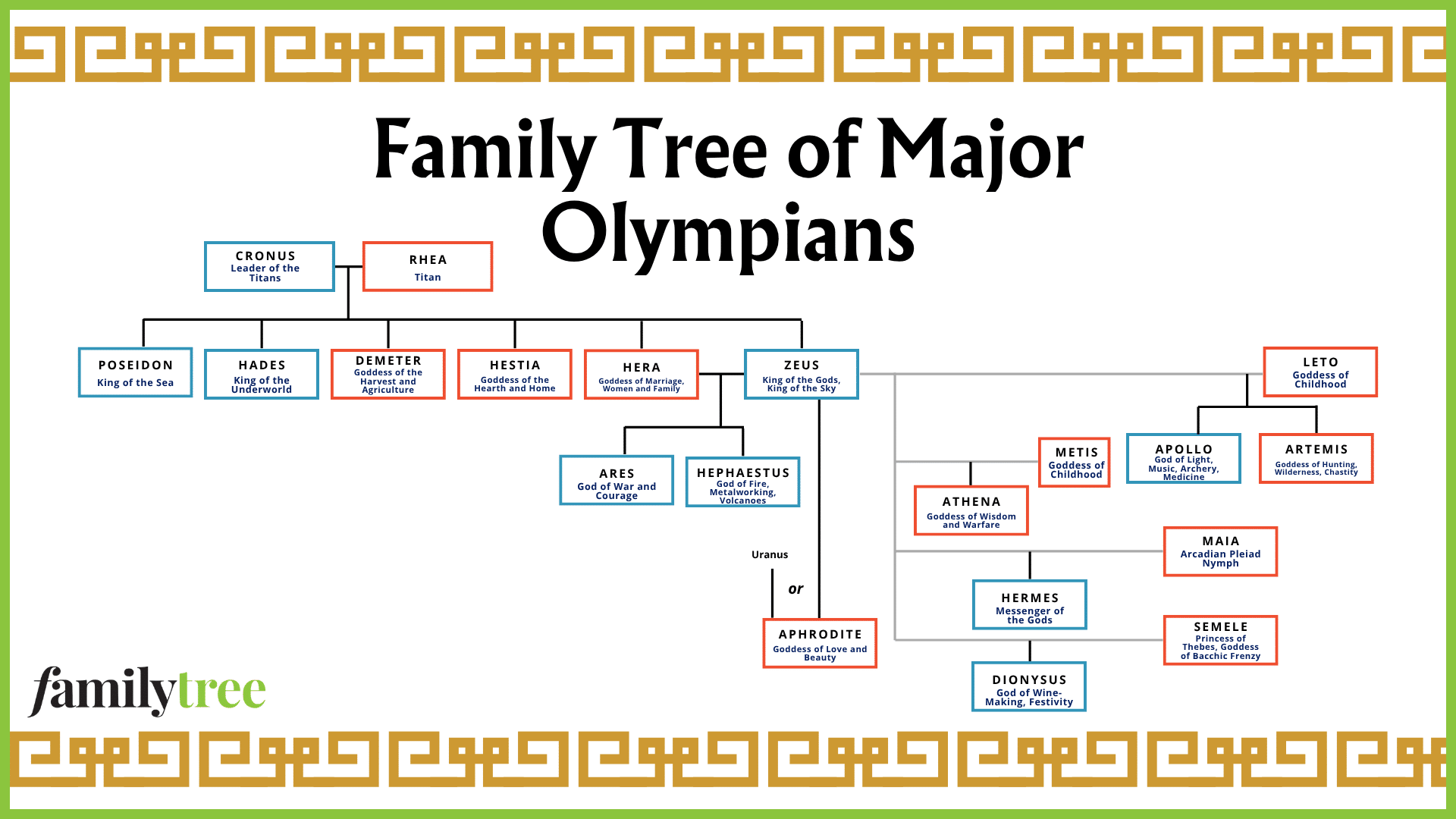
The gods who help and hinder Odysseus during his journey also belong to one extended and often dysfunctional family tree.
At the center of the family tree were the Titans Cronus and Rhea, whose children included:
- Zeus, King of the Gods, god of the sky and thunder
- Poseidon, King of the Sea, God of the sea, storms, earthquakes and horses
- Hades, King of the Underworld, God of the dead and riches
- Hera, Queen of Heaven, Queen of the Gods, Goddess of marriage, women, marital harmony and protector of women during childbirth
- Demeter, Goddess of the harvest, agriculture and fertility
- Hestia, Goddess of the hearth, the home, sacred and sacrificial fire and the state
Cronus feared that one of his children would overthrow him, so he swallowed them at birth. Rhea saved Zeus, who later forced Cronus to release his siblings. The younger gods defeated the Titans and divided the universe among themselves: Zeus ruled the sky, Poseidon ruled the sea and Hades ruled the Underworld.
The family structure directly shapes the story of Odysseus’ journey, as Poseidon becomes his greatest divine enemy, while Athena, a daughter of Zeus, serves as his greatest ally.
Why Poseidon hated Odysseus
One of the central conflicts in the Odyssey stems from a family dispute. After Odysseus blinded the Cyclops Polyphemus, he gained the wrath of Polyphemus’ father Poseidon. For years, Poseidon prevented Odysseus from returning home to Ithaca, creating storms and shipwrecks that prolonged his journey. The conflict was personal rather than political, as Odysseus had harmed the son of one of the most powerful Olympian gods. At the same time, Athena, daughter of Zeus and goddess of wisdom, warfare, and handicraft became Odysseus’ greatest ally among the gods.
The result was dispute among the Olympians. Poseidon sought revenge and Athena repeatedly intervened to protect the hero. Zeus often acted as the mediator, allowing fate to unfold while also balancing the interests of both gods.
A version of this article was published online in July 2026
Related Reads


Author

Katharine Korte Andrew MS/LIS is a digital editor for Family Tree Magazine and professional genealogist.