Genealogists will have the most success researching their family history in North Carolina when they understand general history, geographic regions and migration routes in the state. These, together with an understanding of the major record groups, will ultimately help you create a logical research strategy that pieces together a well-researched family tree.
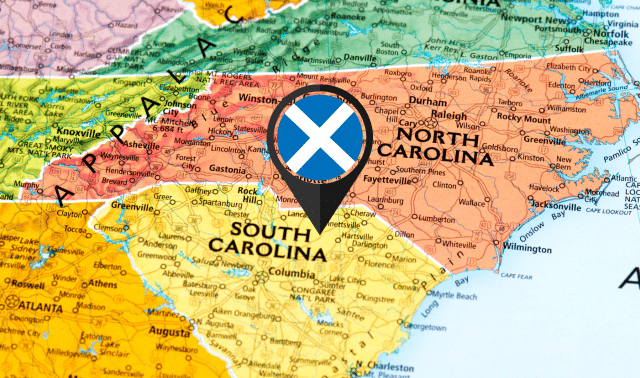
North Carolina is primarily broken up into three geo- graphic regions: the Coastal Plain (eastern), the Piedmont (central) and the Mountain region (western). The Coastal Plain provided transportation along the coast and inland up the many navigable rivers as well as land trade routes. And the Piedmont begins at the fall line (the western edge of the Coastal Plains, where the rivers are no longer navi- gable) and continues to the foothills of the Appalachian Mountains to the west.
What is now North Carolina has been home to dozens of Native American communities, including the Cherokee, Lumbee, Catawba, Tuscarora and Chowanoke. The Cherokee have the most records available, with reservation rolls (1848–1970) on Ancestry.com and the Dawes rolls (1898–1914) and other records at the National Archives. You can view a map of historical Native American territory here.
The first European expeditions in North Carolina began in the early to mid-1500s by the Spanish and English. The English’s earliest known settlement—Roanoke Island—was along the coast, though it did not survive. Founded by Sir Walter Raleigh in the 1580s, Roanoke is commonly referred to as the “Lost Colony” due to the mysterious disappearance of its residents while its governor was away in England. In 1663, King Charles II granted a royal charter to the “Provence of Carolina” (named for his father, Charles I), which then included both North and South as well as parts of modern-day Tennessee, Georgia, Alabama and Mississippi. Charles II selected eight “Lords Proprietor” to govern, though harsh conditions and conflicts with various groups (such as Native Americans and pirates) stalled their progress. But one notable settlement survived: the port city of Bath in Beaufort County, founded in 1705.
Settlement spiked in the southeast portion of the area. Early settlers came up the Cape Fear River, founding settlements like Brunswick Town (1726) and the port of Wilmington (1739). Though dangerous to navigate, the Cape Fear River was the only deep-water river in the area, allowing for larger sailing vessels and the relatively safe transportation of goods.
In 1729, the Crown purchased seven of the eight Proprietors’ parcels of land and created the royal colony of North Carolina (separate from South Carolina since 1719). The eighth Lord Proprietor who refused to sell his share (John Carteret, or the “Lord of Granville”) retained his portion—a 60-mile strip extending south from Virginia’s border—as the Granville District. Early colonists, notably the English, Welsh, Scots-Irish, Scottish Highlanders, and German Protestants (including Moravians), tended to settle in groups. Quakers and Moravians also migrated to the region in the mid-1700s.
You can learn more about these and other groups at www.ncpedia.org, which is an online encyclopedia managed by the state library. Land opportunities in the north became scarce by 1735. The establishment of a land-grant system in North Carolina triggered a surge of migration into the colony. Migrants came from abroad; down from Virginia, Maryland and Pennsylvania along the Great Wagon Road; and up from South Carolina along various trade routes. After the Revolutionary War ended in 1781, North Carolina became the 12th state to ratify the Constitution in 1789.
As in other parts of the American South, slavery was a major part of North Carolina’s economy. By 1860, the state was inhabited by 330,000 enslaved persons and 30,000 free people of color—one-third of the total population. FamilySearch has numerous collections about them, as well as records of the Reconstruction-era Freedmen’s Bureau and Southern Claims Commission. Despite initial reluctance to secede, North Carolina joined the Confederacy in 1861. The Tarheel State provided the most men—and highest number of casualties—of any Confederate state.
Today, North Carolina is known for its prestigious universities, scenic coast, and (as the site of Orville and Wilbur Wright’s famous test flight) “First in Flight” status.
1520s
The Spanish and French explore the Carolinian coast; the Spanish attempt to settle along the Cape Fear River 1585
The English first attempt to colonize Roanoke Island; a second attempt two years later is dubbed “The Lost Colony” when its residents go missing 1629
Charles I gives land
south of Virginia to Sir
Robert Heath, naming
the region “Carolina” for
himself
1630-1789
1663
Charles II grants a charter
for the “Provence of
Carolina” to eight Lords
Proprietor 1729
North Carolina is made a
royal colony 1789
North Carolina becomes
the 12th US state;
it cedes its western
territories (modern
Tennessee) to the
federal government
1790-1861
1838
A few hundred Cherokee
in N.C. refuse to be relocated
as part of the “Trail
of Tears”; their descendants
continue to live in
the state today 1861
North Carolina secedes
from the Union; it’s
readmitted in 1868
1861-1911
1903 Orville and Wilbur Wright pilot the first powered heavier-than-air aircraft near Kitty Hawk 1911
Avery and Hoke Counties are created, the last major changes to North Carolina county borders
It was not until 1913 that the state mandated birth and death records—and even then, it took a few years for some counties to comply. The North Carolina Department of Archives and History has created a vital record index (1800–2000) for existing documents, searchable on FamilySearch. Order originals from either the North Carolina health department or the registrar of deeds office in the county the event took place in www.statewidetitle.com/registers.asp.
You may find birth records (or substitutes) for some locations before the adoption of civil records. Some cities or counties kept their own, earlier birth records, and the government also issued delayed birth certificates for eligible residents beginning in 1935 (some of which date to the 1870s). The county registrar of deeds has any such records for its county, and FamilySearch has microfilm copies of some areas.
In addition, “bastardy bonds” (common in the 1800s) may provide genealogical information for children born out of wedlock. You can find an extract of roughly 22,000 records in North Carolina Bastardy Bonds by Betty and Edwin Camin (self-published), viewable online at North Carolina Digital Collections.
MARRIAGE RECORDS
Marriage records, however, were generally created earlier than those of birth and death, and may be found in the form of banns, bonds, registries, licenses or certificates. Marriage records may have been produced by the church or the county, typically in the place where the bride lived. Some church marriage records date to the mid-1700s, though not all have survived.
Banns and bonds were most common prior to 1851, and they assured that there was no legal impediment to the marriage. An 1851 law required marriage licenses to be returned to the county clerk, proving the marriage had been performed. Thus, you will often find a marriage license with the “return” section on the bottom of the same page.
Marriage records were first required by state law in 1868. You can find original records at the registrar of deeds, and FamilySearch and Ancestry.com each have collections of county marriages.
Formerly enslaved African Americans may have applied for a cohabitation license in 1866 to prove their marriage. FamilySearch has some cohabitation records for North Carolina. For information by county, see www.familysearch.org/wiki/en/North_Carolina_Cohabitation_Records.
North Carolina Digital Collections also has online collections of family Bible records, which can serve as vital-record substitutes.
North Carolina has appeared in every decennial federal census, though some counties are missing in earlier counts. As of this writing, census records through 1950 are available to the public through several genealogy websites, though much of the 1890 census has been lost. The state took its own census in the mid-1780s, and you can access that enumeration at the state archives or Ancestry.com.
Additionally, FamilySearch has the 1850 and 1860 US slave schedules (see page 61), which list enslaved people by the name of their enslavers. Formerly enslaved people had their own last names by the 1870 US census, but may have continued to work the plantations of their former enslavers. Knowing this may help you identify unnamed people in earlier census schedules.
Though North Carolina currently has 100 counties, this was not always the case. Genealogists should pay close attention to original county borders as well as those that have been abolished entirely. MapofUS.org has an interactive map of North Carolina showing county borders as they changed.
NC Ancestry also has a complete list of counties (including those that have been abolished), and you’ll find an online gazetteer of the state at www.ncpedia.org/exploring-north-carolina-geography. Early inhabitants may have received land grants, issued in Colonial times by the eight Lords Proprietor or (after 1729) from the Crown itself. The “Granville District” in the state’s north was made up the land granted to a Lord Proprietor who refused to sell back to the Crown. (The land continued to be administered by his heirs until 1777.)
Alternatively, North Carolina’s “headrights” system (1663–1744) gave settlers a certain number of acres for each person they took with them to the area, usually 50 acres per head. An applicant could claim himself, as well as a spouse, children, other family members, and even the enslaved. The system encouraged settlement and resulted in house- holds that had hundreds of acres.
Key resources for Colonial land records include the book North Carolina Headrights: A List of Names, 1663–1744 by Caroline B. Whitley (North Carolina Office of Archives and History) and “North Carolina, U.S., Land Grant Files, 1693–1960” at Ancestry.com <www.ancestry.com/search/collections/60621>. Find digital images of land grants at www.nclandgrants.com/home.htm. During the American Revolution, the nascent state of North Carolina began selling vacant or previously British land to citizens. Subsequent land sales between private individuals were recorded in deeds, which you can find at the county level. Many counties have made these free and searchable online, and FamilySearch has various land records. Some North Carolina land records (as well as wills and probate records) have been indexed by FamilySearch’s full-text search.
These are some of the most valuable records for genealogists. Original wills from 1760 are with the county clerk offices, while the North Carolina State Archives in Raleigh hold estate and probate records. The North Carolina Digital Collections have Colonial wills, and FamilySearch and Ancestry.com each have digitized estates and probate records. (View all the archives’ online records at archives.ncdcr.gov/doc.)
These come in two types (property taxes and poll taxes) and were kept at the county level. Property taxes generally began after the Revolutionary War in 1777. Records are in the state archives’ custody, and microfilm is available for some later years. Poll tax laws varied over time, but were primarily levied on males 16 (or, later, 21) years or older. (There was also an upper age limit that varied by era.) Tax records from the Colonial and Revolutionary era (1600s–1775), which show the adult males, female head of households, and those enslaved, are available online at digital.ncdcr.gov/collections/tax-lists-and-records.
Charlotte Museum of History: Mecklenburg County’s oldest existing home, the Revolutionary War-era abode of Hezekiah Alexander, is now a museum with nearly 15,000 artifacts.
Duke Homestead State Historic Site and Tobacco Museum: See living history demonstrations of life on a typical 1800s yeoman farm at this national historic landmark, featuring the Duke family’s mid-1800s home, tobacco barns and factory.
Fort Fisher State Historic Site: The scene of the Civil War’s two largest naval bombardments and most ambitious amphibious assault, the “Last Major Stronghold of the Confederacy” is today the state’s most-visited historic site.
Fort Raleigh National Historic Site: Sir Walter Raleigh’s explorers and colonists established settlements in this area in 1585 and 1587. The site hosts the outdoor drama “The Lost Colony” and is home to Elizabethan gardens. Nearby Roanoke Island Festival Park offers more history.
Guilford Courthouse National Military Park: Honoring the site of the March 15, 1781, Revolutionary War battle, the park consists of 28 monuments and a visitor center on 200 acres, with paved walking trails.
Historic Rosedale Plantation: Once a 911-acre plantation, Rosedale includes the 1815 manor house, plus eight acres of grounds and gardens.
North Carolina Museum of History: Changing exhibits trace the state’s history from earliest Colonial times and its Cherokee people to today.
Tryon Palace Historic Site and Gardens: Tour 13 period gardens and three historic homes on the site of Colonial and state governor William Tryon’s 18th-century residence.
Wright Brothers National Memorial: The Wright brothers made the world’s first controlled powered flights here Dec. 17, 1903. See reproductions of their 1903 airplane, 1902 glider, living quarters and hangar.
*FamilyTreeMagazine.com is a participant in the Amazon Associates Program, an affiliate advertising program. It provides a means for this site to earn advertising fees, by advertising and linking to Amazon and affiliated websites.