If it seems like you haven’t heard about scrapbooking in a while, you’re probably right.
The timeless hobby became especially popular in the 1990s, fueled in part by a growing desire to preserve and share family history. As just one example, early issues of Family Tree had a regular “Preserving Memories” column that was often about the craft. And we published special scrapbooking issues in 2002, 2003 and 2004.
But around that same time in the early and mid-2000s, things quieted down as everything on paper seemed to go digital.
Now this paper-crafting pastime is back—including among genealogists.
“I see a lot of people wanting to pass along family stories,” says Lynne Madden, owner of the Craft Your Story scrapbooking store in Mentor, Ohio. “This is a visual way to bring together all the pictures, memories, newspaper articles, and the like.” One of Madden’s first customers, she calls, was a man making a genealogy scrapbook for his grandson.
“Scrapbooks give us the gift to flip through the passage of time,” says Alison Dutton, CEO of Creative Memories. “We are hungry for connection and bonds to the past. To hold an album, see the handwriting, view the photos and touch the memorabilia of someone we love is priceless.”
Many new scrapbookers also like the low-tech, hands-on nature of making a book. “It’s more physically creative,” says Madden. “Cutting and pasting and layering is relaxing to some people. And—especially for those who are with screens all day—it gets you away from the computer.”
In this article, we’ll take a look at “modern” scrapbooking. We reached out to several veterans in the community for tips—and their advice is distilled into the following five steps.
1. Tell One Story at a Time
Scrapbooks differ from traditional compiled family history books. The latter are more like reference books, packed with genealogical details about many generations.
But a scrapbook is more like an illustrated storybook, telling a more specific tale. “Don’t think about putting your entire family history into a single album,” says Carly Morgan of Family Tree Notebooks. “Otherwise, you’re inviting overwhelm. Introduce one person or one family at a time. Start with the stories you absolutely want to save. If that’s all you ever do, that’s something.”
Genealogist Susan Strollo of Souderton, Pa., suggests making an entire scrapbook about one relative, especially if the book is for a close family member. Start with a simple, visual family tree—maybe on a preprinted form—then add pictures of the subject. Layer in pictures of other people and places important to that person: their parents, home, school, hometown, vacation spots, church, or stores they patronized. In between, add stories about each.
If you don’t have that much material (or time), consider making an album about a couple or family group instead.
“After seeing a 50th-wedding anniversary album made by a cousin, I was instantly drawn into the stories and old photos,” says Shelley Gosse of New Foundland, Canada. “I wanted my kids to know their ancestors and where they came from and who they were named after.”
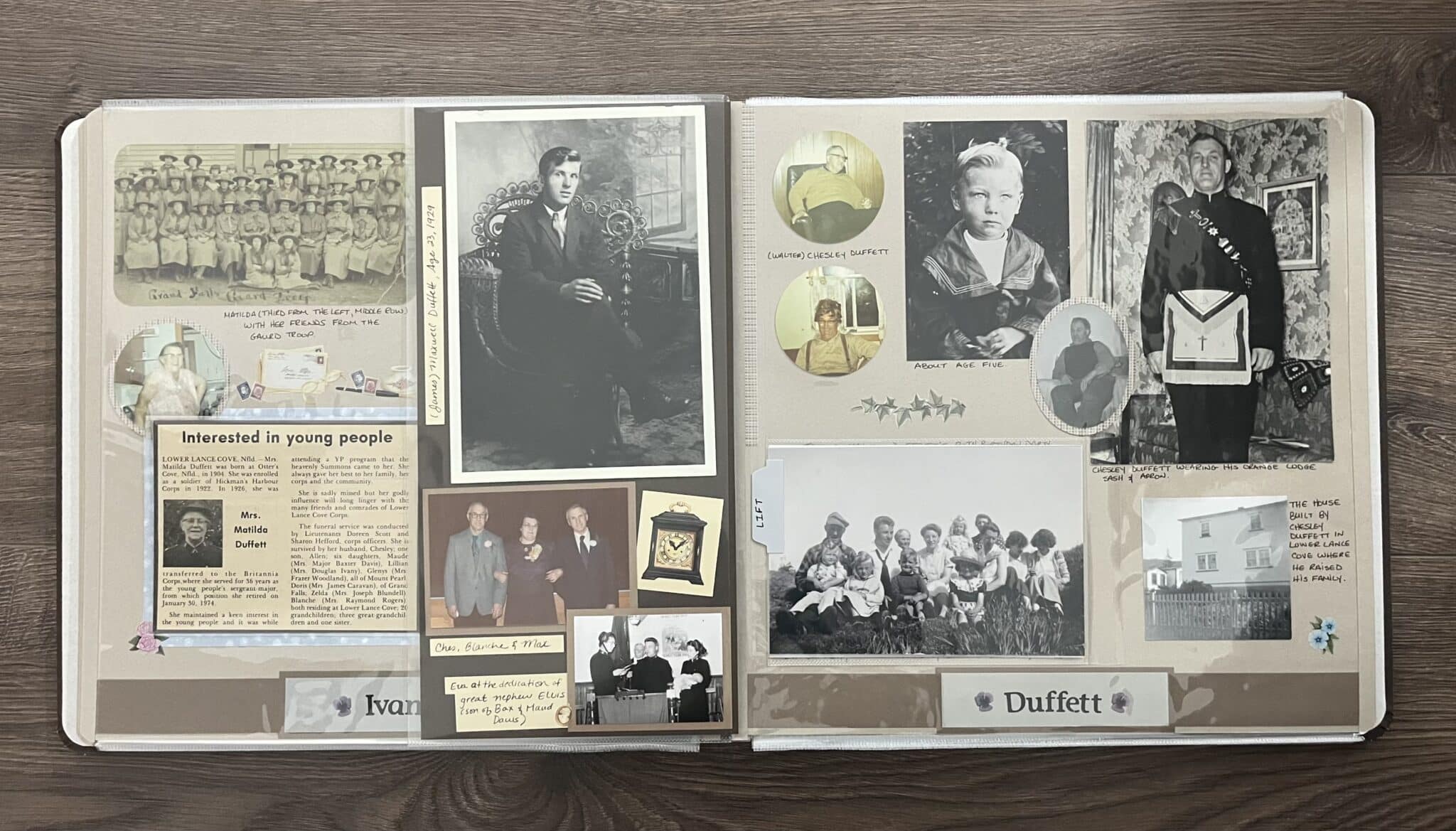
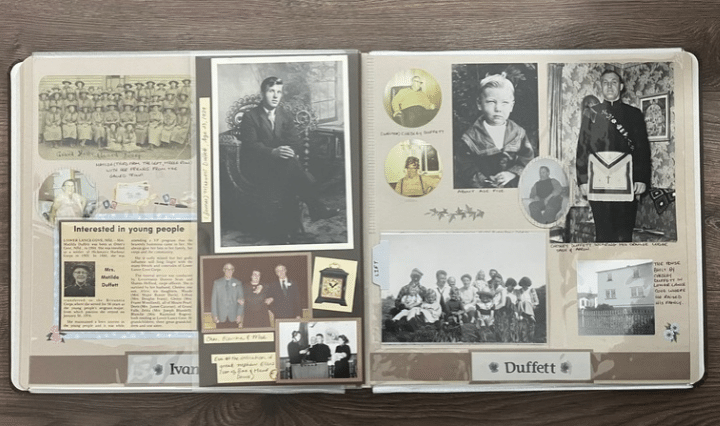
But she didn’t have a wealth of photos and stories. Instead, she created just two pages (plus a smaller, two-sided insert) about her grandfather. The rest of the book celebrates other loved ones.
Some heritage scrapbooks celebrate themes. In an album about family recipes, for example, your relatives could feast on pages filled with recipes; photos of cooking and festive tables; and memories of food traditions. Many scrapbooking retailers sell preprinted recipe cards and even entire heritage recipe album kits.
Military-themed albums are also popular. Commemorate one soldier’s service—or several. “Military pages that show a picture of a soldier in uniform can be enhanced with images of medals, patches and letters home,” says Morgan. “It adds more to the story to be shown those beat-up bits of military decoration and not just the moment of [a] sepia-toned photo.”
2. Focus on Images and Words
Scrapbooking style has evolved in a direction that works well for genealogists. “In the 1990s, you picked out your paper and stickers to make beautiful, decorative pages,” says Morgan. “That made it more about the art and craft than the storytelling.
“Now, the photos and evidence are typically the main elements,” she says. “The family history can be front and center—and visual in a way that makes it more accessible to relatives.”
Irene Miller of Windcrest, Texas, loves including genealogical documents in her scrapbooks, especially when she doesn’t have photos of ancestors. She writes a timeline of the subject’s life and adds pictures of documents and gravestones, plus photocopies from books or newspapers about that person.
While writing the narrative, you may discover gaps in your knowledge—which, in turn, invite you to fill them.
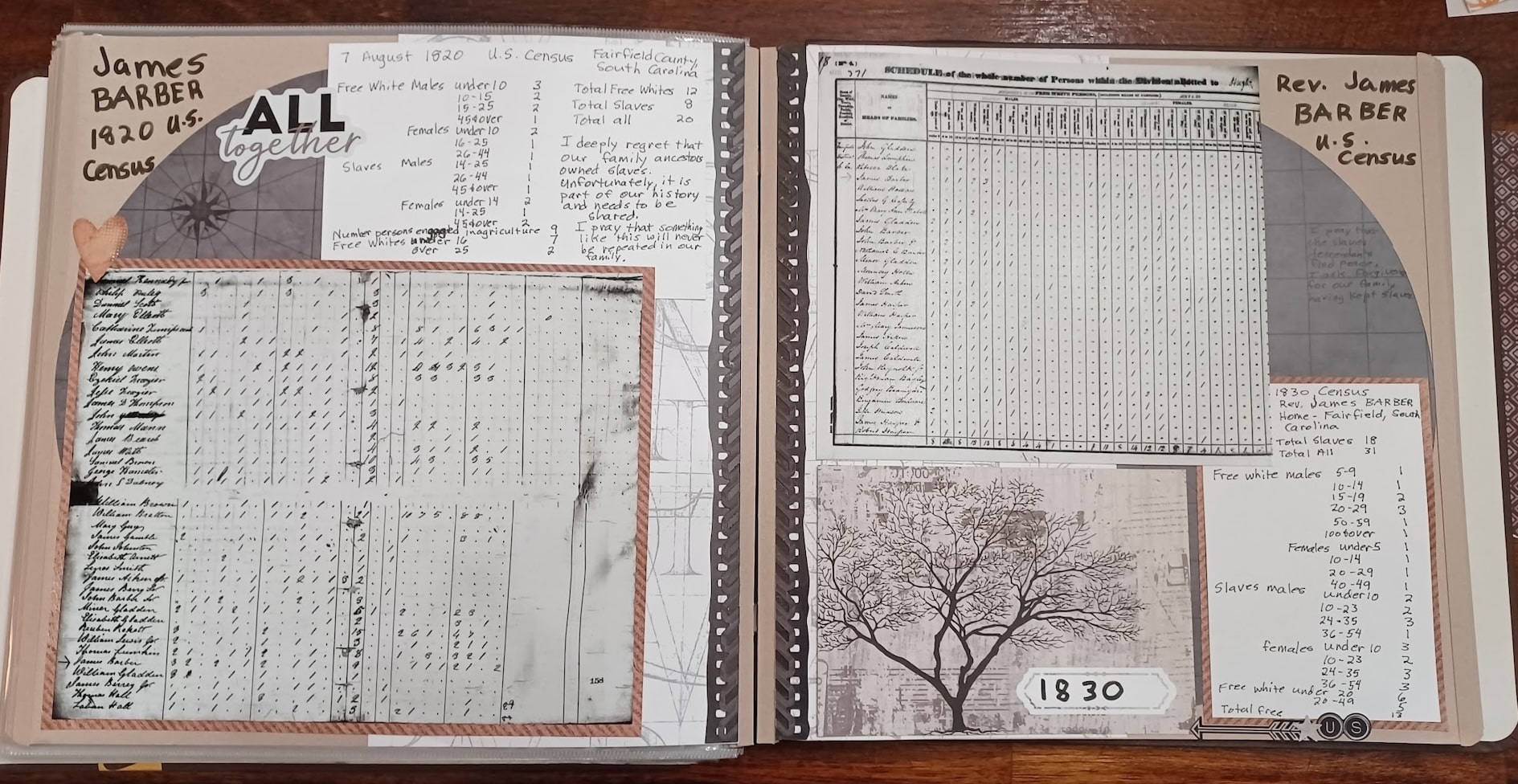
That happened to Cindy L. Hearrell of Fredericksburg, Pa. “When I was completing my album, I had to reach out to living family members to get details,” she says. “My parents are both deceased, and I realized I didn’t have much information on their early years.”
Use text to identify the people in photos and tell their stories. You can write directly on an album page or caption card, or you can have text printed.
Many prefer to avoid crowding a page with text. You might think of the text in a scrapbook like museum labels: They help the reader understand the importance of what they’re looking at and tell interesting—but short—stories.
Make sure handwritten and printed fonts are readable. “A lot of younger people can’t even read cursive fonts, or anything that is too scroll-y or decorative,” Morgan says. “Use clean, easy-to-read fonts like what you see on websites and social media.” Don’t sacrifice legibility for decoration.
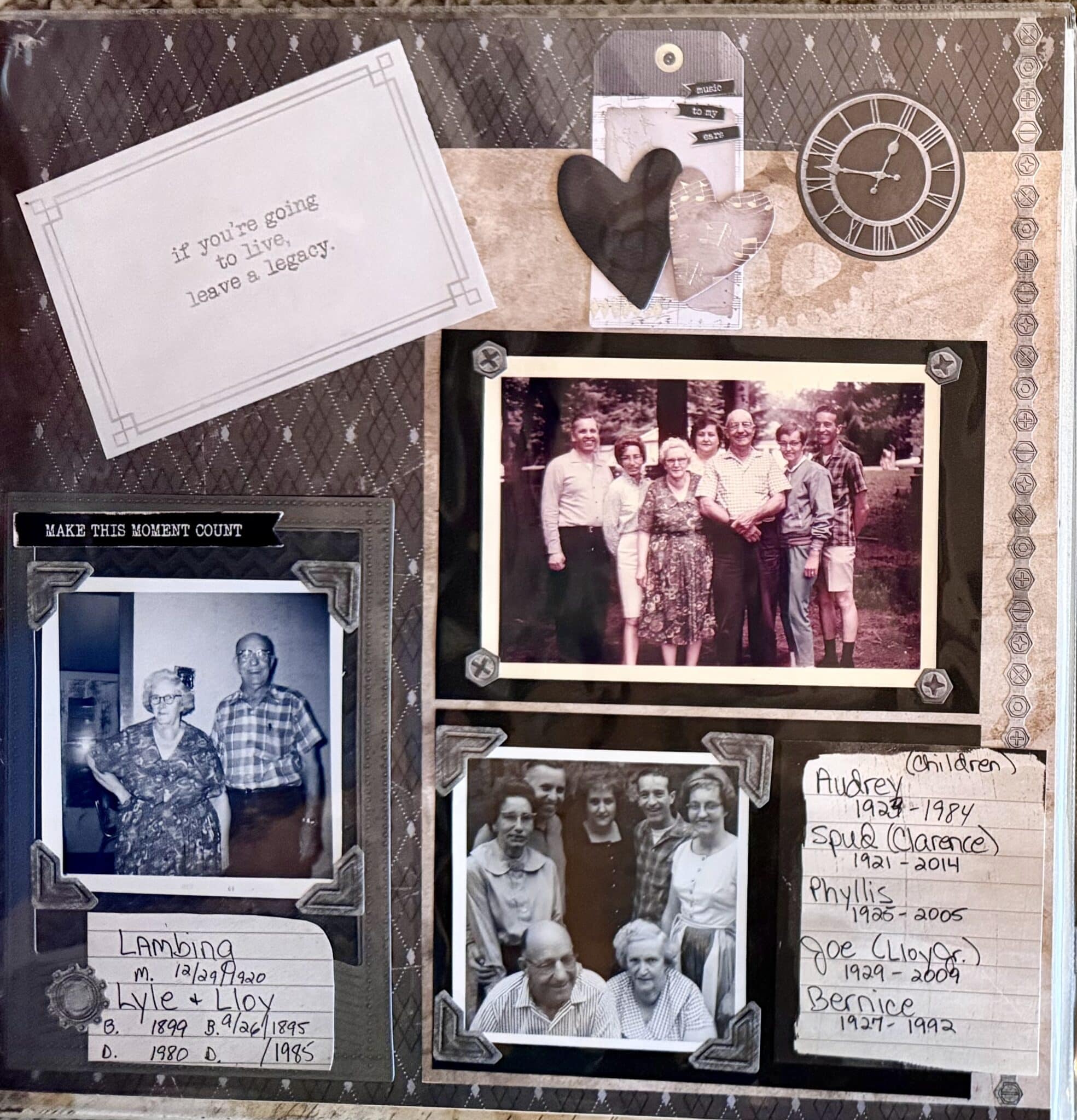
What to include in a heritage scrapbook
Documents
- Family trees: Pedigree charts, family group sheets, etc.
- Census schedules for a household
- Newspaper articles, including obituaries and birth/marriage announcements
- Contemporary maps
- Scans of a city directory, local history, yearbook, etc.
- Report cards
Photos
- Relatives, friends, neighbors, etc.
- Houses
- School: Senior portraits, prom and graduation pictures, class photos
- Local landmarks: movie theaters, post offices, shopping areas
- Holiday gatherings
Memorabilia
- Handwriting samples: Letters, greeting cards, even grocery lists
- Recipe cards
- Ticket stubs
3. Gather Your Gear
For scrapbooks that will stand the test of time and not degrade what’s inside, you’ll need archival materials: albums, pages, protective sleeves and more.
Checklist: Scrapbooking Supplies
- Scrapbook: Post-bound or 3-ring binder for flexible page count
- Page protectors: Polypropylene sleeves sized to the album pages
- Archival adhesives: Options may include sticky dots, tape runner, and photo corners
- Cutting tools: Sharp scissors or straight-edged paper cutter
- Pens or markers: Pigment-based, waterproof, and fade-resistant, with acid-free permanent ink
- Photographs, documents and stories from your family history
Archival-safe pages
There’s no commercial standard for “archival,” so you’ll need to learn for yourself what materials are safe for long-term use.
For example, album pages and decorative papers should be acid-free, buffered and lignin-free. Likewise, adhesives should be acid-free and photo-safe (i.e., that they won’t damage photos over time). And protective sleeves should be made of polypropylene, a plastic polymer known for its stability. Purchase from trusted brands and vendors. Some well-regarded options include Archival Methods, Gaylord Archival and Hollinger Metal Edge.
Albums
You can scale the size of a scrapbook to the story you want to tell. Traditional 12×12-inch albums have 15 to 20 two-sided pages—but that’s a lot of visual real estate to fill. Consider 8×8- or 6×8-inch albums instead, as these allow for fewer images and/or shorter stories on each page.
Photos
Scan and print copies of photos (rather than using originals). Print copies of documents on acid-free paper or as scanned photos.
Before printing, though, consider whether to enhance, restore or colorize items. Genealogy websites Ancestry.com and MyHeritage include photo-enhancement tools for subscribers. Software options include Vivid-Pix Restore software, which is more accessible than something like Adobe Photoshop.
If you do alter your images, remember to retain the original, unedited files. For the sake of transparency and historical accuracy, avoid AI enhancements that change the content of photos and documents.
Budget-friendly photo-printing options include online services and big-box or drug stores. However, the colors in these inexpensive prints may fade or shift over time.
Some experienced scrapbookers use specialized services such as Mpix or Persnickety Prints. Or you could even purchase your own photo printers; the Canon Selphy CP1500 is a popular and relatively affordable option.
Retailers
You can purchase a dizzying array of scrapbooking supplies online. But you can buy them in-person, too. Thousands of retail stores in the U.S. sell scrapbooking materials, many of them (like Madden’s Craft Your Story boutique) small businesses.
Visiting a scrapbook retailer can also connect you to a vibrant community. Store staff and other customers can be rich sources of advice and enthusiasm.
Madden opened Craft Your Story three years ago after noticing that “people were tired of buying things online and not seeing them in person.” A bulletin board in her store announces local events called “crops,” where scrapbookers convene to create albums, swap advice, and get inspired.
You’ll likely find crops in your own community, hosted by libraries, crafting groups, or vendors. Dutton says Creative Memories and its network of advisors host more than 25,000 events per year; find one of them at Creative Memories’ events page.
4. Consider Alternative Formats
Scrapbooking isn’t your only option for creating a visual family history.
Morgan, a graphic designer and long-time crafter, loves a freeform spin on scrapbooking: junk journaling. “Junk” journals use repurposed materials (for example, secondhand or vintage books and ephemera) and generally don’t follow a prescribed structure.
“There are stories that have touched me so much I just want to spend time with them in a different way,” she says. “When I do an ancestor junk journal, it’s so personal. I just think about one ancestor and their story.”
She recalls journaling about one great grandma who was held at Angel Island for 20 days of interrogation. “I was thinking about her as I made it,” she says.
This kind of creative meditation shows care for the ancestor. And “And I get to play with my sticker collection!” she says. “It’s calming for me: it’s a good zone-out. My kids love looking through them and enjoying the tactile nature. Nothing is original or precious: I don’t care how much they poke the photos.”
Junk journaling supplies can be inexpensive and fun. Morgan finds old music books and cookbooks at thrift stores that serve as her “album.” She buys stickers online and uses glitter paint from her children’s art supplies. “Because it’s a junk journal, it can be stuff from anywhere,” she says. “It’s just whatever is speaking to me from my box of ephemera.”
On her YouTube channel, Morgan shares her process in a mesmerizing video titled “Junk Journaling My Ancestors.”
In another video, she offers yet a third take on heritage scrapbooking: pre-designed template pages that can be filled in, printed and assembled into a family history book. She uses these for sharing genealogy at reunions. “In my experience, my family needs the information predigested,” she says.
She organizes her notebooks by family group, making it clear which people are a couple and who their children are. She focuses on basic information, with no more than two to four pages on each.
“I’m only sharing tiny bits about each relative, with the idea that they can ask or dig if they want more,” Morgan says. “I just want them to meet the ancestors.”
Family Tree Notebooks isn’t the only business that creates pre-designed, downloadable pages for family books. Search Etsy for family history book templates to find options in a variety of styles.
5. Put Yourself in the Story
In the same way that quilters sign their quilts, scrapbookers today are encouraged to write themselves into their albums. You want to identify where this book came from and how you’re connected to the people in it.
“When making a family history album, I teach the creator to identify themself in a note or journal box in the inside cover of the album,” says Suzanne Collins of Alberta, Canada. “It may read something like this: ‘Hello, I am [name], the creator of this album. I am the granddaughter of [name]. References to aunts, cousins etc. mentioned in this book refer to the connection with me.’”
Consider adding a picture of yourself that connects you to the relatives you’re documenting. For example, you could add a photo of yourself making a family recipe or visiting a grave or family homeplace. You can add memories of relatives you knew or personal thoughts about your genealogical journey.
Your craftsmanship reveals your care for the stories you’re preserving. “People love creating beautiful pages on topics close to their heart, such as women ancestors or those who served in the military,” says Morgan. “The extra scrapbooking elements just show how much they want this person to be visible, so they go the extra mile to make it beautiful. You sense the feeling of love for them. I love seeing love in other people’s books.”
The act of creating a family history scrapbook also shows your love for those who will receive it. “Every page you create is a memory saved for a future generation,” says Dutton. “Someday, someone will sit down and experience your family story for the first time—and they will feel like they belong and have a place in the world.”
A version of this article was published in the November/December 2026 issue of Family Tree Magazine.
Related Reads