The early U.S. government used bounty land as an incentive and a reward for military service. Because applicants had to prove their qualifications, the process of obtaining bounty land left a paper trail, which is valuable to genealogists today.
The American government wasn’t the first one to grant bounty land. In ancient Rome, Caesar granted bounty land to soldiers. This was a reward that didn’t require the state to use cash, and it placed retired soldiers in newly conquered areas, in which they had an incentive to protect. The English Crown also used bounty land in medieval and early modern times to relieve overpopulation by placing trained soldiers in the borderlands of the remaining British Isles.
The English government continued this practice in the American Colonies. Land was granted to soldiers in almost every colonial New England battle. Soldiers enlisted for even a short time received land. Not only did this reward the soldiers, but it also fulfilled a requirement to have stockades and militia at frontier settlements. Massachusetts, Connecticut, and New York had settlements designated as military towns. Military men would receive land there but were not allowed to leave without prior permission, or they’d lose their land grants.
The Continental Congress carried this idea into the Revolutionary War. Soldiers were promised land in exchange for service, but the promise could only be fulfilled if America won the war. Both the federal government and the states granted bounty land. In 1776, the land that is now Ohio was surveyed for federal bounty land and became principal place where federal bounty land was granted. Other states that granted bounty land included Georgia, Maine, Massachusetts, New York, North Carolina, South Carolina, Pennsylvania, and Virginia. Massachusetts gave land in Maine. North Carolina gave land in Tennessee. Virginia gave land in Ohio and Kentucky.
Some colonies didn’t have enough land to provide bounty land, such as Delaware, New Jersey, New Hampshire, Rhode Island, and Vermont. Some of the states that granted bounty land were issuing it in the same areas, so they had to cede that land to the federal government, which would then issue the bounty land to soldiers. Each state had its own rules and systems. For example, British deserters qualified for land in Georgia. Pennsylvania’s land grants were donation land rather than bounty land.
The offer of bounty land incentivized soldiers to serve and provided pay for service. It was scaled by rank, with greater tracts of land being offered to higher-ranking officers. As in olden days, it encouraged soldiers to migrate westward to the frontier, where they could provide defense. However, many veterans or their widows sold their bounty land warrants. This meant the buyer, rather than the veteran, was the one moving to the frontier to occupy the bounty land.
Applying for Bounty Land
To apply for bounty land, a veteran submitted affidavits from his commanding officers or fellow soldiers, along with his discharge papers. The application listed the soldier’s name and age, residence at the time of application, and service details.
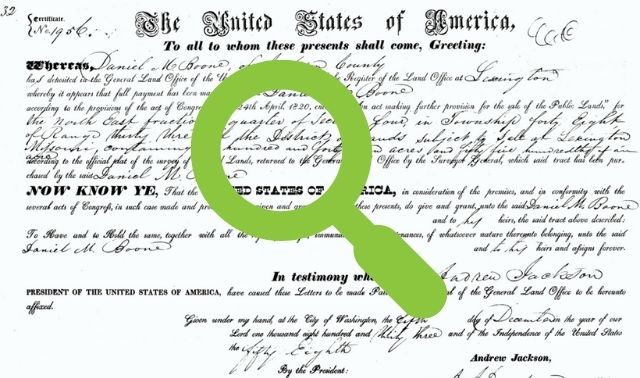
In the case of a soldier who died in service, his heirs could apply for bounty land. Along with the proof of the soldier’s service and death, they had to prove they were his legal heirs. When the bounty land was approved, a warrant would be issued. The warrant included the number of acres and the Bounty Land Act under which the soldier qualified for the bounty land. The veteran or his family would either claim that land or sell the warrant. When the veteran (or his heirs or his buyer) went to claim the land, it was surveyed, and then a patent was issued. The surveys sometimes listed neighbors. The patent meant ownership of the land.
The Secretary of War processed bounty land warrants before the Treasury Department assumed control over public domain land. The General Land Office (GLO) was established in 1812, introducing a standardized administrative method. Land was distributed in quarter sections of townships; This was the beginning of the state land state survey system.
Federal land warrants could only be used to claim land in the military district in Ohio until 1830. An act that year allowed unused warrants to be exchanged for land elsewhere. Acts in 1850, 1852, and 1855 granted land to veterans of the War of 1812, the Indian Wars, and the Mexican-American War.
Case studies
Below are two case studies that illustrate what you can learn about an ancestor who received bounty land.
Case study: Anthony W McKinney
Anthony W McKinney served in the War of 1812 under Captain Samuel McCormick. He applied for both pension and bounty land, so those are filed together for him and his widow, Catharine. His bounty land warrant number is 2219-160-1850, indicating that he was granted 160 acres of land under the Act of 1850, and 2219 is his warrant number.
Anthony applied for bounty land in 1856, and his warrant was issued on 15 March 1857. The application indicated he was fifty-four, which doesn’t align with other records in his pension file. Someone who was fifty-four in 1856 would have only been ten when the War of 1812 began.
Anthony W McKinney served in the U.S. Rangers. He enlisted in Dayton, Ohio, on 25 October 1813 and was discharged on 27 October 1814. He was a private in Captain Samuel McCormick’s Company.
After Anthony’s death, Catherine applied for a widow’s pension and bounty land in 1881. She had to fill out separate forms for both, even though the forms were nearly identical. Not only did she have to provide information about her husband’s service, but she also had to prove her marriage to him and his death.
According to Catherine, Anthony enlisted at the beginning of the war and served until the end. She gave a physical description of him at the time of his enlistment: brown eyes, black hair, light complexion, age eighteen, farmer, born in Kentucky, six feet tall.
Catherine Morical and Anthony W McKinney were married on 8 April 1850 in Fairview, Randolph, Indiana, by Reverend Muller. The couple resided at Fairview until his death on 20 August 1873. Anthony had previously been married to Elizabeth Bracken, who died about thirty years prior in Fairview, Indiana.
Because the bounty and pension records were filed together, they were found in Fold3’s pension record collection.
Case study: Increase Batchelor
Increase Batchelor was awarded 160 acres of bounty land on 17 August 1817 for his service under Captain Benj. Ropes of the 21st Regiment, United States Infantry. This regiment consisted of men from Massachusetts. His warrant number was 12-160-10418, which doesn’t have the same format as Anthony W McKinney’s warrant number.
Increase Batchelder was the head of household in Newburyport, Essex, Massachusetts, in 1810. He was aged 26-44. The household contained two females: one aged 45 or older and another aged 16-25. Two children under the age of ten were in the household—a male and a female.
Presumably, the children belonged to the female aged 16-25. However, it is difficult to determine whether Increase was on the younger or older end of the 26-44 age range.
Increase Batchelor/Batchelder was not found on the 1800 census, indicating he established his household between 1800 and 1810. This lends support to an assumption that he was on the younger end of the 26-44 age range in 1810. A man closer to age 26 than to age 44 seems more likely to have a wife between the ages of 16 and 25 than a wife older than 45.
The same Increase Batchelor/Batchelder was found in neither the 1820 census nor the 1830 census. It seems possible that he died between 1817 and 1820. If he died before his wife, she could have applied for a widow’s pension. However, searching for a widow’s pension without knowing the wife’s name would prove extremely difficult, so research would be more fruitful if the wife were identified first.
Other than ordering his bounty land files, the following research step would be to find Increase Batchelor/Batchelder’s probate record. The probate record would name his heirs and executor or administrator.
Land records are another good research avenue. If Increase sold land after his marriage, his wife would have had to release her dower rights, so those land records should have her name. Additionally, the BLM website can be searched for Batchelors/Batchelders in Ohio.
Once Increase Batchelor’s wife is identified, marriage records can be searched for the couple, and a widow’s pension can be searched.
Increase Batchelor’s bounty land warrant was found on Fold3. The remaining bounty land files are not online and would need to be ordered from the National Archives. This would entail paying a fee and waiting several weeks for the processing to be completed.
Searching for Bounty Land
The McKinneys had a pension and bounty land. Increase Batchelor had bounty land, but it is only speculated that his widow may have received a pension. Many ancestors qualified for bounty land but did not qualify for a pension. How can you determine if your ancestors received bounty land? And how do you find the records if they did?
If your ancestor lived in New England, check the town history. Most of these records describe how the land was acquired and who the first settlers were, which could provide clues to the existence of bounty land. It’s helpful to be familiar with the history of your ancestors’ area. If your ancestor migrated to a place where bounty land was issued, look into the possibility that they claimed bounty land.
Fold3’s bounty land collection is only indexed to L. Other places to search for bounty land records include Ancestry, FamilySearch, and NARA. Indexes are a good starting point for searching because they direct you to the original documents. Such indexes and records are available both online and in published books.
Ancestry has databases for bounty land applications, warrants, and a state grant index. Their warrant collection did not include warrants for those who received bounty land under the acts of 1850 or later. When searching the Ancestry databases, don’t limit it to just the name. Sometimes, searching for the warrant number yields results where the name is blank. Such was the case when searching Anthony W McKinney’s warrant number. (Unfortunately, those blank entries were not his.)
The FamilySearch Wiki lists resources for searching bounty land records in the following states:
- Federal Bounty Land Warrants
- Georgia
- Maryland
- Massachusetts
- New York
- North Carolina
- Pennsylvania
- Virginia
- Maine
- Tennessee
- Ohio
Other FamilySearch collections can be found in the Card Catalog by searching “bounty land.” Additional resources are available in Ancestry’s Red Book Online, Military Bounty Land by Christine Rose, and Revolutionary War Bounty Land Grants: Awarded by State Governments by Lloyd Dewitt Bockstruck.
If you cannot find the bounty land record online or it is not indexed, check NARA. Many records at NARA are not digitized, so you’d have to go to the National Archives in person or order a record using their order form. Some records may be off-shelf because NARA is preparing to digitize them.
Bounty land applications are within the collection of Records of the Veterans Administration. NARA also has custody of bounty land warrants used to obtain land. These are arranged by act of Congress. Some of these warrants have name indexes. Searching “bounty land” within the NARA catalog pulls up many collections. One collection in NARA includes reproductions of early warrants that were lost in fires at the War Department.
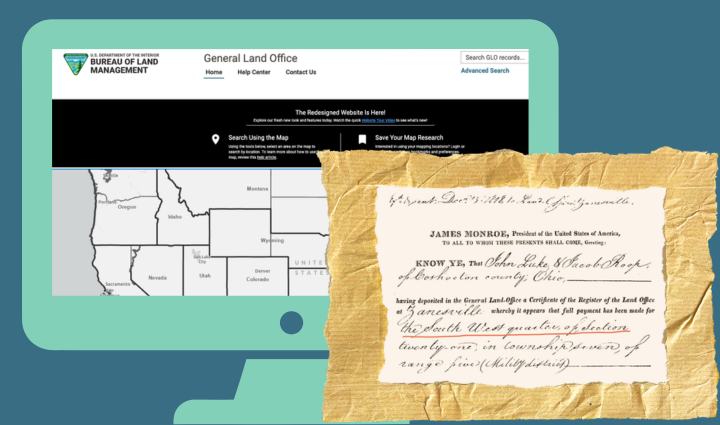
If you want to locate the land your ancestor was awarded, you can search for it on the Bureau of Land Management General Land Office website. Most of the federal bounty land was granted in Ohio, so this would be under the Military Survey meridian. Search all patentees and patentors in your query.
If your ancestor served in one of the early American wars, see if they applied for bounty land. If they did, those records would reveal valuable information about them.
Related Reads


A version of this article was posted online in July 2025.
Author

Katie Rebecca Garner was introduced to genealogy through volunteering with FamilySearch. She has an Associates of Applied Science in Family History Research from BYU-Idaho, specializing in U.S. research. She is currently pursuing an AG specializing in U.S. Mid-Atlantic. Katie writes articles for blogs, magazines, and wikis. She is working on her first novel, a genealogy ghost story.