Text written by David Allen Lambert unless otherwise noted.
America’s “second war of independence”—the War of 1812—was fought by sons and grandsons of the men who battled the British only three decades earlier.
Though it took place early in the U.S.’s history, the War of 1812 resulted in a wealth of service, pension, bounty land and other records about the soldiers, sailors and marines who prevailed against Britain.
This guide will help you use surviving documents to discern the stories of the men who hoisted the sails, loaded the cannons, and fired the muskets more than 200 years ago.
Background: What Caused the War of 1812?
The simmering strife between the United States and her former mother country flared up in the early 1800s due to several factors:
- Impressment: England began forcing American sailors into British naval service.
- Proxy wars with Native Americans: British soldiers in the Northwest Territories (now Illinois, Indiana, Michigan, Ohio and Wisconsin) provoked Indian attacks against American frontier settlers.
- Trade: Britain continued to interfere in trade between the United States and France.
Learn more about these factors in books such as 1812: The War That Forged a Nation by Walter R. Borneman (Harper, 2004) and the PBS documentary “The War of 1812.”
Despite its name, the War of 1812 lasted from 18 June 1812 to 18 February 1815. The Treaty of Ghent (signed 24 December 1814) technically ended hostilities, but skirmishes continued due to the slow communication of the time.
Though the treaty largely restored relations between the two countries to the status quo, the conflict left a permanent mark on the fledgling United States:
- Many buildings in Washington, DC (including the White House) were burned.
- Francis Scott Key wrote the text of “The Star-Spangled Banner” after observing the Battle of Baltimore.
- General Andrew Jackson rocketed to national prominence after his victory in the Battle of New Orleans. He was elected president in 1829.
Determining War of 1812 Service
Unsure whether you have a War of 1812 ancestor? First, determine if your male ancestor would’ve been of a likely age to serve. Most War of 1812 enlistees were born between 1785 and 1795, but muster rolls and payrolls also record older soldiers and sailors born in the 1760s and young men who were barely teenagers.


You may be fortunate enough to have a family archive with letters, diaries or military ephemera from your War of 1812 ancestor.
If you’re left with only a name and oral history, remember the old game of telephone you played as a child. Imagine what information can be altered over 200 years and five or six generations: The ancestor who served as a lowly seaman and saw no action might have morphed over years of retelling into the hero of the USS Constitution. Of course, you don’t want to tarnish this family story your late grandfather passed along, but you do want to learn the truth to share with your own grandchildren.
Use these records to learn the story of your War of 1812 soldier::
Service Records (CMSRs)
Text contributed by Katharine Korte Andrew
Beginning in the 1890s, the War Department created compiled military service records (CMSRs) to document the service of volunteer soldiers from earlier conflicts. Designed to make it simpler for veterans and their widows to file pension and benefit claims, each CMSR reflects information transcribed from original sources like muster rolls, regimental returns, pay records and hospital logs. A new card was made every time a soldier’s name appeared, and those cards were stored in a jacket, with matching numbers on both the cards and the jacket for easy reference.
With a few exceptions, the actual CMSRs for the War of 1812 are not filmed or digitized, so you will need to search the Index to Compiled Service Records of Volunteer Soldiers. This index contains service members’ names, ranks and unit.
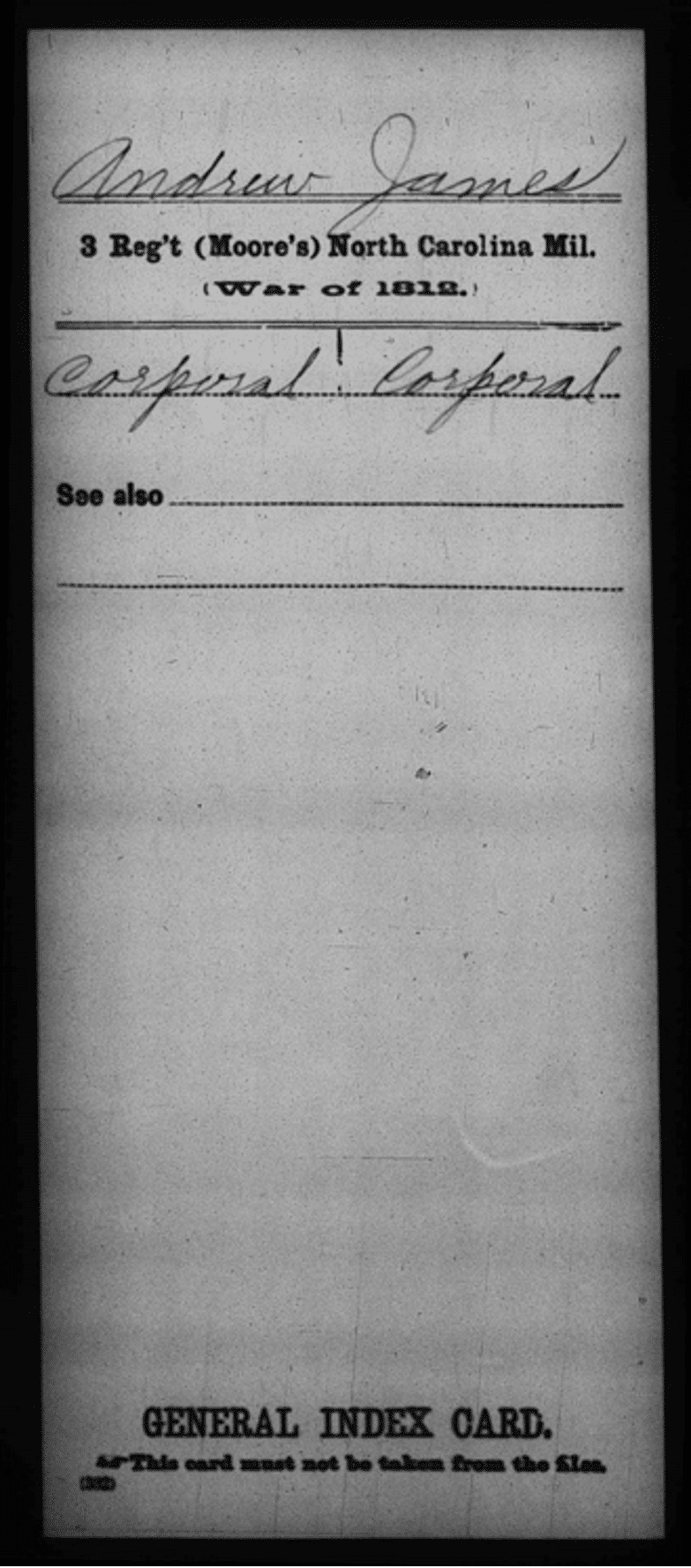
War of 1812 volunteers were generally mustered into service for short stints of less than a year, so many volunteers served more than one enlistment. You may find index records for multiple CMSRs for one person in different units.
The War of 1812 Index to Compiled Service Records of Volunteer Soldiers is on the National Archives and Records Administration (NARA)’s microfilm M602 and searchable (with images) on FamilySearch and subscription site Fold3.
Once you have found your ancestor in the index, you will be able to order copies of their compiled military service record (CMSRs) from NARA online or by mail using form NATF 85 and 86. Instructions are here.
The CMSR itself contains basic information about a servicemember’s military career. CMSRs include an envelope (jacket) containing one or more cards. The cards typically indicate the soldier’s presence or absence during a certain period of time and were compiled from muster rolls. Basic information contained on the cards may include:
- Full name
- Dates of enlistment and discharge
- Period of service
- Residence at the time of enlistment
- Personal description, including age, height, hair and eye color
Other cards may include:
- Pay rates and amount of bounty paid to the service member
- Rank promotions
- Wounds received during battle
- Hospitalization for injury or illness
- Place of birth (usually a country if foreign-born)
- Personal papers such as enlistment papers, documents relating to capture as a prisoner of war or statements regarding any personal property on him when he died.
CMSRs rarely indicate battles in which a soldier fought.
Digitized full CMSRs are available (as of August 2025) for the following states and detachments:
- Mississippi (M678): available as images on FamilySearch; and as a searchable imaged database on Fold3 and Ancestry.com
- Maj. Uriah Blue’s Detachment of Chickasaw Indians (M1829): available on Fold3
- Lake Erie Station (record group 45): available on Fold3
- Maj. Mcintosh’s Company of Creek Indians (M1830): available on Fold3
NARA has also digitized various CMSRs in its series Carded Records Showing Military Service of Soldiers Who Fought in Volunteer Organizations During the War of 1812, 1899–1927. However, this is not a full collection of names represented in the CMSR Index.
If your ancestor was not a volunteer and had already enlisted in the Regular Army when the war began, you will need to look for him in the “Register of Enlistments in the US Army, 1798–1914.” This is available on FamilySearch, Fold3, Ancestry.com and Findmypast.
Outside of CMSRs, you may want to look at NARA microfilm publication M1856, “Discharge Certificates and Misc Records of the Regular Army, 1792-1815,” available on subscription site Fold3. The index for the discharge certificates is available on NARA’s website sorted by Commanders and Soldiers.
Records of the Navy, Marine Corps and Privateers
Many significant War of 1812 battles took place at sea between US and British ships. Both the U.S. Navy and Marines saw victories against the Royal Navy. Here are your best research bets for learning about servicemen from those branches:
Navy
Perhaps your ancestor served aboard Old Ironsides or some other vessel? Unlike for soldiers, there’s no index to naval enlisted men for the War of 1812. Your simplest tactic is to see whether your ancestor applied for a pension and bounty land. If so, the records will give you the ship’s name and his dates of service.
Otherwise, you’ll need to manually search ships’ musters and payrolls until you found your ancestor. You’ll find these in NARA Record Group 45, the Naval Records Collection of the Office of Naval Records and Library. The record series includes Muster Rolls and Payrolls of Vessels, 1798–1859, and Muster Rolls and Payrolls of Shore Establishments of the United States Navy, 1804–1869.
If you know the name of your ancestor’s ship, look for it in the online finding aid. This will tell you whether the NARA records contain muster rolls or payrolls for the ship, and how the records are arranged. NARA has more than 70,000 individual ship logs (or deck logs) available for research, arranged by the name of the vessel. Learn more about this record series here.
Marines
First, search the database of 30,000-plus marines in Ancestry.com’s database “U.S. Marine Corps Muster Rolls, 1798–1958” or on Fold3 (which comes from NARA microfilm T1118, “Muster Rolls of the US Marine Corps, 1798–1892”). You’ll learn the name, rank, enlistment date, muster date, and vessel or station where the Marine is located. Then you can use the records of the United States Marine Corps in NARA Record Group 127 (not fully digitized). This series contains muster rolls from 1795 to 1945, arranged chronologically by vessel or shore station.
In this same record group are “Registers of Deserters, 1809–1907,” giving the Marine’s name and place of desertion from the Marine Corps, and where and when he was captured. For those seeking the parents of young Marines, “Certificates of Indenture, 1815–1856” includes forms signed by parents or guardians for boys bound into service as apprentices to Fife and Drum majors.
Privateers
The US government sanctioned about 500 to 600 privateers to harass and detain British merchant ships during the War of 1812. The site War of 1812: Privateers has lists of privateers by nationality and names of the ship, captain and home port. See also American Privateers in the War of 1812 by Timothy S. Good (McFarland, 2012) for more information.
Records of Commanding Officers
Unfortunately, the U.S. Army didn’t start compiling personnel files for Regular Army officers until 1863, during the Civil War. The first place to search for your War of 1812 officer is Francis B. Heitman’s Historical Register and Dictionary of the United States Army, From its Organization, September 29, 1789, to March 2, 1903 (Government Printing Office). This book is available through Google Books, on Fold3 (for free) and on NARA microfilm M1858.
Many Army officers attended the Military Academy at West Point, so it’s worth checking Register of the Officers and Graduates of the US Military Academy, at West Point, N.Y. from March 16, 1802, to January 1, 1850 by George W. Collum (J.F. Trow), available through HathiTrust. Also search the Ancestry.com collection “U.S. Military and Naval Academies, Cadet Records and Applications, 1800–1908.” This was created from NARA microfilm M688.
The Special Collections and Archives Division of the US Military Academy Library at West Point has historical materials including Register of Cadet Admissions (Cadets Admitted Book), 1800–1953; Register of Cadet Casualties, 1802–1953; and Register of Graduates, 1802–1962. Research for those not affiliated with the academy is by appointment only. A version of the register of cadets up to 1880 is available through the Library of Congress.
For naval officers, consult the book List of Officers of the Navy of the United States and the Marine Corps from 1775 to 1900 by Edward W. Callahan (L. R. Hamersly), which is also searchable on the Naval History and Heritage Command’s site as “Officers – Continental & US Navy/Marine Corps 1775-1900.”
You can learn more about your officer’s service in NARA microfilm M330, “Abstracts Of Service Records of Naval Officers (“Records of Officers”), 1798–1893,” volumes D and E. This is available on Fold3.
State Records
Some state archives or historical societies maintain their own collections of records on War of 1812 volunteers from that state. For example, the New York State Archives in Albany has payroll cards for soldiers of the War of 1812 in collection series B0810, available on Ancestry.com as “New York, U.S., War of 1812 Payroll Abstracts for New York State Militia, 1812–1815.”
The New York State Archives in Albany also has veterans’ claims for awards and reimbursement for personal property used in war service. Its collection includes veterans both in New York State and out-of-state, with supporting documentation in collection series A0020, and veterans’ claims, affidavits of service and powers of attorney in collection series A3352. The archive has published an index to the latter on their website.
Check the state archives and historical societies where your ancestor lived to find other applicable resources. You may find similar records or indexes for your ancestor’s state, county or territory by searching under that place in the Ancestry.com catalog or free on FamilySearch.org.
Regimental Histories
Unlike for the Civil War a half-century later, few compiled regimental histories exist for War of 1812 volunteer and Regular Army units.
However, you can “build” a regimental history for your ancestor’s company by looking at muster records and service records for the unit. You may find specific details of where and when the unit was located during the war in the records of your ancestor’s fellow soldiers and officers. Combined with historical information about the war, these details may assist you in determining where your own ancestor was stationed, or the battles and skirmishes he took part in during the War of 1812. You could also contact the US Army Military History Institute and staff might be able to send you copies of pages from unit histories.
Pension Records
Congress didn’t grant pensions to War of 1812 veterans and their survivors until 1871. As a result, your ancestor may have died before filing for pension benefits.

The Pension Act of 1871 required veterans to have served a minimum of 60 days. Their widows obtained most pensions and must have married the veteran before 1815. The Pension Act of 1878 broadened the eligibility pool, reducing the minimum service length to 14 days. In addition, one condition of receiving a War of 1812 pension was that the applicant did not later support the Confederacy during the Civil War.
Pension files often contain a great deal of correspondence, as the veteran had to provide evidence of his military service. And because a widow had to prove she had been married to a veteran, your ancestor’s file might include copies of civil or religious marriage records, sworn testimony from someone present at the wedding, or even a page torn out of a family Bible.
To see whether your ancestor or his widow applied for a pension, check the pension application index (NARA microfilm M313) available for free on Fold3, FamilySearch and Ancestry.com.
The road to digitize the War of 1812 Pension Files has been a long one. In 2008, the staff at NARA approached the now defunct Federation of Genealogical Societies (FGS) about spearheading the preservation of these files. In 2010, FGS began its fundraising campaign to raise over $3 million to digitize the millions of pages contained in the pension files. Fold3 was selected to digitize the collection and its parent company, Ancestry.com, agreed to match every dollar raised.
Over the years, however, the project stalled, eventually resulting in a hiatus. In 2020, the COVID-19 pandemic slowed progress, and FGS merged with the National Genealogical Society. Then in 2023, NGS signed a new contract with Ancestry.com and NARA to resume digitizing the War of 1812 pension files.
This project continues and, as of 30 July 2025, the collection is roughly 88% complete. The images are accessible on Fold3 for free and will remain free indefinitely.
If you can’t locate a pension for your ancestor or his widow, try NARA microfilm publication M1784, available on FamilySearch as “United States, Remarried Widows Index to Pension Applications, 1887-1942” is a card index to pension applications of remarried widows that covers the years (despite the name of the collection) 1812 to 1942. The cards indicate the remarried name of each widow and the name of her late husband who was the veteran.
Text updated in August 2025 to reflect the digitization efforts to preserve the pensions.
Bounty Land Records
Related to pension records—and sometimes filed in the same file jacket as pension records—are bounty land warrants, which the federal government granted to some War of 1812 veterans in exchange for their service. The land was primarily in Arkansas, Illinois, Missouri and other eastern and central public-land states. Veterans who received warrants are called warrantees. Most sold or gave their warrants to others. The person who redeemed the warrant for land is called a patentee.

To find out whether your ancestor received a bounty land warrant, search the Ancestry.com database “U.S., War Bounty Land Warrants, 1789–1858,” also available on FamilySearch, but restricted to viewing at the FamilySearch Library or a FamilySearch Center. These records, also on NARA microfilm M848, show the stubs retained by the federal government for warrants that were issued.
If your ancestor settled on his bounty land, search for his land patent in the Bureau of Land Management General Land Office (GLO) database. Then you can request copies of the GLO Land Entry Case file from NARA using NATF Form 84, or order them through NARA’s order online system (you’ll need the warrant number from the aforementioned Ancestry.com index or NARA microfilm M848). The case file gives you information about the warrantee, the location of the land, the date the title was transferred to the patentee and more
Tip: If you descend from a War of 1812 service member, you may be eligible to join a lineage society such as General Society of the War of 1812 (accepts men only) or the National Society US Daughters of 1812. See the organizations’ websites for membership information.
War of 1812 Websites
- 1840 Census of Pensioners for Revolutionary or Military Services: Under the act for the taking of the sixth census, pensioners for Revolutionary or Military Services (including veterans of the War of 1812); with their names, ages and places of residence, as returned by the marshals of the several.
- Cyndi’s List: War of 1812: Links to additional resources, websites and databases.
- Illinois State Archives: War of 1812 Veterans: This database indexes the names of Illinois servicemen listed on War of 1812 muster rolls. Follow the directions of the site to obtain copies of the original records.
- Library of Virginia: War of 1812 Muster Rolls and Payrolls Index: Searchable database of approximately 40,000 names.
- Missouri State Archives Soldiers’ Records: Comprehensive searchable database abstracted from the individual service cards and listing more than 576,000 Missourians that served in the military from the War of 1812 to World War I.
- National Archives War of 1812 Resources: Read about the National Archives’ records created before and after the War of 1812, and learn how to obtain them.
- Naval History and Heritage Command: War of 1812 topic guide and archive collections guide
- Ohio History Connection: War of 1812 Roster of Ohio Soldiers: This fully searchable database contains names of 1,759 officers and 24,521 enlisted men.
- Olive Tree Genealogy: War of 1812: Links to additional resources, websites and databases.
War of 1812 Landmarks and Museums
- Battle of Plattsburgh Association/War of 1812 Museum (New York)
- Fort McHenry National Monument and Historic Shrine (Maryland)
- Fort Meigs Historic Site (Ohio)
- Perry’s Victory and International Peace Memorial (Ohio)
- River Raisin National Battlefield Park (Michigan): The only national battlefield marking the site of the War of 1812
- Sackets Harbor Battlefield State Historic Site (New York)
- Star-Spangled Banner Flag House and Museum, National Historic Landmark (Maryland)
- USS Constitution Museum (Massachusetts)
War of 1812 Books and Documentaries
- 1812: The War That Forged a Nation by Walter R. Borneman (Harper, 2004)
- Amateurs, To Arms!: A Military History of the War of 1812 by John R. Elting (Grand Central Publishing, 1995)
- The Civil War of 1812: American Citizens, British Subjects, Irish Rebels, & Indian Allies by Alan Taylor (Vintage, 2011)
- The War of 1812: A Forgotten Conflict by Donald R. Hickey (University of Illinois Press, 2012)
- “The War of 1812” PBS Documentary
Related Reads

Jealous of genealogists with ancestors in major, record-generating US wars? Don’t be. We’ll help you trace people who served in 10 lesser-known military conflicts.

A version of this article was originally published in the July/August 2012 issue of Family Tree Magazine. Last updated: August 2025
FamilyTreeMagazine.com is a participant in the Amazon Services LLC Associates Program, an affiliate advertising program designed to provide a means for sites to earn advertising fees by advertising and linking to Amazon.com and affiliated websites.