I distinctly remember standing in a classroom in front of a couple hundred people and talking about how irrelevant our DNA ethnicity results were. I described them as a “coffee table piece,” just something you might display for guests to browse while they were waiting for dinner to be served.
And they were a coffee table piece circa 2009 when for many of us a report of 100% European was definitely the least actionable part of our DNA testing experience.
Fast forward a few years, and you would hear me calling our DNA ethnicity results a “gateway drug” to genealogy. You know, the one that everyone thinks is safe to investigate because it won’t get you hooked, but then it ends up leading to more hard-core experiences like 14 online repository subscriptions and vacations to the National Archives.
And they were a gateway drug that brought many unsuspecting testers into the fabulous world of genealogy. That’s because by 2015 or so our DNA ethnicity results had evolved into a report that began to spark our curiosity about the places we may be from and create family drama over who had the most Italian or who inherited mom’s trace amount of African.
But it was in 2019 when AncestryDNA released their Genetic Communities that really changed the game for us as genealogists. They have released consistent updates since then, changing the name to Journeys in 2021. These detailed accounts of the migration paths of our ancestors are now the first place I recommend genealogists investigate for clues to their missing ancestors.
Why? I thought you would never ask! Let’s talk about three reasons why you should be putting your AncestryDNA Journeys (and your MyHeritage Communities) first when you are turning to your DNA for clues about your ancestors.
Reason #1: They Hit the Sweet Spot
Most of us are using our DNA to investigate missing ancestors in the last 3-5 generations. In general, our autosomal DNA (the kind of DNA Ancestry is testing) is helpful if you are looking for your 3X great grandparents or closer. If we do some quick math (or take a peek at your family tree), at roughly 25 years per generation, our research is generally spanning the last 125-200 years. Most of us are missing ancestors in the early 1800’s, making this time frame the “sweet spot” of our research. The incredible thing about the Journeys, is they are meant to span this exact time frame. The whole point of the interactive map is to show you where your ancestors may have been in the last 300 years.
Reason #2: It’s Cool Science
Journeys take advantage of two big strengths of the Ancestry DNA database: the large number of testers and their linked family trees. This truly is genetic genealogy, where the DNA and the records work hand-in-hand to produce patterns that reveal information about shared communities. It works by first grouping testers into increasingly smaller genetic groups depending on their shared pieces of DNA. Once the group has been properly refined genetically (meaning the key pieces of DNA that define this group are, well, defined), the regional ethnicity (like Irish, Italian, etc) for each member of the group is evaluated as well as the family trees for dates and locations so they can see who was in the same place at the same time. Surnames are also evaluated to try to provide even more clues as to your connection to this group. It is this combination of DNA and family trees that makes the tool so powerful.
Reason #3: They Are An Exclusive Club
Not everyone will have Journeys, and not everyone who has Journeys will have them for all of their ancestral lines. Even though the Journeys take into account both DNA and family trees when they are defined and formed, your ticket into one of these Journeys is only found in your genetics. That means you have to share enough of the DNA that was found to be exclusive to this particular Journey in order to be included. This exclusivity is one of the most powerful features of the Journeys because if you are placed in a Journey, it is very very likely you can find an ancestor who traveled that path.
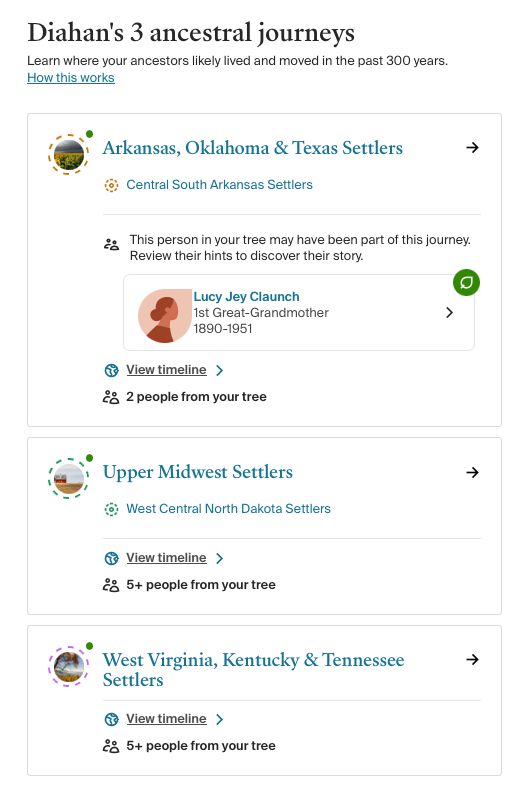
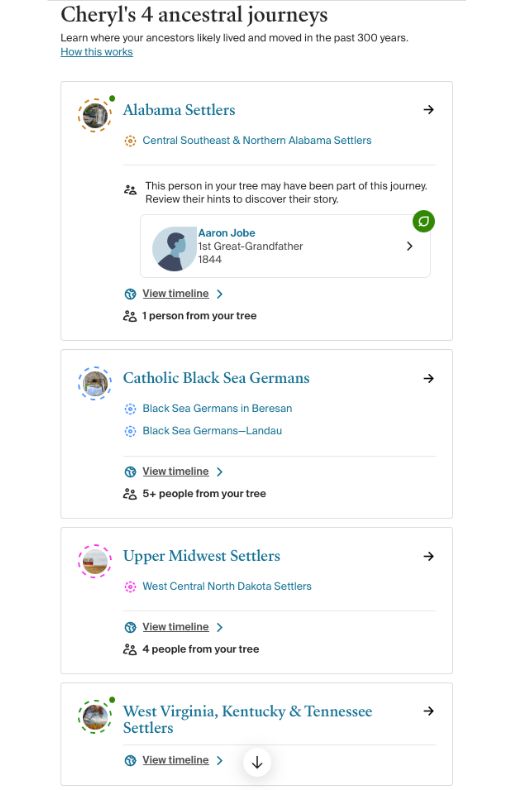
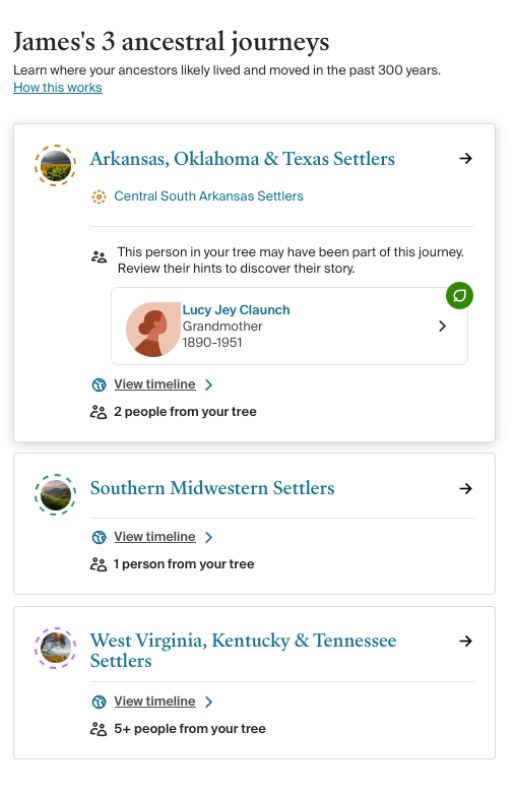
I can see this very clearly as I compare my Journeys to my parents. My dad has three and my mom has four and they actually share a Journey in West Virginia, Kentucky, and Tennessee Settlers. It is very important to understand that sharing a Journey does not mean that you share a recent common ancestor. Especially in a Journey this broad. I inherited this Journey as well as my dad’s Arkansas, Oklahoma & Texas Settlers and my mom’s Upper Midwest Settlers, as you can see below.
I didn’t get my mom’s Catholic Black Sea Germans that traces the path of her maternal ancestors. The fact that I didn’t actually reinforces the exclusivity of these groups. It makes sense that I wasn’t “invited” as that is the smallest and most precise of all of my mom’s Journeys. So the genetic ticket into that one has to be very specific, and apparently I just didn’t win the genetic lottery that would grant me admittance.
There are so many fun things to explore as you review your own Journeys, but I want to keep you focused on your goals: to use these Journeys to identify location(s) where your missing ancestor might have lived so you can search records in that location and continue to build out your family tree. The best way to do this is to explore the Timeline feature.
Timelines
The best way to really understand any DNA tool is to first use it to evaluate what you already know. Choose one ancestral line that is well documented and see if you can find a genetic journey that correlates with this set of ancestors. AncestryDNA often makes it easy for you as they will pull in ancestors from your linked tree into the Journeys tool to give you a head start.
Let’s take a look at my mom’s Catholic Black Sea Germans. This line is well documented for us so ancestors from my tree dot the interactive timeline maps. Starting at the top of the timeline, the map and accompanying narration show me that in about 1800 my German born ancestors accepted the call from the Russian Tsar to colonize the Black Sea region of Russia in exchange for land and exemption from military service.
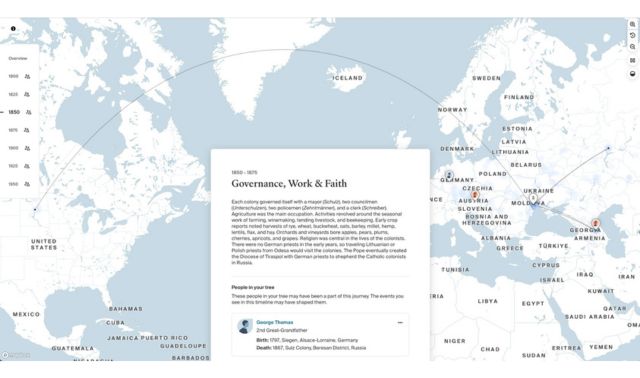
Scrolling between 1850 and 1875 I can see that these colonists left Russia in droves and settled primarily in the Dakotas in the United States. Why? Well, in 1871 the Tsar revoked his military amnesty, and my German ancestors who didn’t want to fight with the Russians were lured to the United States with tales of the Homestead Act.
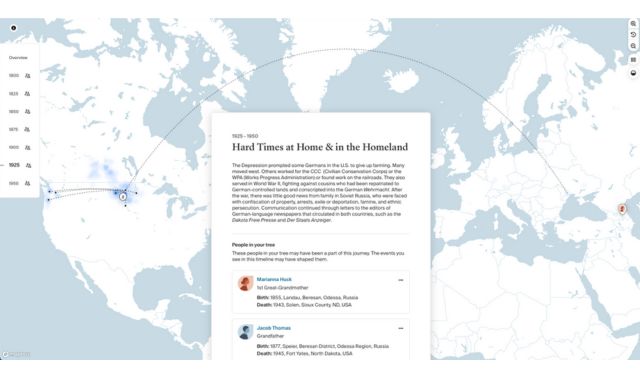
Scrolling even farther forward to 1925 I can even see how my mom’s North Dakota ancestors and their neighbors moved to Washington state where my mom was eventually born in 1949.
As you look at the known migrations for your own family I need you to resist the urge to be unimpressed. After all, you already knew this stuff. But remember that Ancestry has included you in this community based only on your DNA, not on your documentation. In that light, this technology is absolutely incredible. In my case, ancestors from different parts of Germany and France all converged in Odessa near the Black Sea, where they lived for several generations and married into one another’s families. That convergence created a new, distinct genetic group, one whose movements can now be traced through time using DNA alone. I honestly still can’t quite get over my awe of seeing their choices displayed on screen because of my mom’s DNA.
Once you get a feel for how these Journeys work within your known lines, turn your attention to an ancestor whose parents are unknown. My dad’s great grandparents were Richmond and Lilly Claunch. Born in 1860 in Texas and Kentucky respectively. My dad has a Journey called Arkansas, Oklahoma & Texas Settlers.
If I look at the timeline for 1850 I can see the various migrations happening at this time taking people from Tennessee into Arkansas and Texas. So where do the ancestors of Richmond or (or maybe and?) Lilly likely come from according to this Journey? Quite possibly from Tennessee. And not just Tennessee, but southwest Tennessee.
Now, let’s check that against the census records. Lilly tells us her parents were born in Kentucky and Richmond says his are from Alabama…decidely NOT Tennessee. So what does that mean? Well, it could mean a lot of things. But take a look again at the 1850 Journey image. Do you see that one line from northern Alabama into Texas? Scooting back to 1825 we can see those Alabama signals were originally in South Carolina. Could this be representing Richmond’s family? Maybe…
Interestingly, one of the theories as to the parentage of Richmond has his father born in Alabama, and his paternal grandparents born in, can you guess…? Yup, South Carolina.
While I am still not satisfied with the documentation linking these families together, this genetic component is compelling, and encourages me to keep looking down this road. And that’s what these Journeys are really all about. It’s about marrying your genetics and genealogy in a way that offers confirmation of a direction, or a subtle redirection of your efforts that might just lead you to your greatest discovery yet.
Related Reads


A version of this article was posted online in January 2026.