The 1926 Census of Ireland, released on 18 April 2026, can reveal a good deal about your Irish ancestors. As we are all eagerly counting down the days to the imminent release of the 1926 Census, it is always a good idea to get prepared. Let’s take a look at what kind of information you can get from it, where will you be able to find it and one of the most frequently asked questions I get about it – why was it taken in 1926 and not 1921?
When Was the Census in Ireland Taken?
On the island of Ireland, the census would be taken every decade on a year ending in 1, beginning in 1821 until 1911. However, if you are familiar with Irish Genealogy, then you likely know about the track record involved with maintaining census records. During the Irish Civil War, in June 1922, the Public Record Office fire resulted in the destruction of the majority of returns for the censuses from 1821 to 1851. In 1861 and 1871, due to a decision from British bureaucrats, the decision was made to destroy those two censuses after they were taken. As for the censuses of 1881 and 1891, we lost them during World War I, as they were pulped because of the paper shortage at the time.
Why Was the Census Taken in 1926 instead of 1921?
With the Irish War of Independence in full swing in 1921, the plans for the 1921 Census of Ireland had appeared to be on track. It was due to take place on Sunday, 24 April 1921, just a little over 10 years since its predecessor in 1911. However, in March 1921, there was a government report released and was subsequently reported on in the Irish Times where it read:
“A decree was passed authorising the Minister of Home Affairs to forbid the census purposed to be taken by the British Government, as an invasion of the rights of the Irish People.” (Government report, printed in The Irish Times, 22 March 1921).
From that, any chance of a census being taken that year would be quashed.
After the subsequent signing of the Anglo Irish Treaty in December 1921, a Civil War broke out from June 1922 to May 1923. From then on began a long and drawn out process to try to get a census taken.
In 1924, W. T. Cosgrave had put in proposals for a census to be taken but was rejected. It would not be until late 1925 before there would be more talk of a census being taken with newspapers at the time speculating that there would be a census taken in 1926. In January 1926, it would be confirmed that a census would be taken that year, on Sunday 18 April 1926. The census succeeding this one would be taken in 1936. Then with the change of the Irish Free State becoming a Republic in 1949, from 1951 onwards, it would be taken on a five year basis, with some exceptions to that rule.
With a 15 year gap between the two censuses, this is pivotal for the very first census of the Irish War of Independence in a post war period and as an independent state. It contains the information of almost 3 million individuals (specifically 2,971,992 people), demonstrating a population decrease of 5.3%. It is also the first census that would capture a number of Ireland’s mother and baby institutions and a further census for established Industrial Schools and Magdalene Laundries (and those are only a handful of the reasons).
The 1901 and 1911 censuses have been a longstanding staple of Irish genealogy, publicly accessible for inspection since 1961 due to a ministerial order issued at the time. They would gradually come online through the digitization and indexing work done by the National Archives of Ireland from December 2007 to August 2009. Had those censuses been subject to the same piece of legislation to which the Irish censuses post 1926 are subject, we only would have been able to look at them in 2001 and 2011 respectively.
It is an exciting time as Ireland has not seen a census released to the public in 65 years!
What Kind of Information Can I Expect to Find on the 1926 Census?
Let’s take a look at what information will be part of Form A of the 1926 Census. You may notice some of what is included does mirror some of what had been asked on the 1921 England & Wales census, however some questions are new and improved from the prior 1911 census in Ireland.
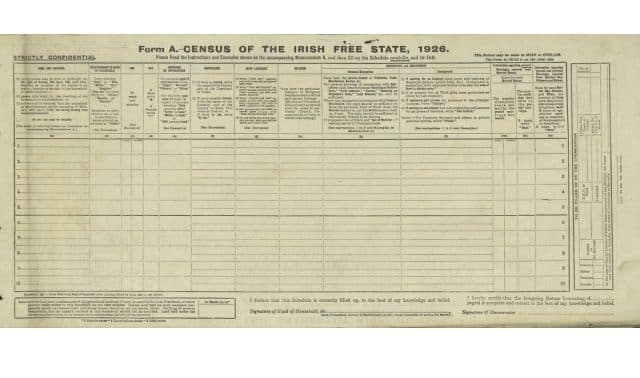
Here is what you will see listed on the form:
- Name and surname
- Relation to head of household, this will include additional relationships – such as whether someone is a step child of the head of household.
- Age – in years and months!
- Sex
- Marriage or orphanhood – depending on the circumstances, this information could help you further identify an entry if you had known a parent had died while a child was young, or perhaps it may give you another lead to pursue.
- Birthplace – this perhaps will have the biggest change since the 1911 census, in that it will refine the birthplace down to a specific townland. This is a huge change from the 1911 census, which specified only a county.
- Irish language – while this may be something that is glossed over, there is something to pay attention to here. Depending on the order it is written, you will be able to discover what the native language for members of a household is. If you see it recorded as “English and Irish,” it means that they can speak both languages but are not a native Irish speaker. However, if it says ‘Irish and English’, it means that Irish is their native language but can speak English as well.
- Religion
- Occupation & employment: personal occupation – this will give you an idea as to what an individual’s occupation is like prior censuses.
- Occupation & employment: employment / name and business of employer – this will provide more historical context into an ancestor’s career, whether they were self-employed, if they were out of work or if they worked for someone, it will state who it is they work for.
- Information regarding present marriage required from married women – this mirrors the 1911 Census in listing how long a marriage has lasted and how many children born alive. However, one thing this census omits (and I wish it did include) is how many children the couple had lost.
- Information regarding present and previous marriages required from married men, widowers and widows – this is a new question asked. Specifically, this question asks for the number of living sons, daughters, step-sons and step-daughters who are under 16 years of age and whether residing as members of this household or are elsewhere.
- Total area in Statute acres of all agricultural holdings – situated at the bottom of the form, it is a question to be answered by the head of each respective household. This is to get an understanding of how much land is owned in statute acres. A metric is given where 5 Statute acres = 4 Cunningham acres = 3 Irish acres.
What Kind of Information will it Give me About buildings and Dwellings?
Not only will it have a use in telling you about your ancestors and their families, but it also gives you more information about the buildings. The type of information that the Enumerator’s Return (Form B) will provide is:
- Whether a building is a private dwelling house or some other kind of building.
- Whether the building is inhabited or uninhabited.
- The number of distinct families who live in each dwelling house or building.
- The name of the head of each family.
- Number of males.
- Number of females.
- The total population.
- Number of rooms that were occupied by each family.
Where will I be able to Access the 1926 Census?
The census will be going online on 18 April 2026 at midnight on the National Archives of Ireland’s website. In February 2025, the National Archives had redesigned its website to update its look and are making it the main home for Irish census records, with a notice placed on the separate standalone census website stating the eventual retirement of that site. However, presently (March 2026), it has not been retired as of yet.
As for if it will arrive on any of the commercial sites like Ancestry, MyHeritage, FindMyPast, etc., like prior censuses, depends on negotiations and subsequent agreements between the commercial sites and the National Archives. This will dictate how long it takes for it to arrive online. It will not be like the situation with the 1921 UK census, where it was initially hosted by an exclusive agreement via on FindMyPast, before it was allowed to be distributed elsewhere.
One thing that is important to note with this census, is that the census will only consist of returns for the 26 counties of the Irish Free State, this is not including the 6 counties of Northern Ireland. Northern Ireland was part of the census that was taken in 1926, but the returns from that do not survive. In 2013, it was revealed in a news piece by the BBC which had stated that PRONI (Public Record Office of Northern Ireland) was unable to locate the census returns for the 1926 Census in Northern Ireland and that the census returns were lost, supposedly during the Second World War. It is an unfortunate situation for those who are attempting to trace their ancestors in Northern Ireland or to find another source to use in their research to bridge the gap.
The next census for Northern Ireland would be in 1937, but would ask fewer questions, the next large scale census being conducted in 1951, the 1941 census being cancelled due to the Second World War so it has left a considerable void.
If you are like me, you will already be going through your tree and making a list to identify who you will be able to find in the 1926 census but for me, it is majority of my tree! As I write this, I am bursting with excitement, looking forward to seeing my paternal grandparents on the census for the first time, my grandfather at 5 years old and my grandmother at 2 ½ years old! It will be another source that will open up even more avenues for all of us in our research, wherever it may take us.
Happy searching!
A version of this article was published online in March 2026
Related Reads


Author

Daniel Loftus is a college student and genealogist based in Cork, Ireland. He specialises in Irish genealogy research & research into mother and baby homes in Ireland - the findings made by himself and his volunteers - published on his website Project Infant. You can find his website here: https://linktr.ee/danielloftus