Once one of Europe’s largest and most prosperous nations, Poland vanished from the map for the entire 19th century, partitioned among Prussia, Russia, and Austria. Yet its language, customs, and traditions survived and flourished, both at home and among Polish emigrant communities worldwide. Researching your Polish roots can be challenging, but once the correct records are located, documenting the details can be highly productive. Below are some resources to get you started.
Names and Places
Before searching in Poland, you must secure these two essential clues:
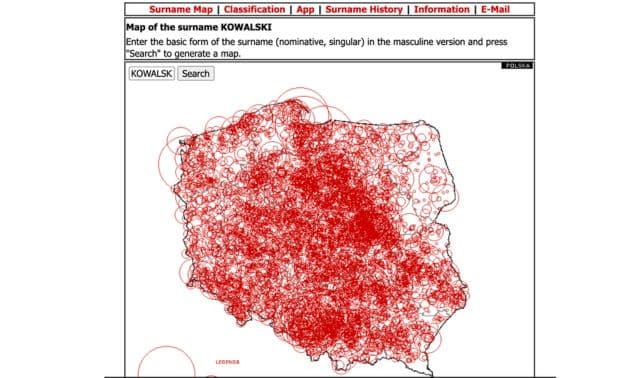
- The immigrant’s original, un-Americanized name: The exact spelling used in the old country, accounting for Polish diacritics and naming customs. Use origins, patronymics and distribution maps to work backward from the Americanized version to the true Polish form. Consult “Mutilation of Eastern European Surnames” by William F. Hoffman to understand how Polish phonetics were commonly corrupted by English-speaking clerks.The Polish Genealogical Society of America has compiled a changed surname list for quick reference.Be sure to also account for Polish grammar, specifically gender-coded endings (e.g., Kowalski for a male, Kowalska for a female). Use mapanazwisk.eu to identify where the surname is concentrated in modern Poland (and narrow down a region if it is rare).
- The exact name of the ancestral town or village: Successful European research requires identifying the family’s precise place of origin, since that locality determines the correct religious parish or civil district.
Home Scavenger Hunt
Your Polish ancestor’s hometown must be gleaned from documents generated in the United States. If you do not have an exact birthplace, start searching the family archive for letters (look carefully at envelopes for postmarks and return addresses) and photographs (check the back of any photo for studio stamps listing the city/town). When working with oral histories, listen for phonetic pronunciations of town names; write them down exactly as they sound, then verify them with documents and geographic tools such as old maps or gazetteers.
Public Records
For many researchers home and family sources may not exist or turn up empty. Additional sleuthing will then be necessary. Public records provide the official paper trail of an immigrant’s life. Focus your efforts on “high value” targets that required specific geographic data. Social Security (SS-5) Applications usually required a specific birthplace, and this original application is often the most accurate source for an ancestor’s village name. Naturalization Records (especially after 1906 when the federal government took over the process) frequently list the town of birth, date of arrival, and the specific vessel used. See the U.S. Naturalizations Records Genealogy Research Guide for how and where to find them. Passenger Arrival Lists often record the “Last Place of Residence” (but be careful; it might not always be the birth location), and names were not changed at Ellis Island—see the article American Names Declaring Independence by Marian L. Smith. These lists can be searched online for free through The Statue of Liberty Ellis Island Foundation (registration required) or FamilySearch or at subscription sites Ancestry.com and MyHeritage. Use the tools the One-Step Webpages website by Steve Morse to search by town or other criteria for those hard-to-find ancestors. Also check the major genealogy websites for WWI & WWII Draft Registration Cards (available through specifically asked for the town or city of birth.
U.S. vital records may just list the country or region. Church records, however, may be more reliable, especially since pastors of U.S. Polish Catholic parishes often recorded parishioners’ places of origin in marriage and baptismal records. Check cemetery records as immigrants often had their specific village of origin carved into their tombstones to preserve their identity. Other sources worth looking at include obituaries, coroner’s records, fraternal benefit society applications, probate and other court records. It is best to corroborate details with more than one document. The Polish Genealogical Society of Connecticut and the Northeast has published several databases available to members including cemetery and obituary records, Polish American marriage records, and European Immigrant Birthplace Records.
If any of the above sources provide you with the name of a large city, this information is most likely to be just a point of reference. Most Polish immigrants were engaged in agricultural occupations and lived in small villages and towns.
Navigating Geography
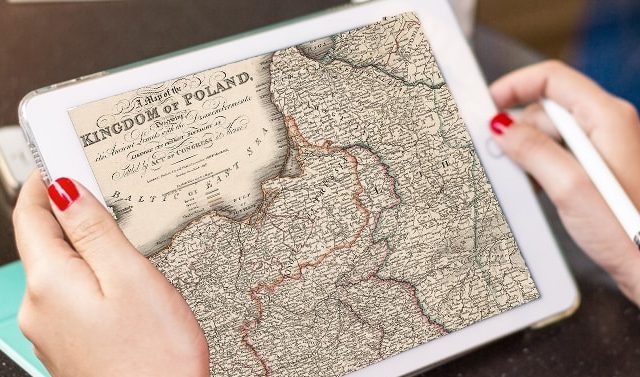
For 123 years Poland did not exist as a country. Shifting borders and three foreign empires (Austria, Prussia, and Russia) shape where your family’s records are kept—and the language they are written in. Maps and gazetteers (geographical dictionaries) are the best tools to identify the religious parish that served your ancestor’s village. For example, Mapa/Szukacz is a modern searchable map to locate a village as it exists today, and the Słownik Geograficzny (1880–1914) provides historical context for nearly every village in the former Polish lands.The David Rumsey Map Collection and the FEEFHS Map Library both offer high-quality historical maps for Central and Eastern Europe to help you track shifting borders. Tools such as Kartenmeister convert German place names to Polish names for the former eastern territories, while the Meyers Gazetteer serves as the essential place-name encyclopedia for the German Empire, linking villages to their specific parishes and districts. Consult the Family Search Wiki for Poland for additional geography resources.
Understanding Polish History
Before you dive deeply into your Polish heritage, you might benefit from understanding some historical context. These events can help explain why your ancestors might have left their homeland for other places or at least illustrate how Poland evolved into the country it is today. Below is an overview of some of these events.
Birth of the Polish Nation: The establishment of the Polish state can be traced back to AD 966, when Mieszko I, ruler of the realm coextensive with the territory of present-day Poland, converted to Christianity.
The Polish Lithuanian Commonwealth: Poland and Lithuania are unified in 1569 by the Polish Parliament (Sehm).
Poland’s Three Partitions: In 1772 Russia, Poland, and Austria seize 30 percent of Poland’s territory, creating the First Partition of Poland. The Second Partition of Poland happened when Russia and Prussia took more than half of Poland’s remaining territory in 1792. In 1795, Russia, Prussia, and Austria carve up the remaining Polish territory, aka the Third Partition.
The Napoleonic Wars (1803–1815): The conflicts engulf Europe, leading to territorial bartering of partitioned Polish lands. Napoleon forms the semi-independent Duchy of Warsaw out of Prussian Poland.
Congresses: In 1815 The Congress of Vienna partitions the Duchy of Warsaw between Prussia and Russia. Russia incorporates much of its formerly Polish territory into a semiautonomous state known as “Congress Poland.”
Abolishing Serfdom: Serfdom is abolished in 1806 Prussian Poland; 1848 in the Austrian Empire and 1861in Russia.
Immigration/Emigration: The first wave of Polish immigration to the Americas began in 1865 with a great wave in the 1870s. Most of the early emigrants to the United States settled in Texas; Hamtramck, Michigan; and the Chicago area. From 1870–1914, 3.6 million Poles left from the three empires that controlled Poland. Many Poles settled in Chicago, New York City, Connecticut, New York State, Pennsylvania, New Jersey, and Massachusetts. The Polish Diaspora extends beyond the Americas to many European countries and Australia.
World War I: Poland becomes a fighting ground from 1914–1918. After the war, Poland gains independence and The Second Polish Republic is founded in 1918.
Nazi Invasion and World War II: The invasion by the Nazis in 1939 triggered World War II. After the war Poland ceded her eastern territories to the Soviet Union and her western borders were moved west to the Oder and Neisse Rivers, thus establishing the present borders. A provisional government was set up under Soviet auspices in 1945. Many Poles, including 90 percent of the country’s Jewish population, are deported to labor camps. A second wave of Polish immigration to America begins.
End of Communism and Modern-Day Enlargement: Communist rule in Poland ended in 1989. Ten years later Poland joined NATO. In 2004 Poland became a member of the European Union.
Finding and Using Polish Genealogy Records
In Poland, records are organized strictly by religious parish and locality, not by surname. To have success, you must identify the specific village.
Below we provide some examples of records you are likely to come across as you research your Polish heritage.
Civil Records
Civil registration did not exist in Poland until 1946. Partitions use the “100-Year Rule” to locate a record’s custodian. Generally, vital records (births, marriages, deaths) over 100 years old are transferred (in theory) to the Polish State Archives, while records less than 100 years old remain at the local Civil Registry Office or Urząd Stanu Cywilnego(USC). However, some of these repositories are slow to comply with archival regulations and older records can still be found at this level. The official State Archives portal Szukaj w Archiwach includes some 88M+ scans of includes registry office records, maps, photographs, technical documents, and more. Instructional videos are available on the site to assist your search. Check the FamilySearch Wiki’s Online Polish Records Table for records available through FamilySearch and its partners.
Church Records (Księgi metrykalne)
In much of Poland, a clergyman functioned simultaneously as the vital records registrar, recording births and christenings, marriages, and deaths and burials. Each religion had separate registers. For Catholics and Protestants, you will need to know the name of the parish, and for Jewish ancestors, the name of the Jewish registration district. In addition, church records may include account books, confirmations, and confession or communion lists. Records may still be in the archive of the parish at which they were created. Some Polish dioceses have centralized some of their older records. If you do not find what you are looking for at the parish level, the Archdiocese may have earlier or later records than those housed at the parish.
Search by surname and parish for births, marriages, and deaths for free on Geneteka. Once Geneteka you obtain a specific volume or year, go to Skanoketa Metryki to view the actual document.
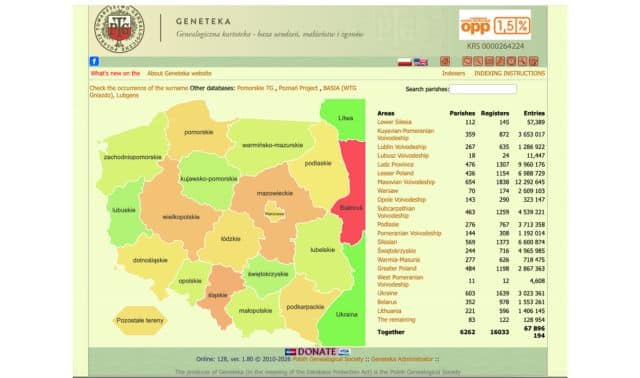
Many Lutheran and Greek Catholic parishes were liquidated due to population shifts because of the upheavals of the Second World War. Any extant records of these parishes will be found at a repository of the State Archives. Membership database, JRI Poland, continues to build “the largest database of Jewish vital and other records online.”
Other Records
Published cemetery inscriptions, parish censuses, and tax lists (for Easternmost parts of Russian Poland only), and other archival sources that are unique to your area of interest, may be available. Check individual archival sites for published guides.
Reading the Records
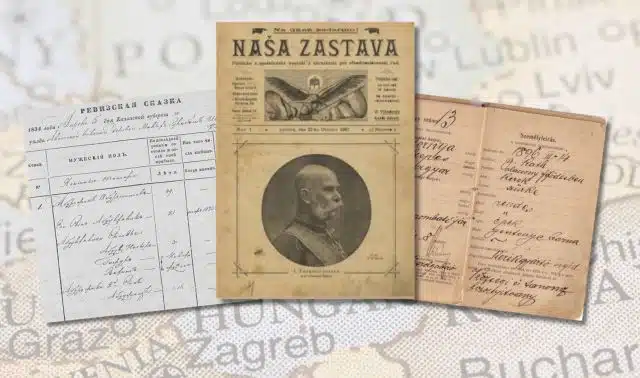
Records in Poland were kept in various languages. Most record keeping was done in Polish but, depending on what part of the country your family is from and what religion your ancestors practiced, you may also have to acquire some knowledge of German, Latin, Russian or Hebrew. Google Translate or Word Lists on FamilySearch quick word lookups or deciphering simple phrases. The In Their Words genealogy translation guides by Jonathan Shea and William Hoffman for how to work with records and view examples. Purchase these books at Langline or check with Worldcat to find them through a local library.
Polish Genealogy Websites
We have already mentioned several websites above. As it turns out, there are many other websites that can guide you on your Polish genealogy journey. These websites can help you locate records, provide useful downloadable guides and more. Some of the most popular sites include:
BaSIA: A free site with more than 6 million indexed entries with linked scans for the Wielkopolska (Greater Poland) region.
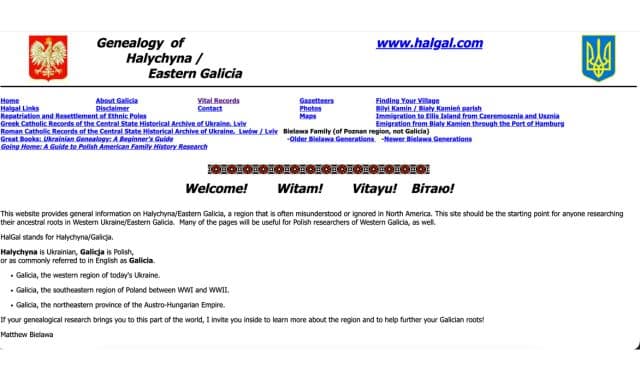
Genealogy of Halychyna /Eastern Galicia: A free website providing general information on Halychyna/Eastern Galicia, a region that is often misunderstood or ignored in North America. This site should be the starting point for anyone researching their ancestral roots in Western Ukraine/Eastern Galicia.
Gesher Galicia Town Locator: A website listing all the towns in Galicia, Austria in the year 1900, including their judicial and administrative districts, and the location of the Jewish, Roman Catholic and Greek Catholic congregations or parishes for that year.
JewishGen: The Global Home for Jewish Genealogy Containsrecords from around the world, hosts the JewishGen Communities Database (6,500 Jewish communities in Europe and beyond, and the JewishGen Gazetteer, a database of nearly 4 million localities in Europe, North Africa, and the Middle East, among other datasets and resources.
Poznań Project: Searchable website specifically for 19th-century marriages in the Prussian partition.
Related Reads