Poland has had a rough history: centuries of war, deadly invasions and subjugation by foreign powers. Among the most devastating events in Polish history were the three Partitions of Poland in the late 18th century.
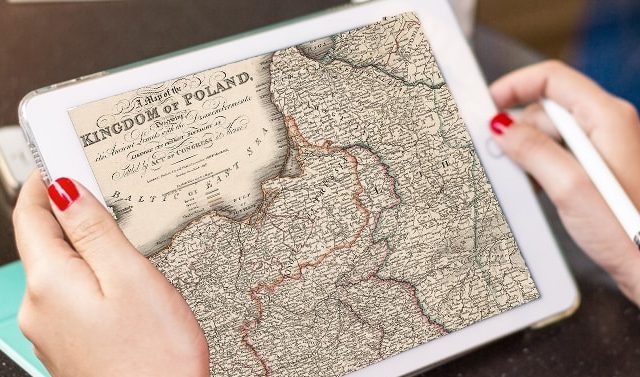
What were the Partitions of Poland, and how did they impact the Poles who lived there? The helpful Partitions of Poland map above tells part of the story. (Click it to see a full version at the David Rumsey Map Collection.)
What Were the Partitions of Poland?
Tadeusz Rejtan, a member of the Sejm, is pictured lower-right lying down in protest of the First Partition
Throughout late medieval and early modern history, Poland was part of the Polish-Lithuanian Commonwealth, a main player on the European stage in the 17th and early 18th centuries.
But the nation, once a center of culture and commerce, fell into disrepair by the mid-1700s. Military losses were made worse by famines and epidemics, and once-profitable trade routes dried up. The country’s unusual political system—in which the nobility elected kings and the legislature had to unanimously approve new laws (liberum veto)—left the government paralyzed and unable to successfully address these issues.
Once Poland started to flounder, the other European powers smelled blood in the water. In the three Partitions of Poland, Prussia, Russia and Austria gobbled up Poland’s land and subjugated its people.
First Partition (1772)
In addition to requiring unanimous approval of new laws, Poland’s political system also called for the election of kings. That process left the country extremely vulnerable to foreign interference.
Poland’s last king, Stanisław II August Poniatowski, was handpicked by Catherine the Great of Russia. (The two had been lovers, and Catherine believed he would be easy to manipulate.) Though widely seen as Russia’s puppet, Stanisław attempted to reform and modernize the country. But his efforts were thwarted by Poland’s neighbors, who saw them as a threat to their ability to manipulate Polish affairs.
Beginning in 1768, civil war raged in Poland as Catholic partisans under the “Bar Confederation” fought against the encroaching Russian influence. Four years later, Prussia, Russia and Austria took advantage of the chaos by invading. They divided nearly one-third of Poland’s land among themselves in what became the First Partition. Austria and Prussia each had ulterior motives: creating a buffer zone between them and Russia, maintaining a balance of power, and diverting Russia’s expansionist eye.
Second Partition (1793)
Despite this setback, Poland rebounded during the late 1770s and 1780s. Art and education flourished, and the Polish economy showed signs of life.
The Polish Sejm (legislature) approved a sweeping new constitution in 1791. The contentious “May Constitution,” considered the first modern one of its time and partially inspired by the American Revolution, was the result of years of debate between conservatives and reformists. Against the backdrop of the ongoing, violent, anti-monarchical French Revolution, the constitution alarmed some conservatives, who went so far as to invite foreign powers to intervene.
Russia and Prussia were happy to oblige, each sending troops to invade under the guise of protecting the Polish monarchy. Under duress, the Sejm agreed to a Second Partition in 1793.
Third Partition (1795)
In response, insurgents led by American Revolutionary War hero Tadeusz (Thaddeus) Kościuszko organized an armed uprising the following spring. Once again seeing an opportunity, Russia and Prussia invaded to quash the rebellion. Despite early successes by the revolutionaries, the allied armies prevailed and laid siege to Warsaw. The end result was the Third Partition, which wiped Poland as an independent country off the map for 120 years.
Most other European powers met Poland’s disappearance with a shrug. But Anglo-Irish philosopher Edmund Burke was one of the few to publicly denounce them. “No wise or honest man can approve that partition, or can contemplate it without prognosticating great mischief from it to all countries at some future time,” he wrote.
Where Did Polish Land Go in the Partitions?
The table below, taken from the Polish Genealogy Cheat Sheet by Lisa A. Alzo, specifies which land went to which powers throughout the three Partitions:
| First Partition (1772) | Second Partition (1793) | Third Partition (1795) | |
| Prussia | Royal Prussia (also known as “West Prussia”) and Great Poland north of the Noteć River | The rest of Great Poland, part of Mazovia, and the cities of Toruń and Gdańsk (Danzig) | The rest of Mazovia, (including Warsaw) and Lithuania west of the Neman River |
| Russia | Land east of the Divina and Dneiper Rivers | Lithuanian Belorussia and much of what’s now western Ukraine | Lithuania east of the Neman River, Courland, and the rest of Ukraine |
| Austria | Little Poland south of the Vistula River, Galicia, and Podolia west of the Zbruch River | (Did not participate) | The rest of Little Poland |
In short: Each Partition saw neighboring powers encroach from the west (Prussia), south (Austria) and east (Russia). Poland’s size was reduced by about 30% in the First Partition, by half in the Second Partition, and wholly in the Third. Note that Austria did not partake in the Second Partition.
The map at the top of this article (created in 1814) shows Poland’s pre-1772 boundaries. The different colors highlight which countries had dominion over Polish lands after the Partitions. Pink indicates Prussian holdings, green for Austrian and yellow for Russian.
In addition to providing the boundaries of each partition, this detailed map also contains clues about how each partition classified the newly acquired land. For example, the Prussian partition distinguishes between East Prussia (the area along the Gulf of Gdansk/Danzig), and West Prussia (the area between Prussia and East Prussia). See the next section for more on this.
You can see another a more-modern view of the Partitions of Poland map here:
In this depiction, Prussian holdings are in blue, Austrian in green and Russian in pink. Click the image to see the original, full map from Wikimedia Commons. You can find more Partitions of Poland maps on websites such as David Rumsey.
Why the Partitions Matter for Genealogists Today
Knowing which partition your ancestor’s town resided in is crucial for finding records. The government ruling each partition (Prussia/Germany, Austria/Austria-Hungary, and Russia) was responsible for creating and storing records. Record availability, format, coverage and even language will vary based on which country was in charge.
The governments also differed in how the administered their new Polish land—and how much autonomy the people living there had:
- Russia incorporated land into its system of guberniyas (provinces). Its Polish territory was formed into the Kingdom of Poland (“Congress Poland”) by the Congress of Vienna in 1815.
- Prussia‘s new land was largely divided into the provinces of West Prussia and East Prussia, with Posen and Silesia becoming their own provinces. Like the rest of the Kingdom of Prussia, these lands became part of the German Empire (1871–1918).
- Austria formed its Polish land into either New (or West) Galicia or the Kingdom of Galicia and Lodomeria. Austria formed a dual monarchy with Hungary in 1867; Polish lands mostly remained under Austrian jurisdiction.
Gazetteers and other mapping tools will help you identify the name of your ancestor’s hometown, plus how that name changed over time. FamilySearch has an excellent collection of Polish gazetteers. Check these out to determine which Partition your ancestor’s town became part of.
A version of this article was posted online in April 2018. Last updated: October 2025.