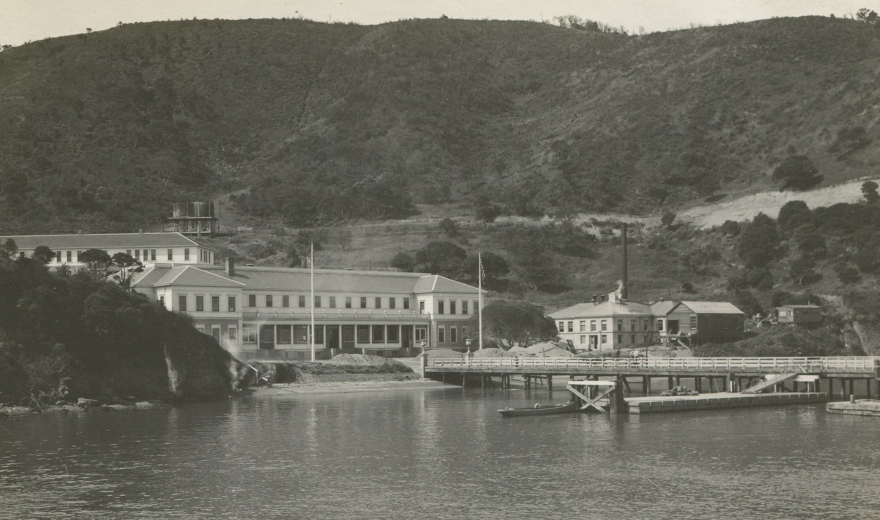
When many Americans think of 20th-century immigration to the U.S., Ellis Island tends to come to mind first. But for hundreds of thousands of people who arrived on the West Coast between 1910 to 1940, another island shaped their immigration: Angel Island.
Located in the San Francisco Bay, the Angel Island Immigration Station processed new arrivals from around the world. But it also became notorious for its treatment of immigrants from Asian countries, particularly China. They often faced long detentions, invasive and difficult interrogations, and the constant threat of deportation.
Angel Island wasn’t simply the “Ellis Island of the West.” It operated within a very different immigration system shaped by exclusionary laws and racial discrimination. Most arrivals to Ellis Island faced a quick inspection before hopping onto US soil. But Angel Island immigrants had to endure days, weeks or even months of confinement within barracks. Some even left physical traces of that experience: poems carved into the wooden walls of the detention building.
Did you relative arrive on the West Coast between 1910 and 1940? Do you suspect that they might have been detained? The experiences of those who passed through Angel Island haven’t been lost. With the right records, you might be able to uncover your ancestor’s story there.
Angel Island History: What Genealogists Should Know
Once the homeland of the Coastal Miwok peoples, Angel Island received its modern name from Spanish explorer Juan Manuel de Ayala: Isla de los Ángeles. Coming under US jurisdiction in the mid-19th century, it became increasingly important to the government. In 1850, Angel Island was declared a military reserve, and the U.S. Army established “Camp Reynolds” (later, Fort McDowell) there during the Civil War.
Around the same time, the U.S.’s Westward expansion (and the desire for transcontinental railroads) necessitated inexpensive labor. Young men from China—particularly the Guangdong Province—stepped in, scraping together funds for passage from family members or garnished future wages.
Between 1871 and 1880, more than 123,000 Chinese immigrants came to the U.S., most of them men. Many found work in mines, on the railroads and as low-wage laborers who intended to return home with their wages.
They faced increasing hostility, especially after the Panic of 1873 (the “Long Depression” that dragged on until 1899). Many Americans blamed the recent Chinese immigrants for scarce employment opportunities, further enflaming anti-Chinese sentiment. Politicians responded by pushing through a series of laws that culminated in the Chinese Exclusion Act of 1882, which put a 10-year moratorium on the immigration of Chinese laborers. (Merchants, clergy, diplomats, teachers and students remained eligible for entry.) The act was renewed for another 10 years in 1892, then again in 1902 with no termination date.
Most who arrived through the Port of San Francisco were processed (and sometimes housed) on the Pacific Mail Steamship Company. Called “the Oriental Warehouse,” the quarters there were condemned as “unsanitary” and “inadequate” in 1904.
Angel Island emerged as the best place take over. An immigrant quarantine station had already operated on the island since 1891, screening Asian passengers and their belongings as fears of the bubonic plague spread. A 20-acre land grant from the War Department allowed for construction on a new facility to begin in 1905.
During the Spanish-American War, Angel Island served as a discharge depot for returning troops. Later, during World War I, soldiers embarked for and returned from Europe through the island, while German sailors were detained in its detention building. After the war, Angel Island continued to function as a disembarkation center through World War II.
The station opened 21 January 1910. Over the next 30 years, roughly 1 million people passed through the Port of San Francisco. Not all of them step foot on Angel Island; passengers were separated by nationality, and only Asian immigrants and others who needed to be quarantined for health reasons, were ferried on to the station.
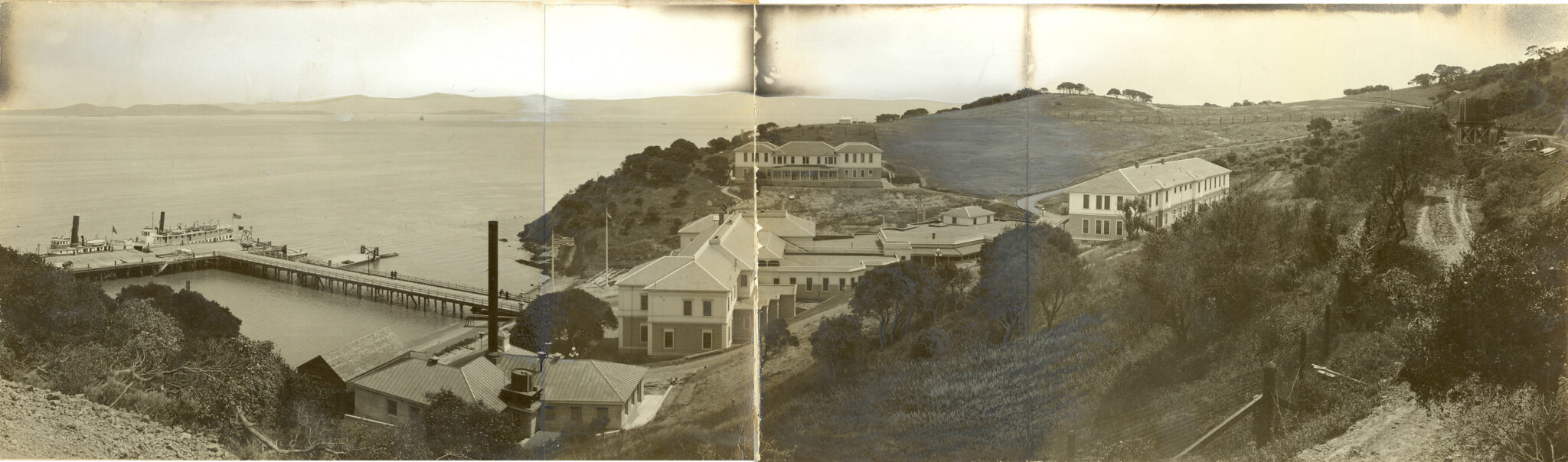
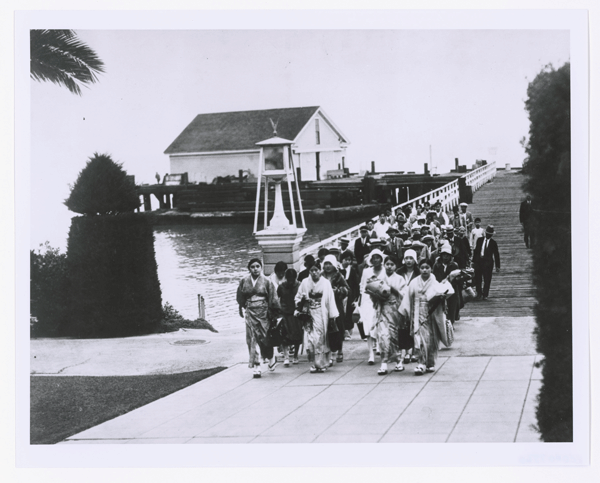
About half of those immigrants—an estimated 500,000 from 80 countries—went through Angel Island for processing upon their arrival or departure. Most came from China or Japan, but others came from India, the Philippines, Korea, Australia, New Zealand and even Mexico.
Unlike Ellis Island, Angel Island was built with detention in mind. Its design and policies reflected the anti-Asian laws and widespread discrimination. Arrivals were separated by race and gender, disrobed, then subjected to thorough medical inspections. About 18% percent of arrivals were rejected (compared to just 1 to 3% at Ellis Island), and those who were suspected of illegal entry were assigned a bunk in the detention dormitory to await interrogation.
White Europeans and US citizens usually avoided the prolonged detention and intense interrogations that Asian immigrants (who could spend even months in detention) faced. Some remained at Angel Island well past a whole year; the longest recorded detention was 22 months.
Some Chinese attempted to skirt regulations by claiming birthright citizenship, especially in the aftermath of a devastating earthquake in 1904. They became known as “paper sons” or “paper daughters,” and were rarer than xenophobic propaganda at the time would suggest.
Immigration officials responded with punishingly long interrogations that questioned applicants and their witnesses about family relationships and home villages. They were grilled about even minute details of their town: tiny architectural flourishes on buildings, or the specific layout of a hometown. Allegedly enacted to expose fraud, this treatment caused prolonged interrogation and a risk of deportation if the applicant made the slightest inconsistency.
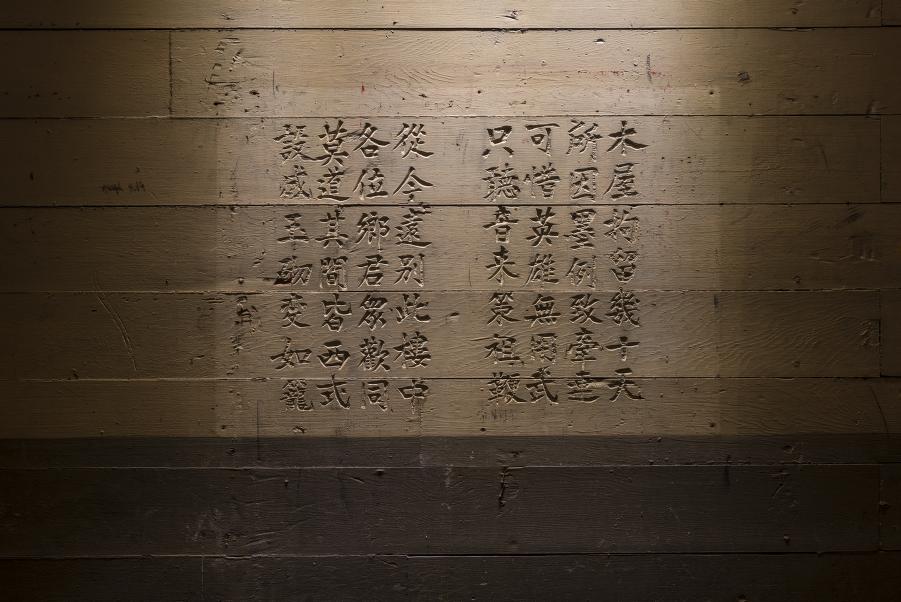
Conditions at Angel Island were infamously bad. Not only were the detention barracks often overcrowded, vermin infested, filthy and firetraps, but the food was barely edible. The human cost of this system still marks the detention barracks. Some detainees recorded their experiences through poems carved into wooden walls—some of which survive to today.
That poetry makes one thing very clear: For many immigrants, Angel Island was not simply a processing center—it was a prison. One immigrant from Taishan wrote:
It’s been a long time since I left my home village;
Who could know I’d end up imprisoned in a wooden building?
I’m heartsick when I see my reflection, my handkerchief is soaked in tears;
I ask you, what crime did I commit to deserve this?
In 1940, fire brought Angel Island’s immigration era to an abrupt end. The blaze destroyed the administration building and women’s quarters, prompting officials to move processing to San Francisco. On 5 November 1940, the last roughly 200 immigrants still held at the station, including about 150 Chinese immigrants, left Angel Island for quarters in the city.
The history of Angel Island isn’t easy. For thousands of immigrants, the island wasn’t a welcome to a new country, but a period of uncertainty, fear and separation. Their experiences speak across generations about confinement, injustice and the hope of reaching a new land.
Today, the U.S. Immigration Station at Angel Island is a National Historic Landmark. The whole island is a California State Park.
Finding Your Ancestors at Angel Island
Researching Angel Island ancestors often starts with the question: Did this person actually pass through the immigration station, or did they arrive directly in the city of San Francisco?
As previously discussed, not every immigrant who arrived through the Port of San Francisco spent time on Angel Island. Many went through inspection aboard the ship and entered directly into the city.
But, if your ancestor arrived on the West Coast between 1910 and 1940 (especially if they came from China, Japan, Korea, India or another Asian country), it’s worth investigating if immigration officials detained, questioned or processed them at Angel Island.
The following resources can aid you in discovering if your ancestor spent time on Angel Island and find information about their time there.
Interview Family Members
Most people who passed through Angel Island since passed on, but their stories might not have. Some immigrants later spoke about their detention, interrogations or journey to relatives or close friends, especially their children.
Ask relatives or family friends who knew your ancestor if heard about your ancestor’s immigration experience. (Note: They may not know the name “Angel Island.”) Small details might survive within family stories, even if the full account has been lost.
Oral history doesn’t necessarily replace immigration files or passenger lists, it can offer clues such as:
- A memory of being on an island outside San Francisco
- Any mention of repeated questioning by government officials
- A story about having to prove relationship
Also ask about any documents, photographs or letters left behind. Look for copies of old immigration documents, such as steamship tickets and certificates proving identity.
Your ancestor may have taken part in one of multiple oral history projects dedicated to experiences on Angel Island. Two are the “Immigrant Voices” project on the Angel Island foundation’s website and the “Angel Island Oral History Collection” at UC [University of California] Davis Library.
Passenger Arrival Records: Port of San Francisco
Passenger lists for the Port of San Francisco will give you:
- Date of arrival
- Ship name
- Port of departure
- Annotations or case numbers that point towards a larger immigration file
Keep in mind: As you research, the names might not appear exactly as you expect. Assumed names (names that people used to enter the country) might be different that the names you know.
Passenger lists are held by the National Archives and are available online at Ancestry.com, FamilySearch (1893–1934/1953). FamilySearch also has registers specifically for Chinese arrivals.
Immigration Investigation Case Files
If your ancestor might have spent time on Angel Island, then it’s important to look for an immigration case file investigating their claims. The National Archives and Records Administration at San Francisco house more than 200,000 case files for Russians, Indians and Pakistanis. But most are for people from Asian countries–Chinese, Japanese and Koreans–because they were detained more often.
These case files are filled with information including the person’s place and date of birth, physical description, and birth and marriage certificates. You may also find documents related to their other arrivals in the U.S. (if they came to the country more than once) as well as interrogation transcriptions, family photographs and even maps that they drew of their home villages. Search for a case file number using the free partial name index from UC Berkeley’s Library “Chinese Immigration to the United States, 1884–1944.” (It’s also available on Ancestry.com.) FamilySearch has San Francisco Boards of Special inquiry minutes and records, plus specific registers for Japanese, Filipino and Hawaiian arrivals.
If your ancestor isn’t in the partial name index, then look for him on a ship’s passenger lists. You can deduce the case file number from the arrival year and ship number in passenger lists.
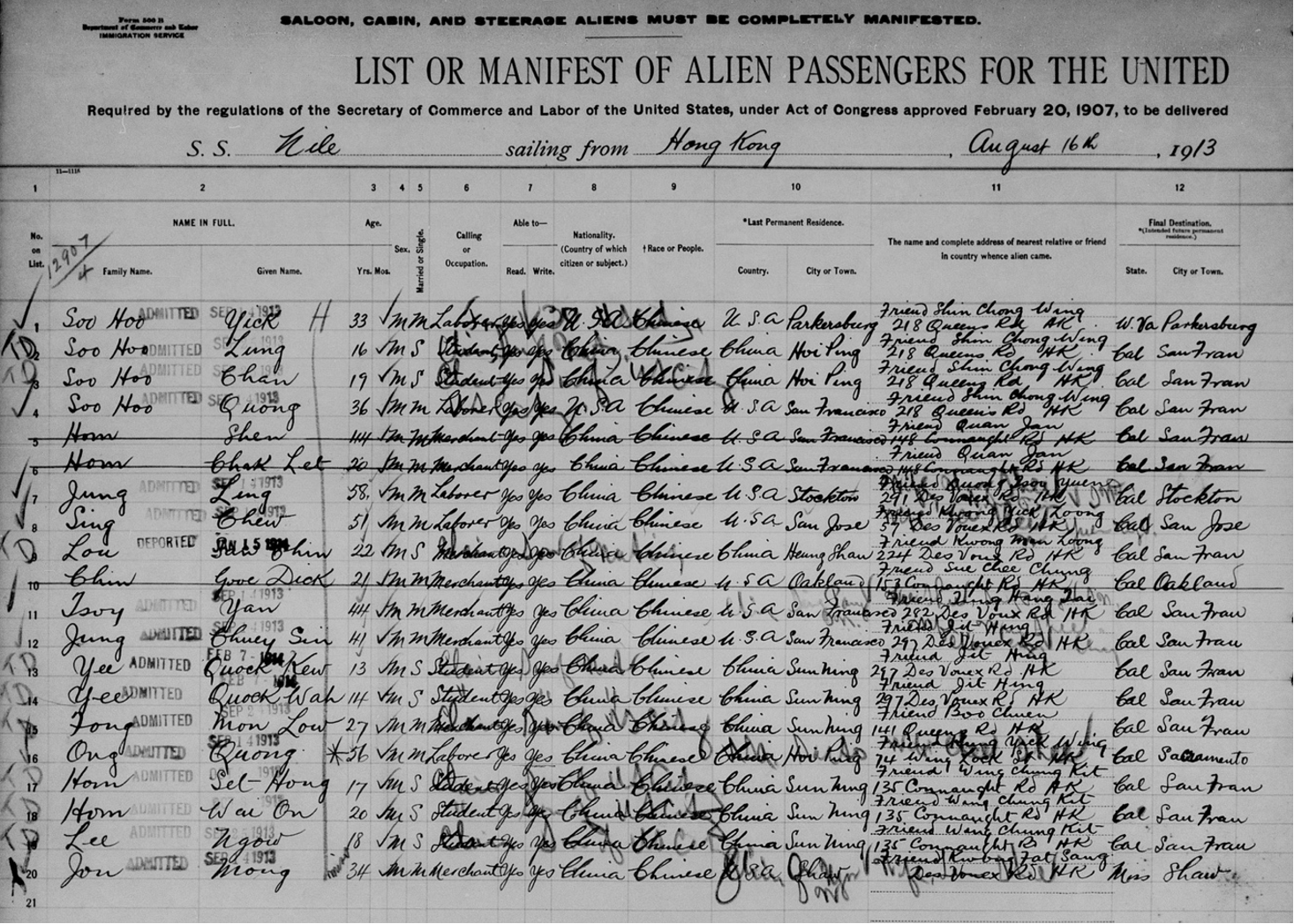
When you find your ancestor, note the five-digit ship number written or stamped at the top of this page. This is the first part of the case file number (in this case, 12907). Then find the manifest page number and the line number (listed to the left of the person’s name). This will give you the second part of the case file number. So, for Ling Jung, the case number is 129087/004-7.
Note that case file numbers were updated upon subsequent journeys to and from the U.S. So if you know that your ancestor first immigrated to the U.S. in 1910, left to visit family in 1915 and then came back in 1916, the case file number may have changed. You would need to find the passenger list from 1916 and follow the steps above to find the case number.
Once you’ve found the case file number, you can request copies of the records from the National Archives at San Francisco.
Ancestry.com also has free collections specifically relevant to Angel Island and Chinese Exclusion-Era research, including:
- “Chinese Arrival Case Files Index, 1884–1940”
- “Index to Chinese Exclusion Case Files, 1903–1944”
- “Chinese Arriving Passenger Arrivals and Disposition, 1903–1947”
- “Registers of Chinese Laborers Returning to the U.S., 1882–1912”
- “Chinese Immigration Exclusion Act Case Files, 1883–1944”
- “Duplicate Chinese Certificates of Residence, 1901”
Lawsuits
If your ancestor filed a lawsuit related to the Chinese Exclusion Acts, the records of those will be at a NARA research facility. Ancestry.com has an index to these federal cases in its database “US Chinese Immigration Case Files, 1883–1924” under “A331” in the NAID filter. FamilySearch also has a register of federal court cases from 1883 to 1916.
Tool Kit
Websites
- Angel Island Immigration Station Foundation
- Angel Island Immigration Station Poetry
- Angel Island: Immigrant Journeys of Chinese Americans
- NARA: Chinese Immigration and the Chinese in the United States
- Google Arts & Culture: Chinese Poetry of Angel Island
- Google Arts & Culture: An Immigrant’s Journey (San Francisco, 1910-1940)
- Immigration through Angel Island, Digital Public Library of America
- Chinese Emigration and Immigration, FamilySearch
- Angel Island: Research Guides, UC Berkeley Library Resources
- Immigrant Voices: A Project of the Angel Island Immigration Station Foundation
National Archives and Record Administration Early Arrivals Record Search
- National Archives and Records Administration (NARA) Pacific Region (San Francisco)
- USCIS Genealogy Program
Books
- At America’s Gates: Chinese Immigration During the Exclusion Era, 1882-1943 by Erika Lee (University of North Carolina Press)
- Laws Harsh As Tigers: Chinese Immigrants and the Shaping of Modern Immigration Law by Lucy E. Salyer (University of North Carolina Press)
- In Search of Equality: The Chinese Struggle Against Discrimination in Nineteenth-Century America by Charles J. McClain (University of California Press)
- Chinese American Names: Tradition and Transition by Emma Woo Louie (McFarland & Company)
- Entry Denied: Exclusion and the Chinese Community in America, 1882-1943 by Sucheng Chan (Temple University Press)
- San Francisco’s Chinatown by Judy Young and the Chinese Historical Society of America (Arcadia Publishing, 2016)
- Immigration at the Golden Gate: Passenger Ships, Exclusion and Angel Island by Robert Eric Barde (Praeger, 2008)
A version of this article was published online in June 2026.
Related Reads


Author

Katharine Korte Andrew MS/LIS is a digital editor for Family Tree Magazine and professional genealogist.