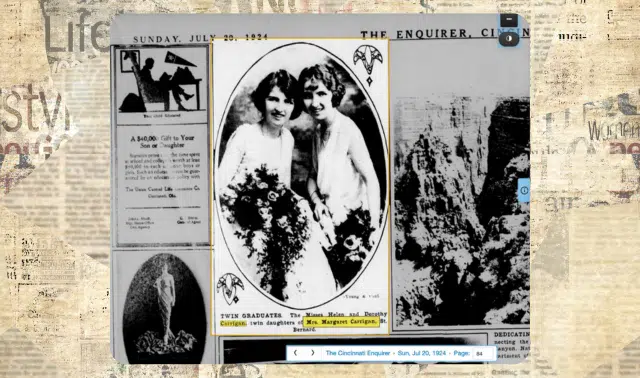

As your family tree grows, keeping track of who you’ve researched and who still needs attention can become just as challenging as the research itself. If you’ve ever wished you could stick a brightly colored sticky-note on your ancestor in your family tree with reminders like “military service,” “brick wall” or “needs more research,” you’re not alone.
Ancestry.com offers several tools that can help turn your family tree into more of working research space. MyTreeTags let you label and sort people in your tree, Ideas can suggest possible next steps, and Stickies give you a place to leave flexible reminders, tasks and notes tied to one or more people. Used together, these features can help you organize your research directly within your Ancestry.com family tree instead of relying on a separate spreadsheet, a stack of browser tabs or your memory.
Whether you’re tracking direct ancestors, DNA connections, unfinished research or just want to organize the people in your family tree file a little bit more, the following tools can help you spend less time searching through your tree and more time making discoveries.
MyTreeTags: Filters for Ancestry.com Profiles
MyTreeTags are labels that you can assign to people in your Ancestry.com family tree. Unlike notes or comments, MyTreeTags appear directly on a person’s card within each tree view available on Ancestry.com, which makes them useful when you want to spot important information at a glance instead of digging through the Notes field or trying to remember where you left off.
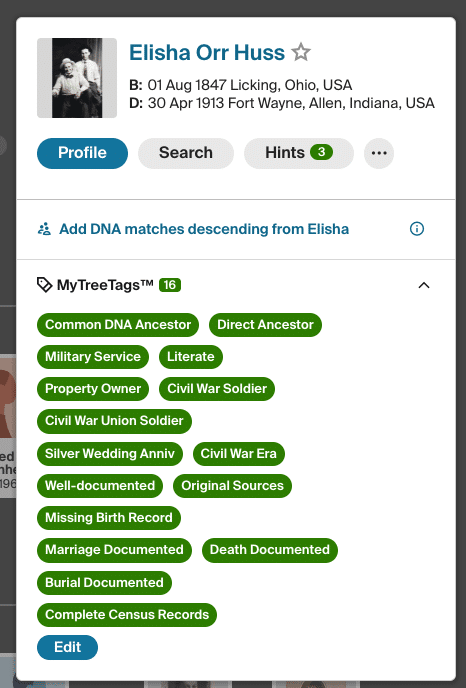
What are universal and custom tags
There are two kinds of MyTreeTags:
- Universal tags: standard tags available to everyone with an Ancestry.com membership.
- Custom tags: tags that you create and only appear in your tree. These only appear in that tree and don’t transfer between trees or accounts.
Only you and people you invited to edit your tree can attach, detach, edit, create or delete the tags. People you’ve invited as contributors or guests can see the tags, but not change them. (This also applies if your tree is public.)
Here’s what Ancestry.com’s MyTreeTags workspace looks like within an individual’s profile:
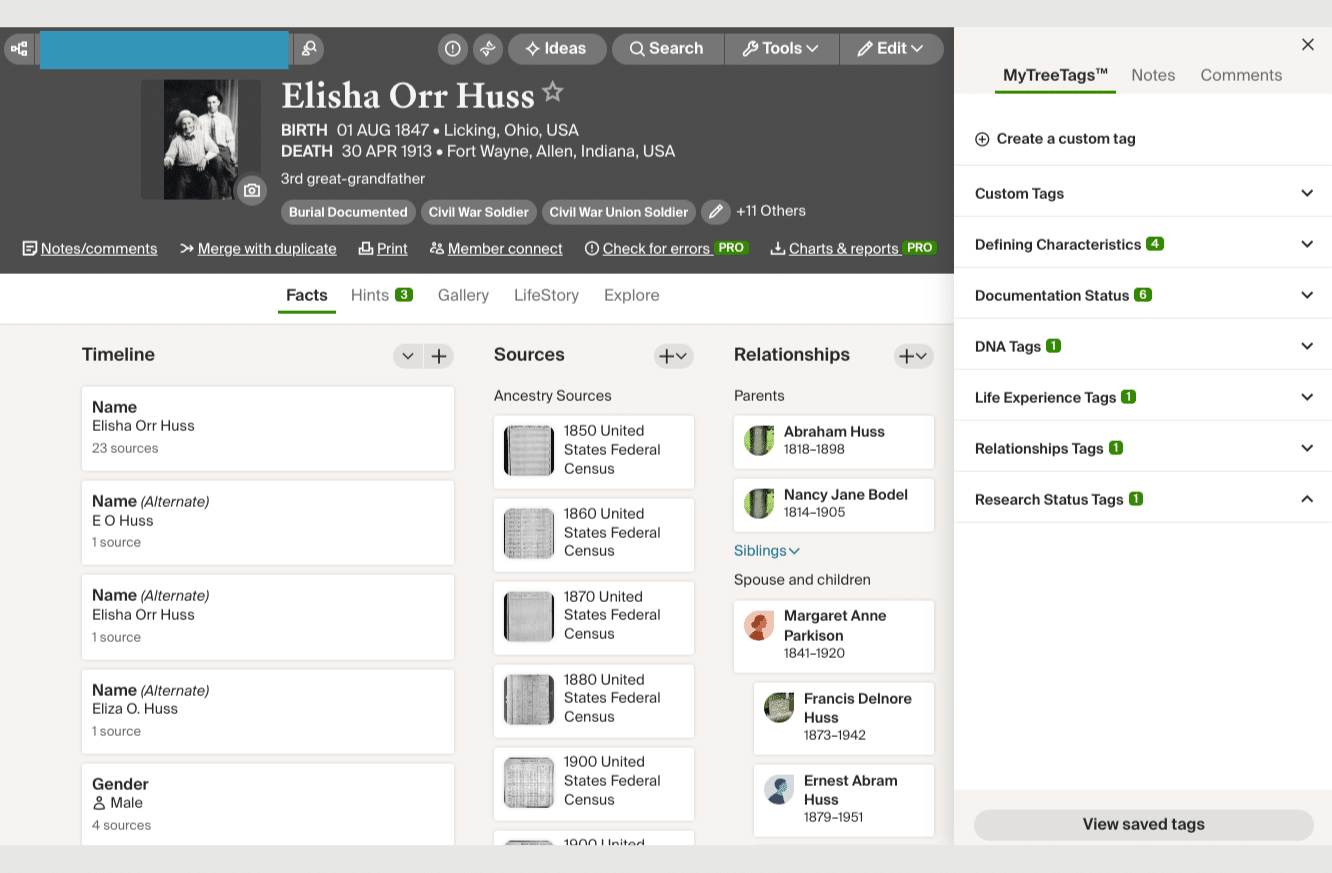
Ancestry.com has a large amount of universal tag options already built in to MyTreeTags grouped into categories:
- Defining Characteristics: Blind, Civil War Confederate Soldier, Civil War Era, Civil War Soldier, Civil War Union Soldier, Deaf, Died in Accident, Died in Epidemic, Died in Infancy, Died in War, Economic Mobility, Employer, Golden Wedding Anniv, Great Depression, Korean War Soldier, Large Family (8+ children), Literacy Acquisition, Literate, Lived in One Region, Long Marriage, Married Multiple Times, Property Owner, Reconstruction Era, Revolutionary Soldier, Revolutionary War Era, Silver Wedding Anniv, US Colored Troops, War of 1812 Soldier, Widow, Widower, WWI Era, WWI Soldier, WWII Era, WWII Soldier
- Documentation Status: Birth Documented, Burial Documented, Complete Census Records, Death Documented, Marriage Documented, Missing Birth Record, Missing Burial Event, Missing Census Records, Missing Death Record, Missing Marriage Record, Original Sources, Secondary Source, Single Source
- DNA Tags: Common DNA Ancestor, DNA Match, and DNA Connection
- Life Experience Tags: Enslaved Person, Free Person of Color, Immigrant, Indentured Servant, Military Service, Royalty/Nobility, Slave Owner
- Relationship Tags: Adopted Into this Family, Adopted Out of This Family, Died Young, Direct Ancestor, Multiple Spouses, Never Married, No Children, Orphan
- Research Status Tags: Actively Researching, Brick Wall, Complete, Hypothesis, Minimal Documentation, No Documentation, Partially Documented, Prioritized Person, To Do, Unverified, Verified, Well-documented
If you don’t know whether a specific universal Tag applies to your ancestor, click the ? button next to the tag and you can read a brief description.
Custom Tags are where MyTreeTags becomes flexible for your research process. You can create Custom Tags for virtually any purpose. You can also create custom MyTreeTags in the “Custom Tags” category. You can create all kinds of tags: “tuberculosis,” “possibly connected but unsure,” “institutionalized,” “changed name,” or any other descriptor you want to highlight or by which you’d like the ability to sort (occupations or cause of death—whatever themes seem to run in your family). Once you’ve created the tag, you can apply it to as many people as you would like.
A word of caution: Before you start creating custom tags, think about the categories you will actually use. A few, consistent tags are much more helpful than dozens of oddly specific ones that you’ll forget about later. For example, instead of creating separate tags for “possibly born in Ohio,” “maybe Ohio” and “Ohio???” choose one clear tag like “Birthplace Question.” You’ll appreciate the restraint in the future.
Why use MyTreeTags?
MyTreeTags are useful because the feature lets you build your research and organizational system into the Ancestry.com family tree itself. Instead of relying on a separate spreadsheet, a list of bookmarked websites or the very dangerous assumption that “Future You” will remember what “Past You” was doing, you can mark your steps visibly where you are already researching.
For example, if you are working on researching an immigrant ancestor, you might want to add MyTreeTags like “Immigrant,” “Missing Birth Record” and “Actively Researching.” That way, when you return to this person later, you don’t have to re-read the entire profile to remember where you left off in your research. The tags will immediately tell you what you need to know, what you still need and what kind of research problem that you are dealing with.
How to add MyTreeTags and filter for ancestors
To apply tags to your tree open a person’s individual profile within your Ancestry.com family tree and click “Add Tags.” You can also do this from the family tree viewer. From there, you can choose from the universal tags, create a custom tag or apply custom tags that you’ve already created. To go back and edit them (or add more) later, you can press “Edit” next to the applied tags.
Additionally, finding people within your family using MyTreeTags by filtering them. You can use the tags to filter your tree and pull up groups of people who share the same tag, which means you can quickly find every “Brick Wall,” all “Common DNA Ancestor” or every individual you marked as “Missing Death Record” without clicking through your tree one person at a time. You can filter individuals using the “Find” toolbar or through the “List of all people.”
Ancestry.com Ideas: Research Suggestions
MyTreeTags are also connected to Ancestry.com’s new AI-powered beta feature, Ideas. As of writing (July 2026), only subscribing Ancestry.com members in the United States can access Ideas on the website (not yet available on the mobile app).
“Ideas” help users “get ideas” for their next-steps in their research. When you view an ancestor’s profile in the family tree, you can click the new “Ideas” button near the top of the page. When clicked, the Ideas feature will analyze an ancestor, their records and timeline, and their family connections to generate personalized suggestions for your research.
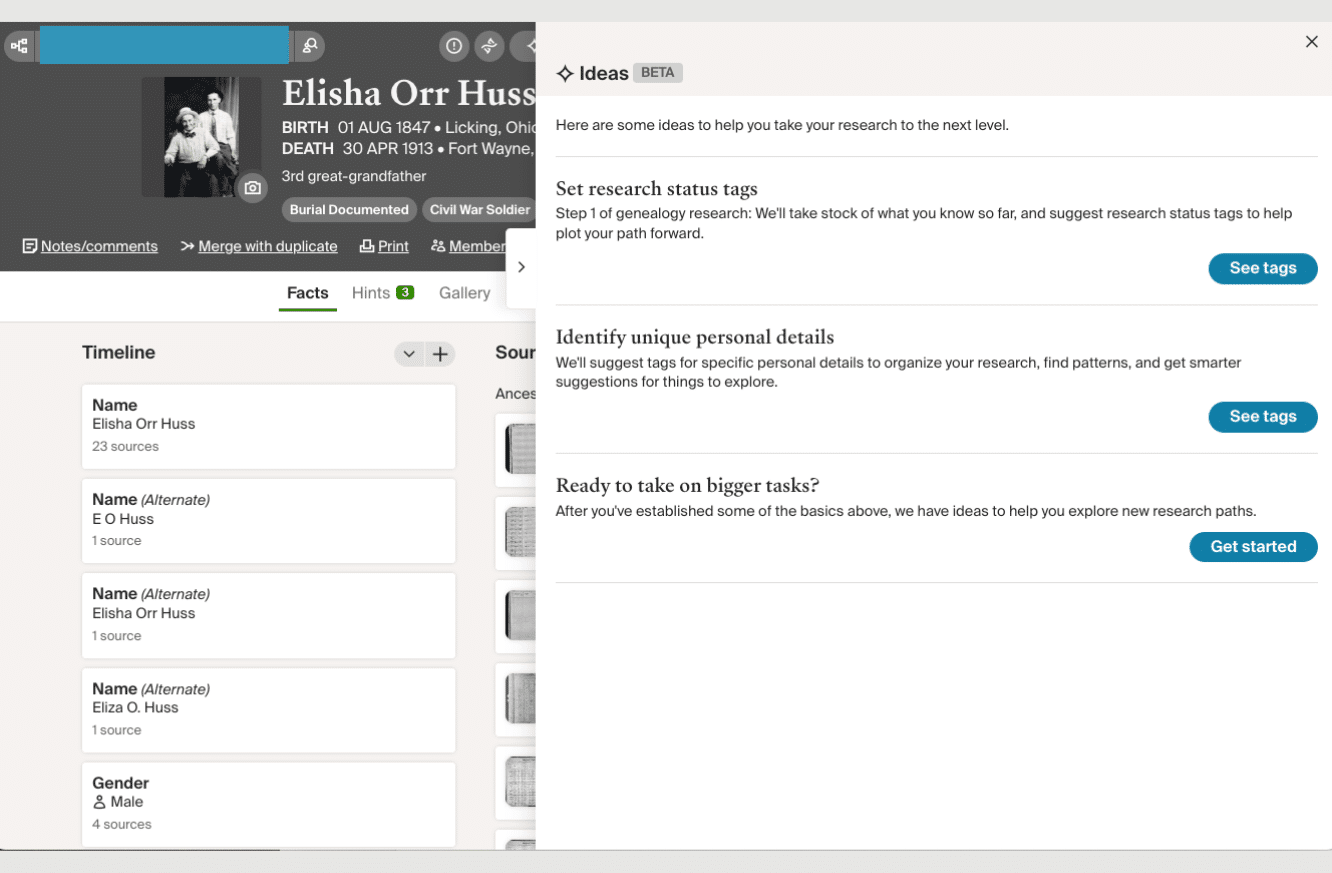
According to Ancestry.com, “this AI-powered feature adjusts its personalized recommendations based on actions you take as you continue your research. The “to-do” list isn’t static—it automatically updates when you make changes to your MyTreeTags, tags, etc.”
Ideas will recommend two kinds of tags to apply to a person’s profile: research status tags that show where you are in your research and where to focus your time; and identity tags, which capture the personal details found in records and can help adjust your research efforts. (For example, “never married” or “literate.”) Each suggested tag that you apply comes with an action plan, which gives you steps you can take to continue the research.
Once you feel ready to take on bigger tasks after identifying MyTreeTags with Ideas, you can click “Get started” under “Ready to take on bigger tasks?” and the Ideas feature will recommend several research paths based on its an analysis of your ancestor. You can copy the action plans into the Notes section of the profile for future reference or use the Stickies future to track your progress.
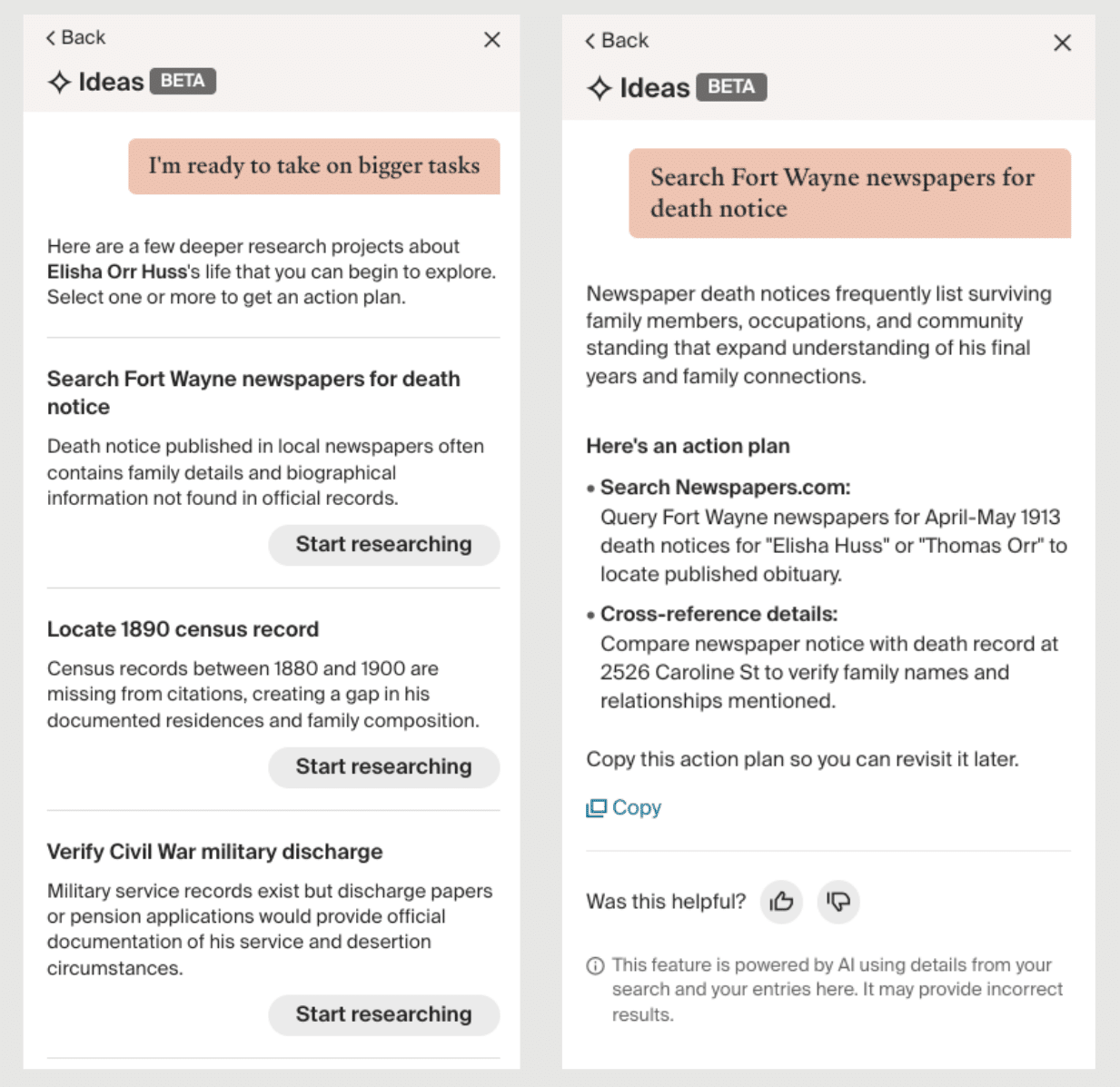
As with any AI-powered feature, treat Ideas as a tool, not as a final authority. The suggestions that it generates can be helpful for identifying missing records or giving you a place to start when you’re not sure what to do next. But AI can also misinterpret information, miss important context or make suggestions that don’t fully fit your ancestor’s time period, place or circumstances. Before applying a suggested tag or following an action plan, take some time to review the attached records and decide whether the suggestion actually makes sense. “The computer said so” is not the same as proof.
Stickies: Quick Notes for Your Ancestors
Stickies are another new feature available to Ancestry.com members and a quick way to track tasks, discoveries and research to-dos.
Unlike Comments, Stickies are visible only to you. Even if your tree is public or shared, other users can’t see them. That makes Stickies useful for reminders, next steps, tentative ideas and the half-finished thoughts that don’t necessarily need to live in a public comment.
To access Stickies click on Tools > “View notes.” There, you will find the ability to add Stickies. Within the sticky, you can also embed links, add bullet-pointed lists, and format the text. This is a useful departure from Ancestry.com’s “Notes” field, which doesn’t function like a full text editor. You can also attach a sticky to multiple individuals in your tree, add a date or location, and set Research Status Tags by clicking “Add Info.”
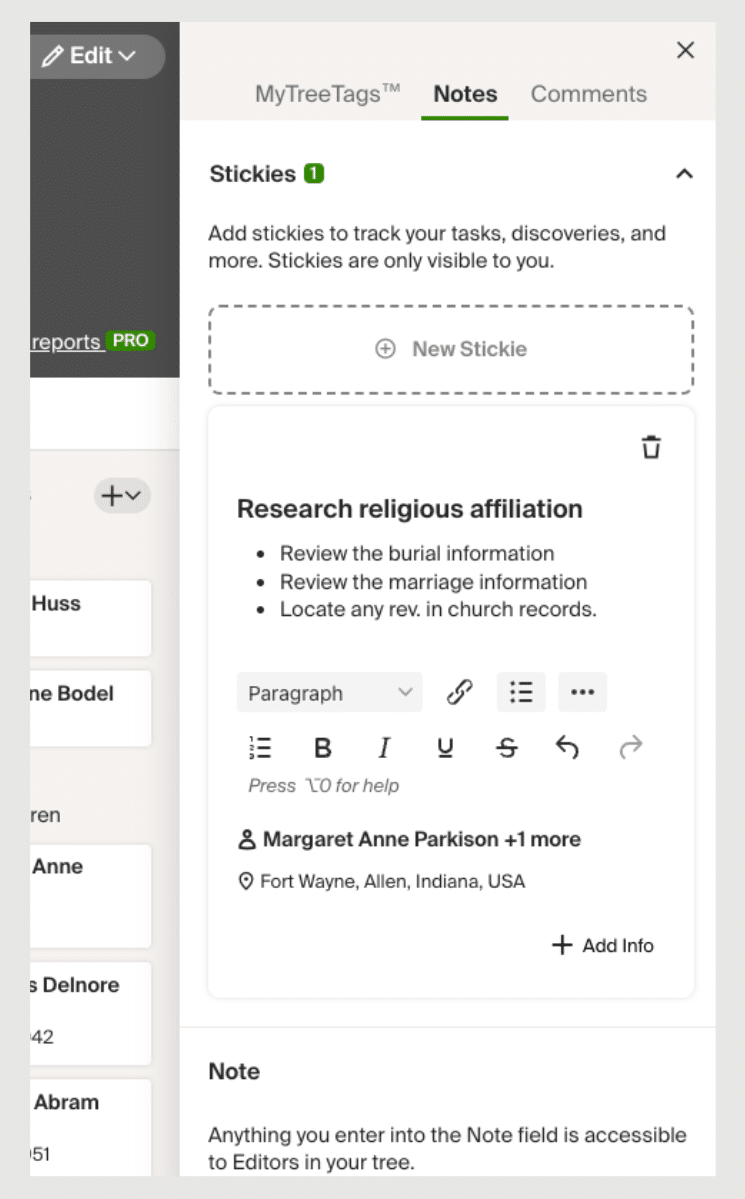
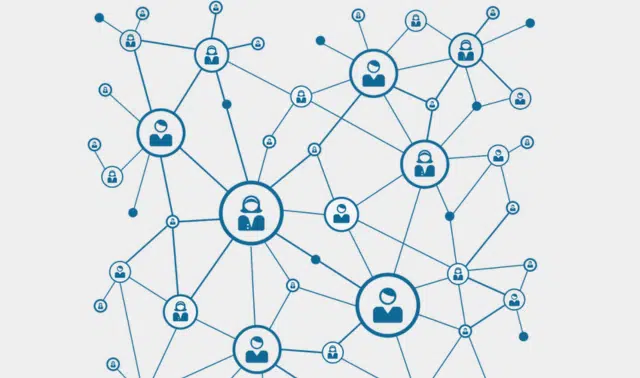
Notably, Stickies are compatible with another Ancestry.com Pro Tools beta feature: Networks. When working within the Networks system, you can add a single sticky across all the people in the Network. This is helpful for when you are working with a group of people that needs to be researched together, share similarities or you are using the FAN Club method (cluster genealogy).
Because Ideas, Stickies and Networks are all newer or beta features, their availability, appearance and exact wording may change. Make sure to check your own account for the most current options.
A similar article about MyTreeTags by Sunny Jane Morton was published online in February 2019. This updated article was published online in July 2026.
Related Reads


Author

Katharine Korte Andrew MS/LIS is a digital editor for Family Tree Magazine and professional genealogist.