

Knowing the genealogy lingo is the first step for many family historians. It’s helpful for beginner genealogists to learn the difference between a library, a repository and an archive.
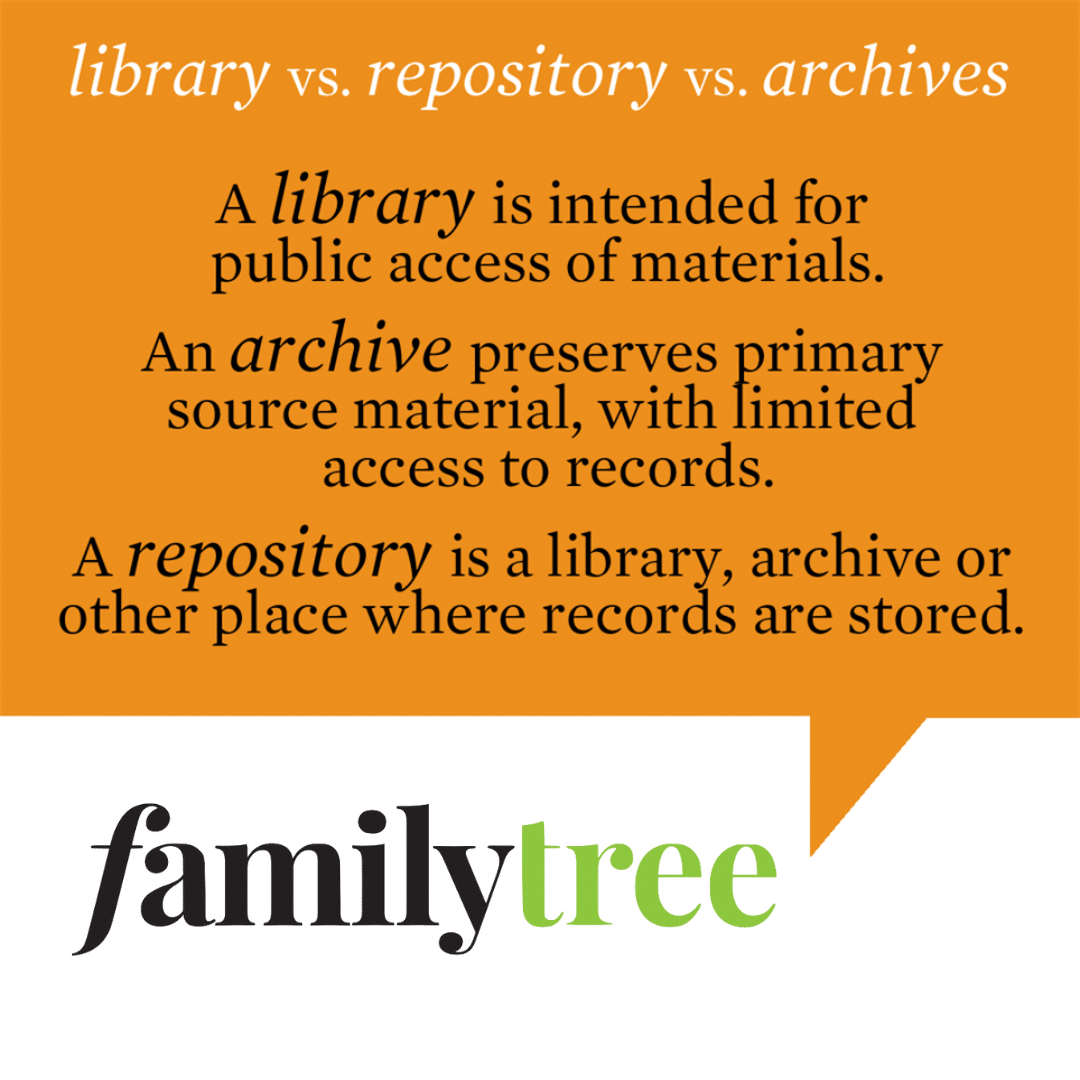
A library is a repository, but a repository may not be a library.
A repository is any place records are stored for safekeeping. Many digital repositories can be accessed online. Repositories are still present in the real, bricks-and-mortar world, though. The difference between visiting a repository and a library is that a library is intended for public use for research and leisure, and (usually) allows items to be checked out, with a library card. A repository may or may not allow checking out of materials.
So what’s an archive?
An archive also is a type of repository, but with a focus mainly on non-current primary records—those created at the time the related event occurred. In addition, an archive usually does not allow material to be checked out. An archive’s main goal is to do just that: archive. There’s little to no general circulation of the materials. Of course, there’s overlap in the type of holdings and the functions of these institutions, and you’ll likely find yourself using all three as you discover your family history.
See? Not so complicated!
Related Reads


A version of this article was posted online in October 2016. Last updated: November 2025