

by James M. Beidler AND Katy Bodenhorn
Pennsylvania was the most religiously and ethnically diverse of the original Thirteen Colonies. Philadelphia, its largest city, was the top port of arrival during the 1700s and remained an important entry point well into the 20th century.
After growing enormously in the 19th century and serving as the nation’s breadbasket before the Midwest was settled, Pennsylvania had a wealth of coal and timber that made it a center of industry and a magnet for immigrants of many ethnicities. As a result, many people across the U.S. have at least one ancestor who stepped foot in Pennsylvania.
Here’s how you can research them.
Table of Contents

Pennsylvania Genealogy Fast Facts
- STATEHOOD: 1787
- US TERRITORY OR COLONY SETTLED: 1682
- FIRST FEDERAL CENSUS: 1790
- CONTACT FOR VITAL RECORDS: Pennsylvania Department of Health
Division of Vital Recordscs - AVAILABLE STATE CENSUSES (OR SIMILAR): Colonial, 1671, 1857 (Chester Co. only); tax records
- PUBLIC-LAND OR STATE-LAND STATE: State
- BIRTH AND DEATH RECORDS BEGIN: 1852/1893 (county); 1906 (state)
- MARRIAGE RECORDS BEGIN: 1852 (county); never statewide

Pennsylvania State History
Native American nations such as the Lenni Lenape and Susquehannock inhabited Pennsylvania for centuries, with some Shawnee bands also settling in the region. The Delaware River Valley was a battleground between colonizing European nations beginning in the 1630s: first by Sweden (1638–1655), then the Netherlands (1655–1664,1673) and finally the English (from 1674).
English King Charles II saw an opportunity in 1681 to solve two issues at once. By bestowing a charter for “Pennsylvania” (Latin for “Penn’s woods”) on the son of Admiral William Penn, he could cancel out a debt to Penn and deal with dissent from the Religious Society of Friends (nicknamed Quakers), of which the younger namesake Penn was a member.
Penn founded a colony based on religious toleration—making Pennsylvania one of the few American colonies not to have an established church. The opportunity for land (and, secondarily, religious tolerance) led many German-speaking people to Pennsylvania, in addition to Scots-Irish and other British Isles denizens.
The German-speaking immigrants brought with them a variety of Protestant traditions: Lutheran, Reformed, Anabaptists (Amish, Mennonites, Church of the Brethren), Moravians (Unity of the Brethren) and Schwenkfelders. Dominance by the pacifist Quakers began to recede during the French and Indian War (1754–1763), when a militia was first organized.
Under the English, border conflicts dogged Pennsylvania. The province included modern Delaware, but three other colonies (Virginia, Connecticut and Maryland) all claimed land near their respective regions.
The colony’s southern border with Maryland had to be established by the Mason-Dixon line in 1767. Meanwhile, hundreds of Connecticut settlers received land in Pennsylvania in defense of Connecticut’s “sea to sea” charter.
Little more than a decade later, the colony was a hotbed for independence and served as the meeting point for the Continental Congress. Colonial leaders signed the Declaration of Independence in Philadelphia; the city’s Independence Hall and Liberty Bell remain two famous symbols of American independence.
After the Revolutionary War, the city played host again in 1787 when the new U.S. Constitution was debated; Pennsylvania was the second state to ratify the new governing document. Though many Pennsylvanians stayed put, others went westward into Ohio, the Midwest, and eventually across the continent.
Enslavement was legal in Pennsylvania in Colonial times, but the Gradual Abolition Act passed in 1780 led to emancipation for newly born children of registered enslaved people at age 28.
In fact, Philadelphia has a prominent role in Black history. The city hosted an early and robust abolition movement, and its location as the first major “free” city north of the Mason-Dixon line made it a crucial stop on the Underground Railroad.
By the 19th century, coal mining and steelmaking in Pennsylvania attracted many immigrants from Southern and Eastern Europe as well as Ireland. And the Great Migration of the 20th century brought tens of thousands of African Americans from the South.

Pennsylvania History Timeline
| 1638-1664 | 1674-1701 | 1776-1787 | 1800-1878 |
| 1638 Settlers found New Sweden in the Delaware River Valley | 1674 The English retake control of New Netherland after a brief conflict with the Dutch | 1776 The Second Continental Congress signs the Declaration of Independence in Philadelphia | 1800 The US capital moves from Philadelphia to the newly built Washington, DC |
| 1655 The Dutch capture New Sweden, incorporating it into New Netherland | 1681 King Charles II grants the Province of Pennsylvania to William Penn | 1787 Pennsylvania is the second state to ratify the Constitution | 1878 Lackawanna County is created from Luzerne County, the last major change to Pennsylvania’s county borders |
| 1664 The Dutch cede New Netherland to the English | 1701 The “Lower Counties” (Delaware) gain a legislature independent from Pennsylvania; the two share a governor until 1776 |

Pennsylvania Historic Map
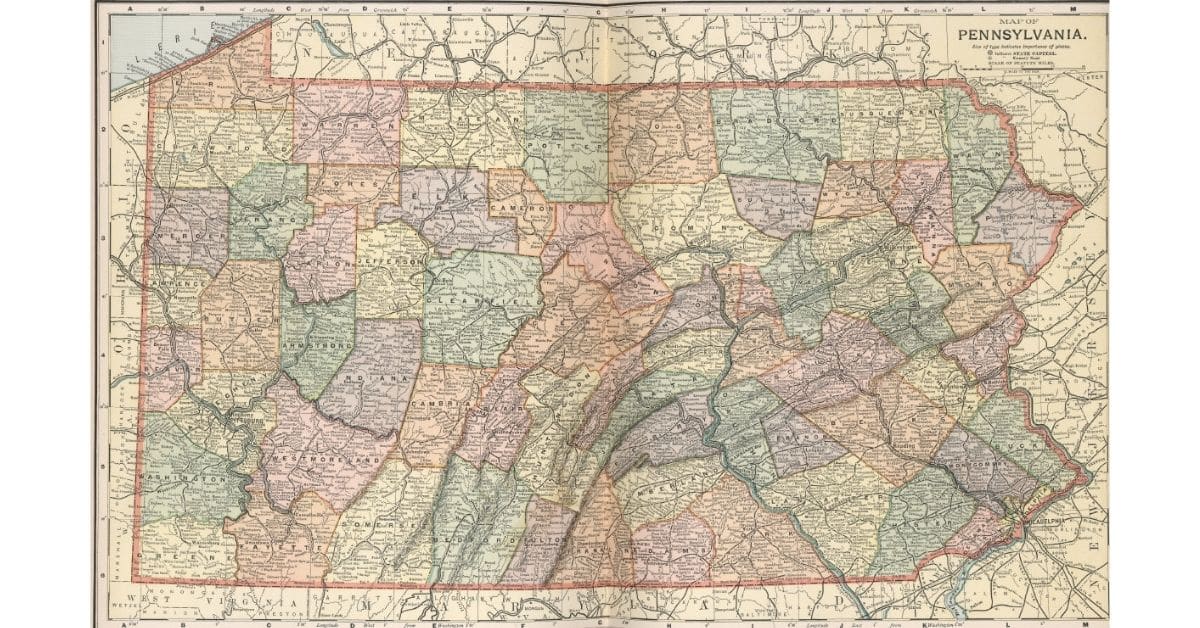
Map of Pennsylvania. Matthews-Northrup Co. Buffalo, New York. 1891. (David Rumsey Map Collection)
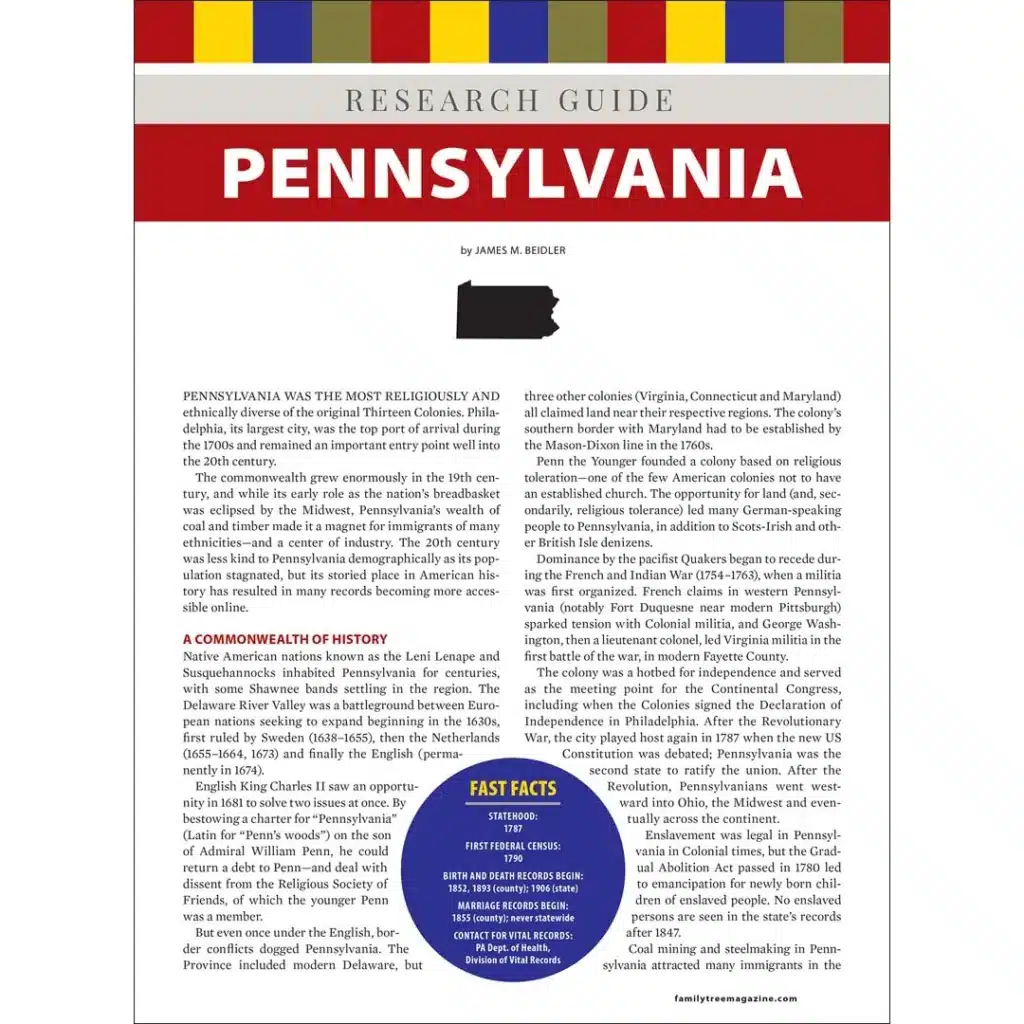
Keep this Pennsylvania genealogy research information handy with a printable PDF! This four-page download includes everything: Pennsylvania’s history and online records, the best websites for genealogists, listings of key libraries, archives and societies that hold the records you need, and a timeline of key events in the state’s history.
Pennsylvania Genealogy Records Online

Vital Records
Pennsylvania has a wide-ranging genealogical infrastructure. Participants include statewide organizations as well as a network of county and local organizations and repositories—many of whom have been helped with digitization by major genealogy players such as FamilySearch and Ancestry.com.
Ancestry.com’s Library Edition, for example, includes major record sets from the Pennsylvania State Archives.
Though a 1682 law required vital record-keeping, only a few early marriage licenses were actually kept and are extant. The first concerted effort at vital records was in 1852, when counties began keeping registers of births, marriages and deaths. However, compliance was low and the law was repealed in 1855; those that have survived are on Ancestry.com. Counties again kept registers of births and deaths from 1893 to 1905.
State certificates for births and deaths begin in 1906, and records become public after 105 years for births and 50 years for deaths. Most public records are on Ancestry.com, and you can view a free index at the state archives. Records still within the blackout periods can be ordered from the department of health by family members or legal representatives.
Counties have kept marriage licenses continuously since 1885. (Note: Pennsylvania does not keep marriage records at the state level.) You can find many of them on FamilySearch and Ancestry.com.
Some larger cities began keeping vital records even earlier than these dates. Find a full timeline of vital records in the Genealogical Society of Pennsylvania’s The Pennsylvania Genealogical Almanac.

Pennsylvania Census Records
Pennsylvania has appeared in every US census, with no major record losses (except for the nationwide loss of the 1890 census). Federal censuses are widely available on genealogy websites.
The state itself took no official state censuses but did take a “Septennial Census” every seven years from 1779 to 1863. Only about 11% of the returns survive (available on Ancestry.com) and their contents more closely resemble a tax list.
Speaking of tax lists: FamilySearch has county tax lists, and Ancestry.com has statewide tax lists (including the detailed 1798 U.S. Direct Tax, nicknamed the “Window Tax”).

Pennsylvania Church Records
Pennsylvania’s history of religious diversity means an abundance of records from churches and their pastors—fortunate, given the state’s spotty 19th-century vital records. The amount of genealogical data and public accessibility of these records varies from denomination to denomination, and even from one congregation to another.
Many church records are in the Ancestry.com collection “Pennsylvania and New Jersey, Church and Town Records, 1708–1985”. Many registers or their transcriptions are available from denominational archives or county historical societies, and Findmypast has digitized some Roman Catholic registers for the southeastern part of the state.

Pennsylvania Land Records
Pennsylvania is a “state land” entity, with a rich, complex patchwork of distribution methods and documentation, particularly before the Revolution. The Pennsylvania State Archives have digitized many of their holdings of original land transactions. Also online are state-produced “warrantee township maps” (connected surveys showing original land purchases and purchasers); southeastern counties as well as Philadelphia are being mapped.
Many county recorders of deeds have digitized their holdings, though the collections range from free access to “pay per view.” More and more of the early county-level deeds are also available through FamilySearch’s full-text search that can be used to access names that aren’t in the traditional grantee-and-grantor indexes.

Pennsylvania Immigration and Naturalization Records
Philadelphia passenger arrival lists from 1800 are held by the National Archives and available at FamilySearch, Ancestry.com and Findmypast. Pennsylvania required oaths of allegiance of foreign (non-British) men 16 and older during the Colonial era, which were published as Pennsylvania German Pioneers. (Ancestry.com has a searchable version online.)
Likewise, with a large population of non-British residents who needed to become subjects, Pennsylvania has naturalizations from Colonial times; see M.S. Giuseppi’s Naturalizations of Foreign Protestants. Prior to 1906, many local and county courts created citizenship documents.

Ohio State Publications and Resources
NEWSPAPERS
The press of Pennsylvania—particularly of English- and German-language publications but also other ethnic tongues—is well-represented on free sites like Penn State’s Pennsylvania Newspaper Archive and Chronicling America, as well as subscription sites such as Newspapers.com and GenealogyBank. The State Library of Pennsylvania is a leading clearinghouse for newspapers.

Pennsylvania Genealogy Resources
WEBSITES
GENEALOGY BOOKS AND PUBLICATIONS*
- Guide to African American Resources at the Pennsylvania State Archives by Ruth E. Hodges (Pennsylvania Historical and Museum Commission)
- Guide to Genealogical Sources at the Pennsylvania State Archives by Robert M. Dructor (Pennsylvania Historical and Museum Commission)
- The Pennsylvania Genealogical Almanac, No. 1, 2024 edition (Genealogical Society of Pennsylvania)
- Pennsylvania Births series by John T. Humphrey (Humphrey Publications)
- Pennsylvania Land Records: A History and Guide for Research by Donna Bingham Munger (Rowman & Littlevield Publishers)
- Research in Pennsylvania, third edition by Kay Haviland Freilich (National Genealogical Society)
GENEALOGY SOCIETIES AND ARCHIVES
- Blair County Genealogical Society
- Genealogical Society of Pennsylvania
- Historical Society of Pennsylvania
- Lutheran Archives Center
- Mennonite Heritage Center
- National Archives at Philadelphia
- Pennsylvania State Archives
- Philadelphia City Archives
- Presbyterian Historical Society
- State Library of Pennsylvania
- Western Pennsylvania Genealogical Society
*FamilyTreeMagazine.com is a participant in the Amazon Associates Program, an affiliate advertising program. It provides a means for this site to earn advertising fees, by advertising and linking to Amazon and affiliated websites.
Last Updated: November 2026