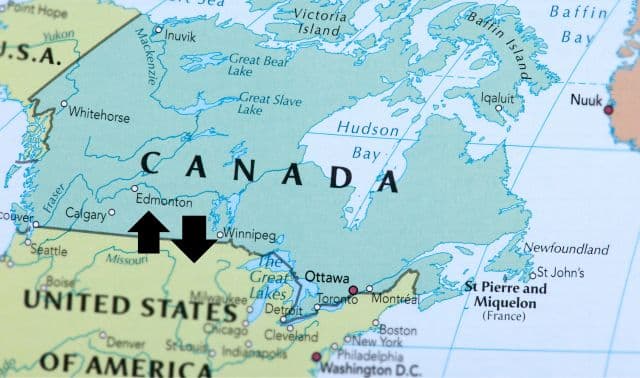
The United States – Canadian border is the longest boundary in the world with more than 8,800 miles of land, shared history, commerce, and family ties. The United States just celebrated its 250th anniversary of the war called the “American Revolution” or the “American War of Independence” and the beginning of the creation of the country that became the United States of America. Some don’t know how the border between the countries was created. The formation of this northern border evolved in tandem with the formation of two great nations – Canada and the United States. Touching eight provinces and thirteen states, this boundary is remarkable! According to the Sovereign Limits site:
More than 8,000 monuments and reference points and 1,000 survey control sites – maintained by the International Boundary Commission – dot the United States–Canada border. The boundary can be legally crossed via 119 official border crossing sites, six unstaffed road crossings, thirteen international ferries and thirty-nine rail crossings, as well as by air and sea.
History of the Creation of the Boundary
Prior to the American Revolution, there was no boundary designated between the British-controlled territory of what became Canada and the lands of the colonies of Britain in what became the United States, except a designation in the 1763 Treaty of Paris making the 45th Parallel the boundary of the Quebec Colony and New York (which included what is now Vermont). Trade, hunting, fishing, and travel between these territories was open, unregulated, and often the locations of skirmishes with Indigenous people or those attempting to create a business territory for the fur trade or other commerce.
In 1763 Treaty of Paris, the British formally took control of the colony of Canada from the French and renamed the territory the Province of Quebec. Through Parliamentary action, the territory of the Province of Quebec included the Ohio and Illinois “Countries” and the Great Lakes region, east to the Appalachian Mountains, and west to the Mississippi. The northern area extended into lands held by the Hudson’s Bay Company, referred to as “Rupert’s Land.”
It wasn’t until another Treaty of Paris was signed in 1783, when the American colonies were recognized by Great Britain as an independent nation called the United States of America, ending the American Revolution. This treaty included provisions for the delineation of the boundaries that would allow for American western growth and development. The 45th Parallel figured heavily in this negotiation as it had been a boundary agreed upon in the 1763 Treaty of Paris for the line between what was then the colony of New York (which included what would also become Vermont) shared above. The St. Lawrence River was the boundary between the U.S. and what became Ontario, then extended west to the Great Lakes where the lakes were split between the countries and then west from Lake Superior to the Mississippi, through Lake of the Woods (a dispute about this northern boundary eventually became the 49th Parallel.
In the new negotiations in 1794, in the Jay Treaty, the International Boundary Commission was formed when British troops were removed from Detroit and other frontier posts in the United States territories. According to the International Boundary Commission’s website:
In 1794, the Jay Treaty created a Commission to determine the location and source of the St. Croix River. A Commission was mandated in 1858 to survey the border west of the Rocky Mountains and, in 1872 a Commission was set up to survey the border west of Lake of the Woods.
Over the years, twenty agreements, conventions, and treaties between four sovereign nations (the United States, Canada, the United Kingdom, and Russia) have been negotiated to define the border as people moved westward and then north.
By the 1846 Oregon Treaty, the 49th Parallel was used for the border in the west, from the Rocky Mountains to the Pacific Ocean, giving the U.S. land that would become Washington and Oregon, while Britain kept Vancouver Island and north.
By 1908, the International Boundary Commission’s work was temporarily focused on boundary adjustments, previous treaty survey works, and further delineation of water boundaries. In the Treaty of 1925, the International Boundary Commission was established to permanently maintain the international boundary.
Populations That Moved Across the Borders
For as long as humans populated North America, there has been movement back and forth in the continent. There weren’t lines drawn in the dirt nor buoys in the water, or guards to keep some in and others out. First Nations/Indigenous people intermarried and formed confederations and alliances to guard natural resources for their people. Protection from others hunting or harvesting created friction that resulted in partnerships of tribal nations to protect what they had, share what they wanted and keep out those who wished them harm.
With the advent of European exploration, fishing and settlements, alliances and coalitions were key. The French and English settlements in the eastern part of the continent were seeking the furs, timber and fishing opportunities of North America as well as religious and financial freedoms in addition to the land – freedoms that were scarce in Europe. The concept of land ownership was not something the First Nations/Indigenous people held and the Europeans either “bought” lands (again, Indigenous people didn’t believe that land could be sold) or stole them. Growing populations, European conflicts that impacted the North American settlements (the Seven Years’ War, conflicts between French and English settlements and more), and incursion of fishing and timber claims, with later gold rushes and other mining operations, pitted populations and nations against each other. Out west, the Pacific coast was impacted by Spanish and Russian settlements and explorations.
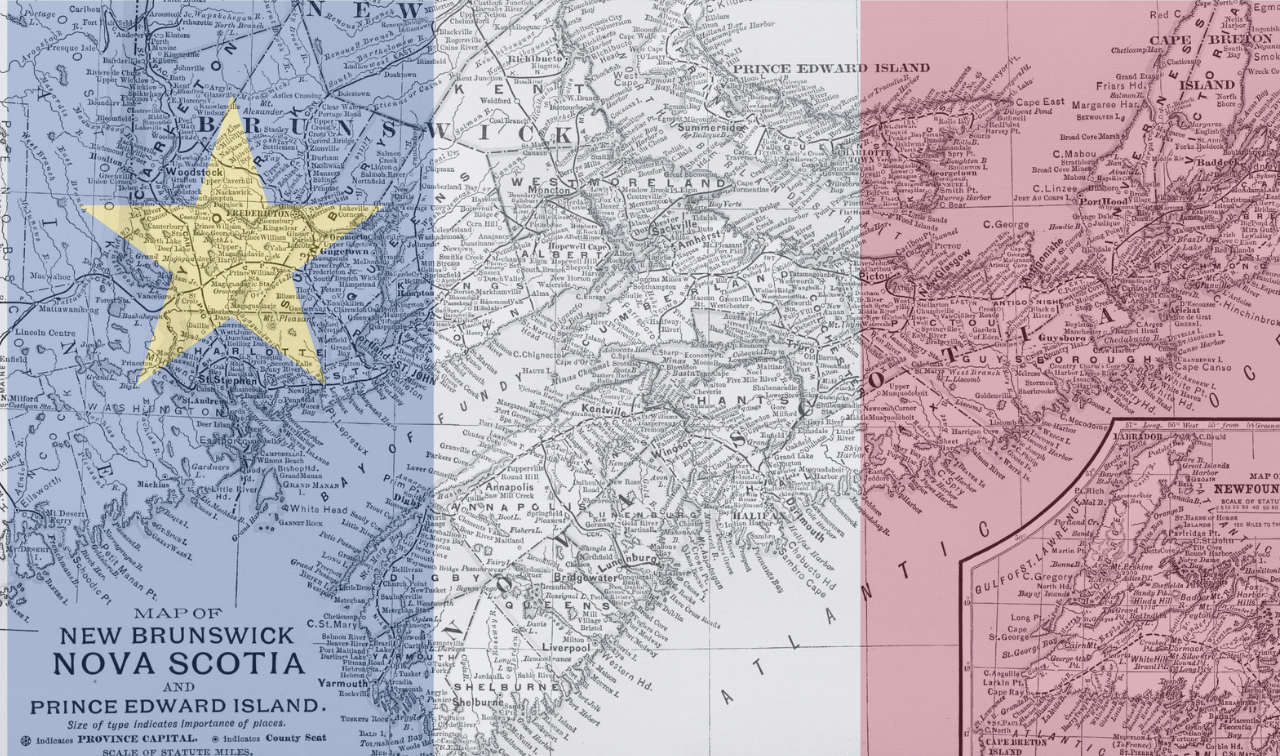
Examples of population movements include the spiritual/migratory journey of the Anishinaabe from the east coast to the upper Great Lakes. The fur trade that flourished from Quebec to Montreal expanded west into Detroit, Lake Superior, Green Bay and beyond. French Acadians were forcibly deported from Nova Scotia in the mid-1700s to the English colonies of the east coast, France, and Louisiana. New England “Planters” moved north to the lands of the Acadians.
During the Revolutionary War, British Loyalists escaped to the north (principally Ontario) for safety from the Patriots of the colonies, and later Black Loyalists from the colonies settled in Nova Scotia and New Brunswick. Russians entered the fur trade on the west coast and up into what was to become western Canada and Alaska in direct competition with Hudson’s Bay Company and the American Fur Company.
To fully understand your ancestors and their migrations and border crossings, it is necessary to learn the regional and national histories of the times that your relatives lived, including the political changes that are documented in records. For the Acadians, mentioned above, there were at least six changes of government from French to British and back again. Canada and the United States, in more modern times, created immigration “quotas” and limitations on certain population groups.
Record Types and Where to Find Them
Treaty & Survey Records
These records include the International Boundary Commission maps, survey notebooks and a variety of correspondence and treaty histories.
Immigration and Crossing Records
The United States began recording border crossings in 1895. In this era, half of immigrants to Canada later went to the United States. With over one hundred crossing locations, it is now possible to investigate records created from this time through locations that your ancestors may have journeyed. C
The National Archive and Records Administration (NARA) and the Library of Congress can offer context, information and lists of records, photographs and reports.
On Ancestry.com, over 4 million arrivals from 1895 to 1956 are named on “St. Albans Lists” (these are not just records of the crossing at the St. Albans, Vermont border but the naming convention recognized this collection that was stored at that location; many border crossing locations are documented) available through Ancestry.com. These include:
- US Border Crossings from Canada to U.S., 1895-1960
- Detroit, Michigan, U.S., Border Crossings and Passenger and Crew Lists, 1905-1963
- Canada, Border Crossings from U.S. to Canada, 1908-1935
- U.S., Passenger and Crew Lists for U.S. Bound Vessels Arriving in Canada, 1912-1939 and 1953-1962
For FamilySearch, also be sure to check out the following:
- Research Wiki for “United States, Border Crossings from Canada to the United States”
- FamilySearch Index Cards (Vermont, Franklin, St. Albans, Canadian Border Crossings, 1895-1954, as an example).
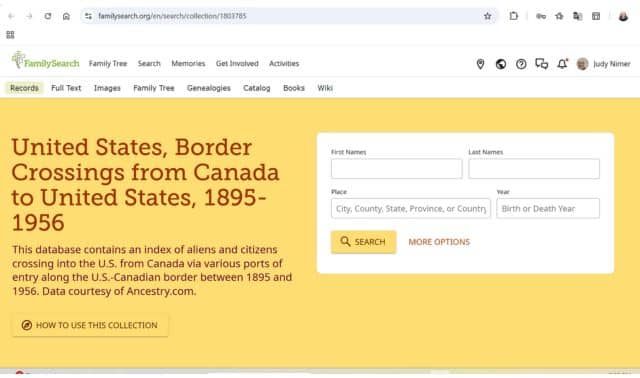
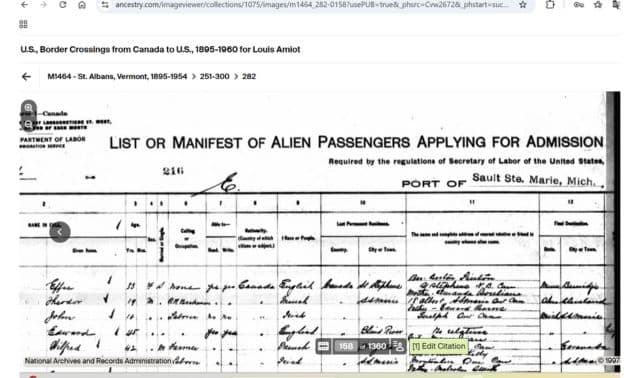
Here, I use a relative as an example: Louis Amiot, who came to the Upper Peninsula of Michigan, through Sault Ste-Marie.
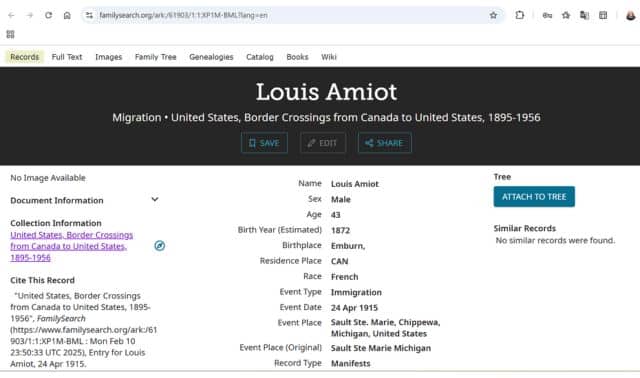
These are examples of the variations of records depending on the location in two different important sites – Ancestry.com and FamilySearch.org. Note that on these images, it is necessary to check the written/typed name of the border entry site! These records for Ancestry and FamilySearch state “St. Albans” in the site’s title, but the actual arrival location is Sault Ste-Marie in Chippewa County, Michigan, not for St. Albans, Vermont. As noted above, the collection references St. Albans, but the records are very much wider coverage (they are stored in St. Albans and, of course, now online!).
For the Library and Archives Canada site, note that prior to April 1908, people were free to move back and forth across the Canadian and U.S. border with no records for these movements in Library and Archives Canada collections. The Library and Archives Canada website is undergoing a gradual transition to pages that are updated so check back periodically.
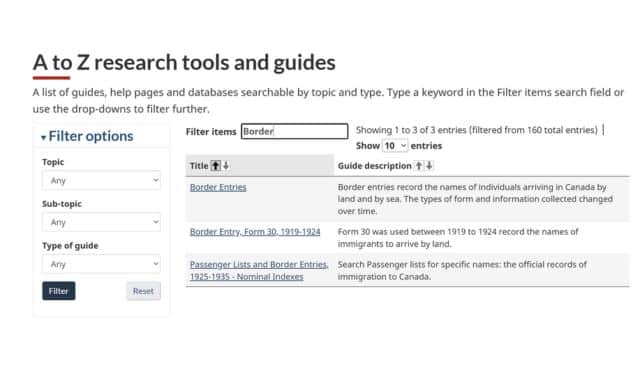
Online sources of families in Canada include the Canadian Research Knowledge Network, which includes Canadiana and Heritage Canadian — both with holdings in the millions of records, with newspapers, government documents, genealogy and border crossing information (using the “search” function).
Local and Regional Sources
Provincial and State Archives are excellent resources for seeking information on patterns of immigration, available records, and compilations of descendants. Canadians and Americans have written about their ancestors and their movements over time, so be sure to utilize large library resources such as FamilySearch regional centers and the local FamilySearch Affiliate libraries.
The Allen County Public Library in Fort Wayne, Indiana holds books and materials donated by families that compile their histories and movements. In New England, be sure to check the New England Historic Genealogical Society/American Ancestors and the New York Genealogical and Biographical Society – both organizations hold records beyond New England as families moved in the country.
Other important collections with cultural, border crossing and fur trade information, trading company records and documents of lawyers/notaries of these northern regions include:
- Detroit Public Library, Burton Collection
- Archives of Michigan
- Wisconsin Historical Society
- Minnesota Historical Society
- North Dakota State Archives
- South Dakota Historical Society & Museum
Moving west, you can look to sources like the Manitoba Historical Society and the British Columbia Archives: Provincial archives in Canada hold many records pertaining to Americans who moved in or out of Canada. Family histories by descendants hold much to help researchers on any side of the border as many Canadian American families moved depending on work, family needs, economic situations and more. For instance, French-Canadian families often went back and forth across the border from Quebec into New England to work in cotton mills, having a home or land where other family lived while wage earners went south for financial reasons.
Here is a sampling of some of the larger provincial resources and special collections of those who crossed the border:
Note: First Nations people are noted in records in these provincial archives and on their own websites and in special research collections.
British Columbia: British Columbia Archives and its genealogy page.
Manitoba: Manitoba Historical Society and the Archives of Manitoba, which includes the Hudson’s Bay Company Archives.
Nova Scotia: Nova Scotia Archives with specific pages and information for Mi’kmaq, Gaelic Nova Scotians, African Nova Scotians, Acadians and more (use main page link above, scroll down to special pages).
Ontario: Archives of Ontario, Library of Toronto, and nearby Toronto location of the United Empire Loyalists Association of Canada
Quebec: Bibliothèque et Archives nationales du Québec (Genealogy page and locations)
Bibliography (and Further Reading)
Books
- The Peoples of Canada: A Pre-Confederation History by J. M. Bumsted (4th edition, Oxford University Press, 2003)
- North American Border Conflicts: Race, Politics, and Ethics by Laurence Armand French and Magdaleno Manzanarez (1st edition, Routledge, 2017)
- Lines Drawn Upon the Water: First Nations and the Great Lakes and Borderlands edited by Karl S. Hele (Reprint, Wilfrid Laurier University Press, 2016)
- The Founding of a Nation: A History of the American Revolution 1763–1776 by Merrill Jensen (Oxford University Press, 1968)
- The Divided Ground: Indians, Settlers, and the Northern Borderland of the American Revolution by Alan Taylor (Vintage, 2007)
- Frontiers and Boundaries in Canada: Studies in Political Geography by Mary Tivy (UBC Press, 2011)
Articles
- “Over the Borderline” by Sunny Jane Morton, Family Tree Magazine, September 2018.
- “The Border: Canada, the US and Despatches from the 49th Parallel”(review) by Allen Smith, Canadian Historical Review 85 (4): 879-881. (Jan 2005).
- “Imagining the Border: Mapping the U.S.–Canada Boundary, 1783–1903” by Robert Sweeny, Canadian Historical Review 87, no. 1 (2006): 1–25.
A version of this article was published online in November 2025. Last updated: May 2026
Related Reads