
What do the Wright Brothers, Doris Day, John Glenn, LeBron James, William McKinley, Neil Armstrong, Gloria Steinem, Thomas Edison, Jack Nicklaus, and Ulysses S. Grant have in common? All hail from Ohio, the seventh most-populous US state.
From its beginnings as the first western frontier to a modern hub of commerce and education, Ohio has played a key role in American history. Today, millions of people throughout the world can find Buckeyes in their family trees. If you’re one of them, use our guide to discover their records and stories.
Table of Contents

Ohio Genealogy Fast Facts
- STATEHOOD: 1803
- US TERRITORY OR COLONY SETTLED: Part of the Northwest Territory, 1787
- FIRST FEDERAL CENSUS: 1800 (fragments), 1820 (extant)
- AVAILABLE STATE CENSUSES (OR SIMILAR): 1803-1911 (quadrennial voter “censuses”)
- PUBLIC-LAND OR STATE-LAND STATE: Public
- BIRTH AND DEATH RECORDS BEGIN: 1867 (counties), 1908 (state)
- MARRIAGE RECORDS BEGIN: upon county establishment; 1949 (state)
- CONTACT FOR VITAL RECORDS: Ohio Department of Health Vital Statistics

Ohio State History
FRONTIER DAYS
Native American villages dotted the river valleys and dense forests between Lake Erie and the Ohio River in colonial times. The names that the Miami, Shawnee, Delaware, Seneca, Iroquois, Wyandot, Tuscarora and Ottawa tribes gave to many Ohio rivers endure today—the word “Ohio” itself is Iroquois for “great river.”
French fur traders and British surveyors found abundant game and fertile land, but frequent conflicts prevented settlement until after the American Revolution. In 1787, the newly formed US government created the Northwest Territory out of land ceded by Britain after the Revolution. The act set Ohio, along with Illinois, Indiana, Michigan and Wisconsin, on the path to statehood. The Ohio Company of Associates ventured the first permanent US settlement in the territory, Marietta, in 1788.
Revolutionary War bounty land warrants and the chance to buy public land drew pioneers from New England and other eastern states. Ohio’s early settlers also included scores of immigrants from Germany, Great Britain and Ireland.
Its population booming, Ohio became the 17th state in 1803. Officials selected land to build a new capital city, Columbus, in 1812, amid the backdrop of the War of 1812. Migration into Ohio continued to swell with the construction of new transportation routes. By 1825, the Erie Canal delivered families from as far as the Hudson River to the shores of Lake Erie. The Ohio and Erie Canal (1832) expanded that range, and the National Road (1825–1833) allowed more settlers to pass through the state. Some Ohioans followed the frontier as it moved westward to Indiana, Illinois, Missouri, Iowa, and beyond.
GROWTH AND CHANGE
By 1850, Ohio’s population had reached nearly 2 million, and the state was a top producer of wheat, corn and wool. The construction of railroads created new jobs and made exporting products more profitable. A different type of transportation system developed as abolitionists helped slaves pass from entry points along the Ohio River to safety via the Underground Railroad. More than 300,000 Ohioans served in Union forces during the Civil War, making the state the third-largest supplier of troops behind New York and Pennsylvania. After the war, steel, iron, and oil industries developed in Cleveland and the Mahoning Valley. Miners in eastern Ohio worked to meet the demand for coal. Glass, rubber, electric, paper, machinery, and other businesses drove the growth of cities. Factory jobs attracted thousands of immigrants to the state, particularly from Germany, Poland, Hungary, Russia, Italy and Scandinavia, including many of the Jewish faith. Southern African Americans added to the new arrivals as they migrated north to fill factory jobs.
Approximately 200,000 Ohioans served in World War I. A generation later, more than 800,000 Ohio men and women served in World War II. The postwar years brought suburban expansion and interstate highways. Today, technology, education, health care, retail, transportation and service-based businesses have become increasingly important to the state’s economy.

Ohio History Timeline
| 1600 | 1700 | 1800-1832 | 1835-1896 |
| 1650s The Iroquois Confederacy claims Ohio country after defeating local tribe | 1763 France cedes its land east of the Mississippi to Great Britain; King George III forbids Colonial settlement there | 1800 Connecticut cedes the Western Reserve; the land is incorporated into the Northwest Territory | 1835 Ohio and the Michigan Territory wage the mostly bloodless Toledo War over a strip of land at their border |
| 1660s The French claim Ohio as part of New France; French explorers become the first Europeans to visit the region | 1783 The Northwest Ordinance is passed, organizing the US territory north and west of the Ohio River | 1803 Ohio joins the Union as the 17th state | 1896 The last revision is made to Ohio’s county boundaries; some borders had shifted throughout the 1800 |
| 1795 A coalition of Native American tribes formally cedes the Northwest Territory to the United States | 1832 The Ohio and Erie Canal links the Ohio River at Portsmouth with Lake Erie |

Ohio Historic Map
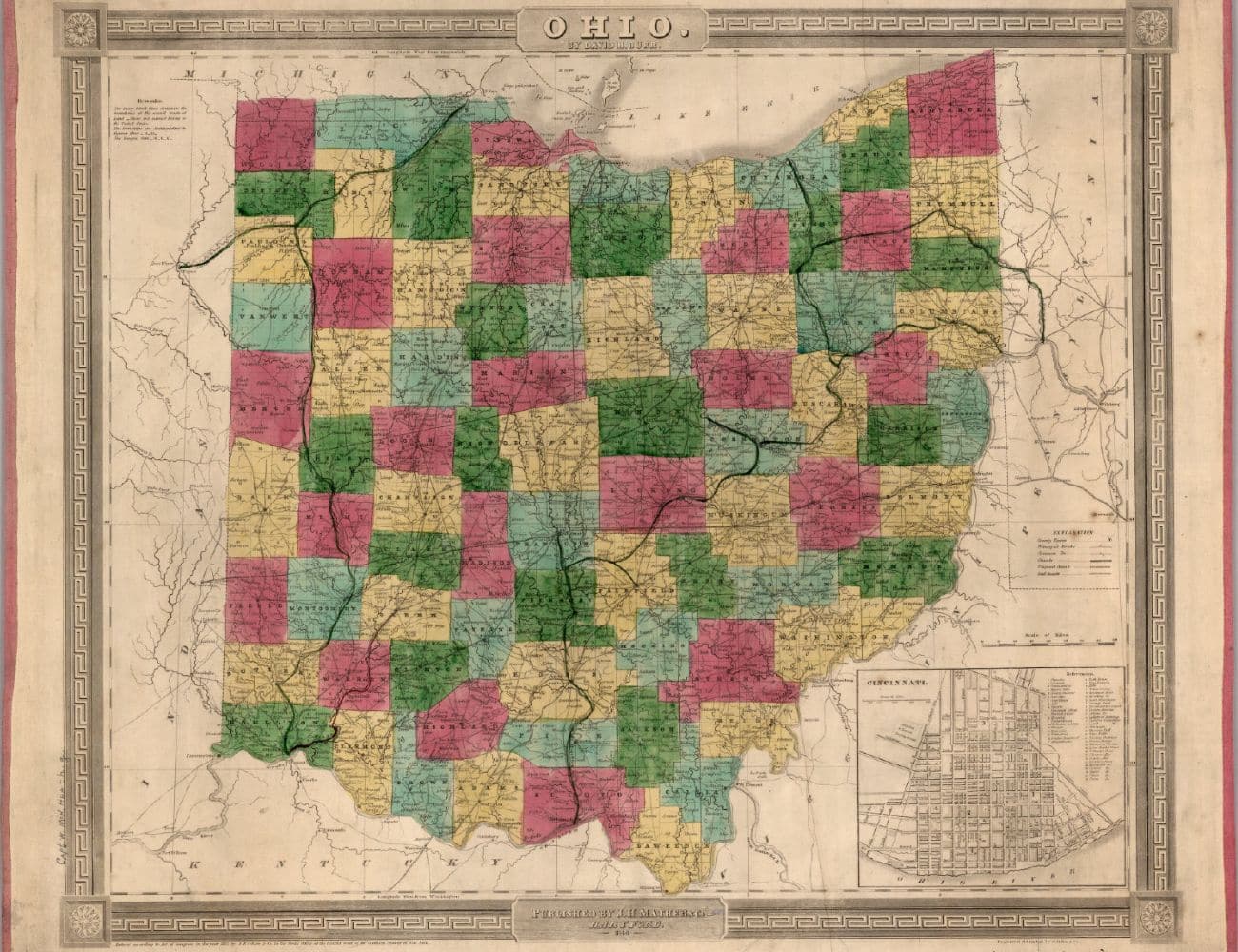
Ohio. By David H. Burr. Published By J.H. Matheer & Co. Hartford. 1846. (David Rumsey Map Collection)

Keep this Ohio genealogy research information handy with a printable PDF! This four-page download includes everything: Ohio’s history and online records, the best websites for genealogists, listings of key libraries, archives and societies that hold the records you need, and a timeline of key events in the state’s history.
Ohio Genealogy Records Online

Vital Records
BIRTH AND DEATH RECORDS
Most of Ohio’s 88 counties have birth and death records from 1867. But these records are incomplete until late 1908, when state registration became mandatory. Nearly all surviving county registers have now been digitized. FamilySearch has collections of both birth and death registers: (births) and (deaths).
The state began issuing birth and death certificates on 20 December 1908. Original birth records are not available online, but Ancestry.com offers an “Ohio, Birth Index, 1908–2003” collection that serves as a finding aid. Copies of birth certificates can be ordered from the Bureau of Vital Statistics.
State death records issued through 1953 can be viewed at FamilySearch. Search for and order death certificates from 1913 to 1935 and 1954 to 1970 at the “Ohio Death Records Index Search” at the Ohio History Connection (the state archives). Note that birth records more than 125 years old and death records more than 50 years old are held by the Ohio History Connection. Unlike other states, Ohio does not have privacy restrictions regarding who may request copies of vital records.
MARRIAGE RECORDS
Ohio counties created marriage records from the time they were established, starting in the 1790s. Marriage records are still kept at the county level, though the state also began registering marriages in 1949. You can view many records online at FamilySearch. Ancestry.com and MyHeritage provide indexes covering various years. To obtain a copy of a marriage record, contact the county probate court.
DIVORCE RECORDS
Divorce records are usually created by the county court of common pleas; early divorce cases were heard by Ohio’s supreme court. Relatively few divorce records have been digitized, though Ancestry and Findmypast offer indexes to help locate some records. Contact the county’s clerk of courts to request a copy.
ADOPTION RECORDS
Access to adoption records is restricted, and no public index exists. Visit here to learn more.

Ohio Census Records
Though modern Ohio appears in the federal census as early as 1800, early census records of Ohio are incomplete. The 1800 and 1810 censuses are lost except for returns of Washington County, so the 1820 census is the first (mostly) intact one of Ohio—just two counties are missing.
Census records of Ohio from 1830 to 1950 are essentially complete. For 1890, only the special veterans schedule and fragments of Hamilton and Clinton County returns survive. Search census records at Ancestry, FamilySearch and MyHeritage.
Ohio did not conduct state censuses. However, look for tax and voter lists, which can serve as substitutes. The FamilySearch Catalog has some tax resources.

Ohio Land Records
Ohio was a great land experiment. The state was initially carved up into several districts, each with their own ways of measuring and distributing land. So when researching an early Ohio settler, it’s crucial to understand the area he lived in. Download the state auditor’s free publication, The Official Ohio Lands Book, to learn more. Much of the state was measured using the new rectangular survey system, which subdivided land into ranges, townships and sections. Land offices handled the sale of county recorder’s office. Check the FamilySearch Catalog using a place search to find digitized land records; many older deeds have been digitized, even if they’re not yet searchable. (Note that county boundaries shifted through the mid-1800s.

Ohio Naturalization Records
Before 1906, immigrants could complete the naturalization process at virtually any Ohio courthouse. The majority of these records have been digitized by FamilySearch. Ancestry.com and MyHeritage also have Ohio naturalization record collections. After 1906, changes in the law required naturalizations to be handled by federal courts. Several Ohio cities have divisions of US district courts; those records are held by the National Archives facility in Chicago. FamilySearch has digitized many district court records created through the mid-1900s.

Ohio State Publications and Resources
NEWSPAPERS
Newspapers proliferated throughout Ohio from the early 1800s on, as both large and small communities relied on them for information. Ohio History Connection (OHC) and libraries throughout the state have original and microfilmed newspaper collections. Archival newspapers held by OHC and other facilities are being uploaded to OhioMemory as they’re digitized, and Ohio papers may also be found on free or subscription sites.
DIRECTORIES
In addition, many Ohio cities and counties produced annual directories of their residents. Digital images of select directories are available at Ancestry.com, Fold3, the Internet Archive, MyHeritage and other sites. You can find a helpful county-by-county listing of Ohio directories, complete with links to online holdings, at www.ldsgenealogy.com/OH/City-Directories.htm.

Ohio Probate Records
Search for pre-1852 Ohio estates in records of the county court of common pleas or chancery court. (Note: Some counties have moved older records to a local archive.) Post-1852 estates can be found in the probate court. FamilySearch has digitized a number of 19th- and 20th-century Ohio will books, estate journals, and guardianship records. Ancestry.com offers select will and probate records.

Ohio Genealogy Resources
WEBSITES
- Cyndi’s List: Ohio
- FamilySearch Research Wiki: Ohio
- Linkpendium: Ohio
- OHGenWeb
- Ohio History Central
- Ohio Memory*
- Ohio Obituary Index
GENEALOGY BOOKS AND PUBLICATIONS*
- Genealogical Research in Ohio, 2nd Edition by Kip Sperry (Genealogical Publishing Co., 2003)
- Ohio Genealogical Research by George Schweitzer (self-published, 1994)
- Ohio Guide to Genealogical Sources by Carol W. Bell (reprint, Genealogical Publishing Co., 2009)
- Ohio Towns and Townships to 1900: A Location Guide by Julie M. Overton, et al. (Ohio Genealogical Society, 2011)
- Ohio Wills and Estates to 1850: An Index by Carol W. Bell (reprint, Genealogical Publishing Co., 2012)
GENEALOGY SOCIETIES AND ARCHIVES
- American Jewish Archives
- Cincinnati and Hamilton County Public Library
- Cleveland Public Library
- Columbus Metropolitan Library
- National Archives at Chicago
- Ohio Genealogical Society
- Ohio History Connection
- Western Reserve Historical Society
*Past Honoree of Family Tree Magazine Best 75 State Websites
*FamilyTreeMagazine.com is a participant in the Amazon Associates Program, an affiliate advertising program. It provides a means for this site to earn advertising fees, by advertising and linking to Amazon and affiliated websites.