This article will cover the history of Acadia and her people, from first settlement to exile to today’s celebration of Acadian culture. Along the way, you’ll learn how to research your ancestors who came from there.
Where is Acadia? Who are the Acadians?
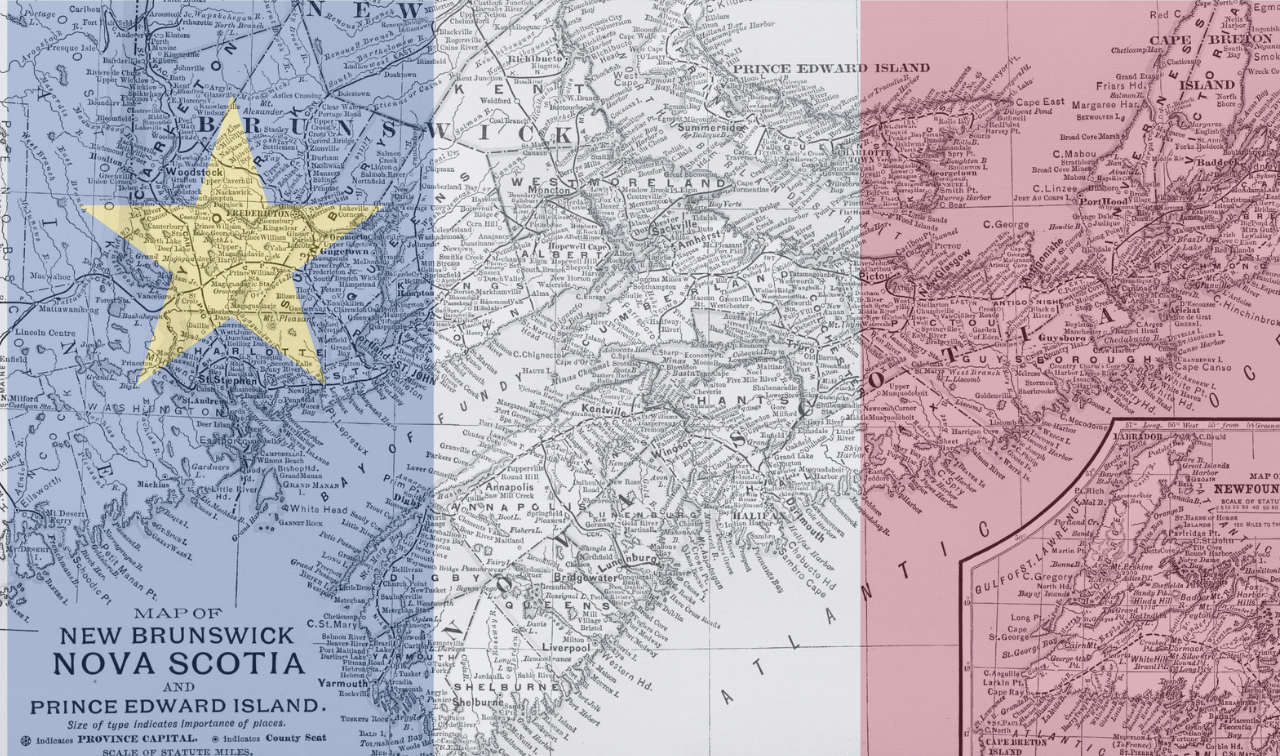
Acadia is a term used for modern-day Nova Scotia, New Brunswick, Prince Edward Island, and parts of Newfoundland and Québec. The people who live there—and those descended from earlier residents, who came to have mixed First Nations and French ancestry—are Acadians.
Note that Acadian and “French-Canadian” are not necessarily interchangeable. The two groups have distinct histories, politics and cultures. Acadians were expelled in the 1750s, suffering significantly different traumas than the French who lived in other parts of Canada (Montreal, Québec City, etc.).
Some Acadians identify only as Acadian. Others descend from Acadians who intermarried with residents of Québec, making them both Acadian and French-Canadian.
Cajun and Creole are other terms for Acadian-related cultures: people in Louisiana and the Gulf Shore region. (Cajun comes from some French-speakers’ pronunciation of “Acadian.”) These are descendants of Acadians who intermarried with locals in their new homes, resulting in a blended ancestry of French, Spanish, African and Indigenous heritages.


Starting Acadian Genealogy Research
Step 1: Learn Acadia’s History
French colonial origins: Explorers first applied the term “Arcadie” to parts of North America in 1524. Then, in the spring of 1604, a band of 75 Frenchmen landed near the mouth of the St. Croix River. Near today’s border between Maine and Canada’s New Brunswick, they established some of the first French settlements in North America. There they met the Mi’kmaq First Nations peoples, who had lived there for millennia. The French colony evolved into Acadia, which changed hands between France and England throughout the 1600s.
English control and the Great Expulsion: The British captured Acadia’s capital of Port-Royal, and in 1713, cemented Acadia’s place as a British territory. Tensions remained high between the resident French-speakers (many of them Catholic) and British colonists (many of whom were Protestant). The result was “Le Grand Dérangement” (the Great Expulsion), in which thousands of Acadians were expelled from Canada. Many traveled to other Francophone territories, notably New Orleans (where they eventually became called “Cajuns”).
Just a few years later in 1763, almost all of French Canada became British territory. And many Loyalists (colonists who sympathized with Great Britain in the American Revolutionary War) settled in Nova Scotia and New Brunswick after the British defeat.
Confederation: Despite the Expulsion, Acadia retained a distinct identity through the following centuries. In 1847, American poet Henry Wadsworth Longfellow wrote Évangéline, a Tale of Acadie about an Acadian girl separated from her love. Over time, Évangéline became a folk hero. Nova Scotia achieved self-governance within the British Empire in 1848. It was one of three provinces that formed the Canadian Confederation in 1867.
Acadia today: Canada achieved full sovereignty in 1982, and remains part of the Commonwealth of Nations. The Crown formally acknowledged the crimes committed against Acadians in 2003, and Congrès Mondial Acadien (Acadian World Congress) convenes every five years, most recently in August 2024.
Visitors to Acadia today know the friendliness of the people, the beauty of its countryside, and the richness of its history. Journeying to those ancient lands—especially as a descendant of both the First Nations and those first French settlers—is unlike any other experience. The region’s dual heritage survives in the Acadian people, music, cuisine, and re-created forts and settlements.
Step 2: Identify your Acadian ancestor
As with any genealogical research, start by learning more about yourself and your immediate family. Find documentation for your parents’ and grandparents’ births, marriages, deaths, places of residence (including in censuses), wills and land records. These “stepping stones” will help you reach further back in time, even if the size and complexity of Acadian families can get you off track fast!
Acadian surnames are one clue that your family descends from that region of today’s Canada. But don’t make the mistake of jumping back in time without researching generation by generation. Those who have Acadian ancestry in the United States can’t simply trace an Acadian surname back to Canada—many families first went to Québec before immigrating to the United States in the 19th or 20th centuries.

Step 3: Find Historical Records
Once you’ve identified your Acadian family, find them in the following types of records. The Nova Scotia Archives have a helpful overview of general Canadian genealogical research.
Censuses
Residents of Acadia were enumerated several times throughout the late 1600s and early 1700s. The Acadian & French Canadian Ancestral Home website hosts transcriptions of censuses relevant to Acadian research. Because these are derivative records, you’ll want to verify with original images (held by Library and Archives Canada and the Nova Scotia Archives).
Descendants of Acadians who returned to Canada may be named in later nationwide censuses, taken throughout the early 1800s and every 10 years from 1851. Search Canadian census records at Library and Archives Canada. Note that what is now Québec was once part of “Lower Canada” (1791–1841), then “Canada East” (1841–1867).
Church records
From the earliest days of settlement, Catholic parishes were important centers of Acadian communities. Jesuit missionaries reached Port-Royal as early as 1611, and St. Jean-Baptiste (founded in 1613) is considered the oldest parish in Canada.
Unfortunately, many church records have been lost throughout Acadia’s turbulent history. However, the Nova Scotia Archives have digitized surviving parish registers from St. Jean-Baptiste. Généalogie Québec’s Drouin Collection contains registers from all over Canada and is available at Ancestry.com.
You can find searchable collections of early Canadian church (and civil) records at FamilySearch under Search > Search by Place. You can drill down to specific provinces and types of records. For example, this collection compiles 18th-century church and civil records from Nova Scotia.
The Drouin Institute also collaborated with Université de Montréal on PRDH-IGD, a pay-as-you-go database of some 3.2 million records from 1621 to 1861. Most are extracted Catholic registers from Québec. Learn how PRDH-IGD compares with Généalogie Québec here.
Published genealogies
As previously stated, the histories of many Acadian families have been documented. Some are “dictionaries” of known residents, notably Dictionnaire généalogique du Québec by René Jetté (Les Presses de l’Université de Montréal) and the seven-volume Dictionnaire généalogique des familles canadiennes by Cyprien Tanguay (available at Ancestry.com).
Jetté’s collection is generally considered more reliable. But Tanguay’s dictionary was the basis for a well-known publication by the Drouin Institute called Dictionnaire national des Canadiens francais or “Red Drouin,” named for the color of its original cover.
A similarly named “Blue Drouin” contains marriage records, mostly from Québec. It’s divided into a 61-volume series for men and a 64-volume series for women.
Both the Red and Blue Drouins are available to search through Généalogie Québec. The American-French Genealogical Society sells versions of each on CD-ROM.
Social media
You’ll find many potential cousins online—so many, in fact, that it can feel overwhelming! Facebook groups for the various Acadian heritage sites mentioned in the next section can help you study surnames and connect with other descendants of Acadians. Gail Dever of “Genealogy a la Carte” has compiled a list of social media pages and websites.
Step 4: Study the Great Expulsion
Acadian history dates back to the early 1600s. But the biggest challenge in Acadian genealogy research is Le Grand Dérangement, or the Great Expulsion. This mass deportation of Acadians from Canada (a culmination of English-French conflict in North America) began in the fall of 1755.
Effects of the Expulsion on Acadians
Acadians swore themselves to neutrality in the French and Indian War (1754–1763). But the English still feared Acadians would take up arms as allies of France. They seized some 10,000 Acadians, burning their homes and confiscating their property.
The Acadians were forced onto ships in deplorable conditions, then shipped abroad: back to France, to the French colonies of Louisiana or the West Indies, to the Thirteen British Colonies along the Atlantic, or even farther. Families were separated—parents from children, and husbands from wives.
Faced with this harsh reality, some left on their own terms. The exiles faced hostility even where they resettled: French-speaking Catholics often living among English-speaking Protestants. You can learn more about their experiences in the Canadian Encyclopedia.
Published histories
This period of history is well documented in the six-volume Histoire et généalogie des acadiens by Bona Arsenault (Leméac) and Dictionnaire généalogique des familles acadiennes by Stephen White (Centre d’Études Acadiennes-Université de Moncton).
Published genealogies, such as the latter, track various settlement groups and individuals over the decades. These often have lineages, vital record transcriptions, maps, and lists of surnames.
These books can be somewhat difficult to find, as they don’t generally circulate. Access them with help from a reference librarian or through WorldCat. They’re often in the collections of communities and states that hosted the Acadian diaspora (especially New England, Louisiana and Michigan) and also throughout Library and Archives Canada and the Archives of Québec.
A Genealogist’s Guide to Visiting Acadia
Nothing replaces the experience of visiting ancestral locations yourself. By seeing the environment in which your ancestors lived, you’ll gain a new appreciation for the hardships they faced.
For example, the tide in Nova Scotia is the highest in the world, putting into perspective what your Acadian ancestors had to deal with when settling and farming. They had to be creative, utilizing aboiteau (specially designed dykes) to drain land and manage water flow. Exhibits from the National Historic Sites of Parks Canada include walking tours and models.
The sections that follow highlight can’t-miss destinations for your trip to Acadia. Find more travel information here, including a “Doers & Dreamers Travel Guide.” And consult the Fodor’s Travel Nova Scotia & Atlantic Canada guide, in its 16th edition as of this writing.
Halifax
The provincial capital of Nova Scotia has excellent Acadian food, music and exhibits.
Points of interest include the Nova Scotia Archives, which have custody of historical records from the province. Learn about early settlement, deportations, and everyday life in Acadian communities. Resources include registers from St. Jean-Baptiste, the oldest parish in Canada .
The Nova Scotia Historical Society once met at the archives, but has since moved its programming online.
About 30 kilometers east of Halifax is Chezzetcook Cove. Acadian and Mi’kmaq families settled here as early as 1688, and the area offers beautiful views of the Atlantic.
Annapolis Royal
This is the site of Fort Anne, Canada’s oldest national historic site that has guided tours collections encompassing both French and English rule . Fort Anne is also the site of the earliest Acadian burials; gravesites aren’t marked, but archeological efforts are attempting to locate graves.
Don’t miss the Annapolis Royal Historic Gardens, which have beautiful walking paths. A re-created Acadian home on the site includes a plaque that names some early Acadian families, a stop for quiet reflection or rest.
Across the Annapolis River is Port Royal, a re-creation of Champlain’s original settlement. Surrounding the fort are the ancient homesites of many ancestors, with some genealogical information available from the Annapolis Heritage Society.
Another nearby highlight, the BelleIsle Hall Acadian Centre, holds artifacts, Acadian culture books and more. It’s on the land of my Savoie ancestors!
Pubnico
Here, you’ll find the Historical Acadian Village of Nova Scotia, as well as an Acadian Museum and Research Center of Pubnico that has published lists of descendants of Acadians who returned to the area after deportation. The latter has artifacts on display that date back hundreds of years.
Clare
The Université Ste-Anne (the only French-immersion institution in the province) is home to a visitor’s center and the Rendez-vous de la Baie. Similar to Pubnico, the Rendez-vous de la Baie chronicles a re-uniting place of Acadians with a museum, art gallery, and cultural programming. Email before visiting to inquire about records of deportees and families who returned.
Grand-Pré
This town was a major center of deportation, brought to wider fame by Henry Wadsworth Longfellow’s epic poem “Évangéline, a Tale of Acadie.” A statue of Évangéline—who became a kind of folk hero to deported Acadians—sits on the lovely grounds of a church. The church’s interior displays records and illustrations of the deportation.
Now a UNESCO World Heritage Site, Grand-Pré can be emotional to visit. It hosts on-site camping, programs through the tourist season, and Acadian family reunions.
Not far away is the Deportation Cross, which stands at the site where boats are believed to have taken deported Acadians to larger ships waiting off the coast.
Cape Breton
To the eastern-most part of the province, the island of Cape Breton provides incredible views of the ocean, mountains and forests. Along its Cabot Trail (a scenic highway) is historic Chéticamp and the Les Trois Pignons Cultural Center that provides information about the Acadians who settled there.
Also on the island is the Fortress of Louisbourg. Historians and re-enactors will help you understand the eras of both the French and English control over this key site.
And nearby Isle Madame can provide a glimpse into the unique culture of Acadians who lived on islands. It hosts an Acadian Day celebration each August 15.
Related Reads


A version of this article appeared in the November/December 2024 issue of Family Tree Magazine. Last updated: June 2026