
Sign up for the Family Tree Newsletter Plus, you’ll receive our 10 Essential Genealogy Research Forms PDF as a special thank you!
Get Your Free Genealogy Forms
"*" indicates required fields
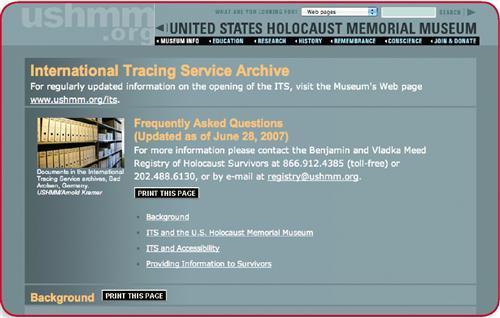
After a long wait, Holocaust survivors and their descendants’ hopes were realized last summer as the first set of digitized records from a major trove of Holocaust-era documents was transferred to the Holocaust Memorial Museum <www.ushmm.org> in Washington, DC.
Allied forces discovered the files at the end of World War II, and stashed them at the International Tracing Service (ITS) set up in Bad Arolsen, Germany, to reunite families separated during the war. The ITS archives — comprising 30 to 50 million pages of documents — include records of camps, prisoner transportation, ghettos and arrests. Nearly 40 million Central Name Index cards contain 17.5 million names from those records.
Spurred by the ITS’ huge backlog of Holocaust survivors’ requests for information about their loved ones, the museum spearheaded a push to open the records. (See <www.ushmm.org/museum/exhibit/focus/its/faq> for more information.)
Now, each of 11 nations in the ITS’ governing commission gets one copy of the archive. As the designated US repository, the Holocaust Memorial Museum receives batches of record images as digitization progresses. The last group should arrive by early 2008.
The records, which are handwritten in a variety of languages, won’t be posted or indexed online. Instead, museum staff is creating a database that will let its archivists quickly respond to requests for information. When it’s up and running, queries from or on behalf of Holocaust survivors will have priority.
ADVERTISEMENT
