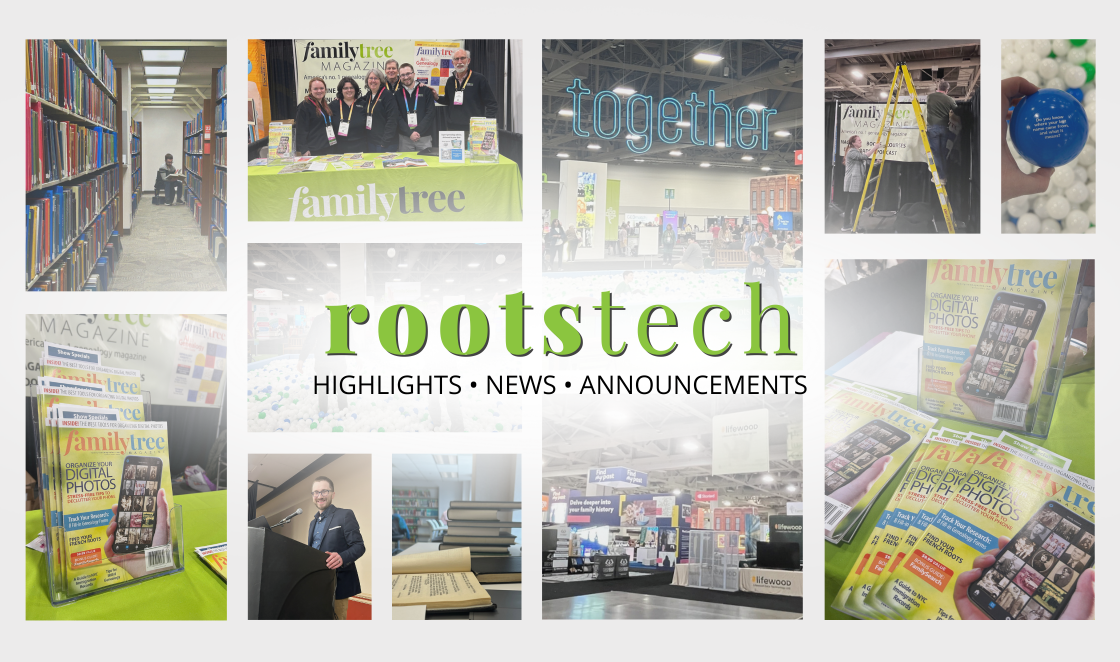
RootsTech is the world’s largest family history and genealogy conference, hosted annually by FamilySearch in Salt Lake City, Utah. Held from March 5 to 7, this year’s conference had the theme “Together”: uniting living people, connecting with ancestors and bringing families together through genealogy research.
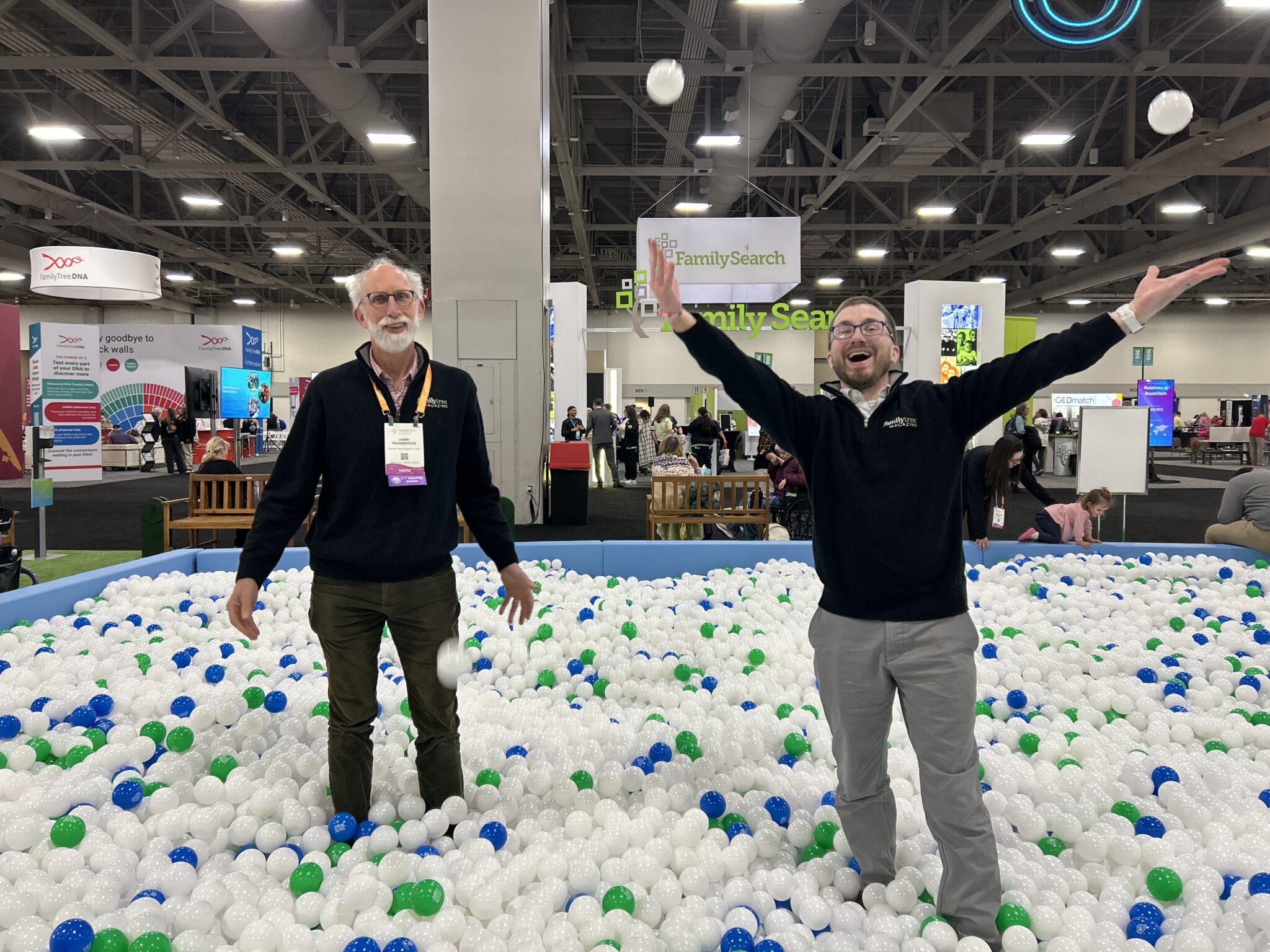
“Together”-ness was reflected not just in the conference’s keynote presentations, but also in an unusual feature of the exhibit hall: a huge ball pit. Many of the pit’s 50,000-plus balls displayed an icebreaker question meant to inspire conversation—even between strangers.
A global event, RootsTech encourages researchers from around the world to hone their skills and share what they’ve discovered.
Family Tree Magazine at RootsTech
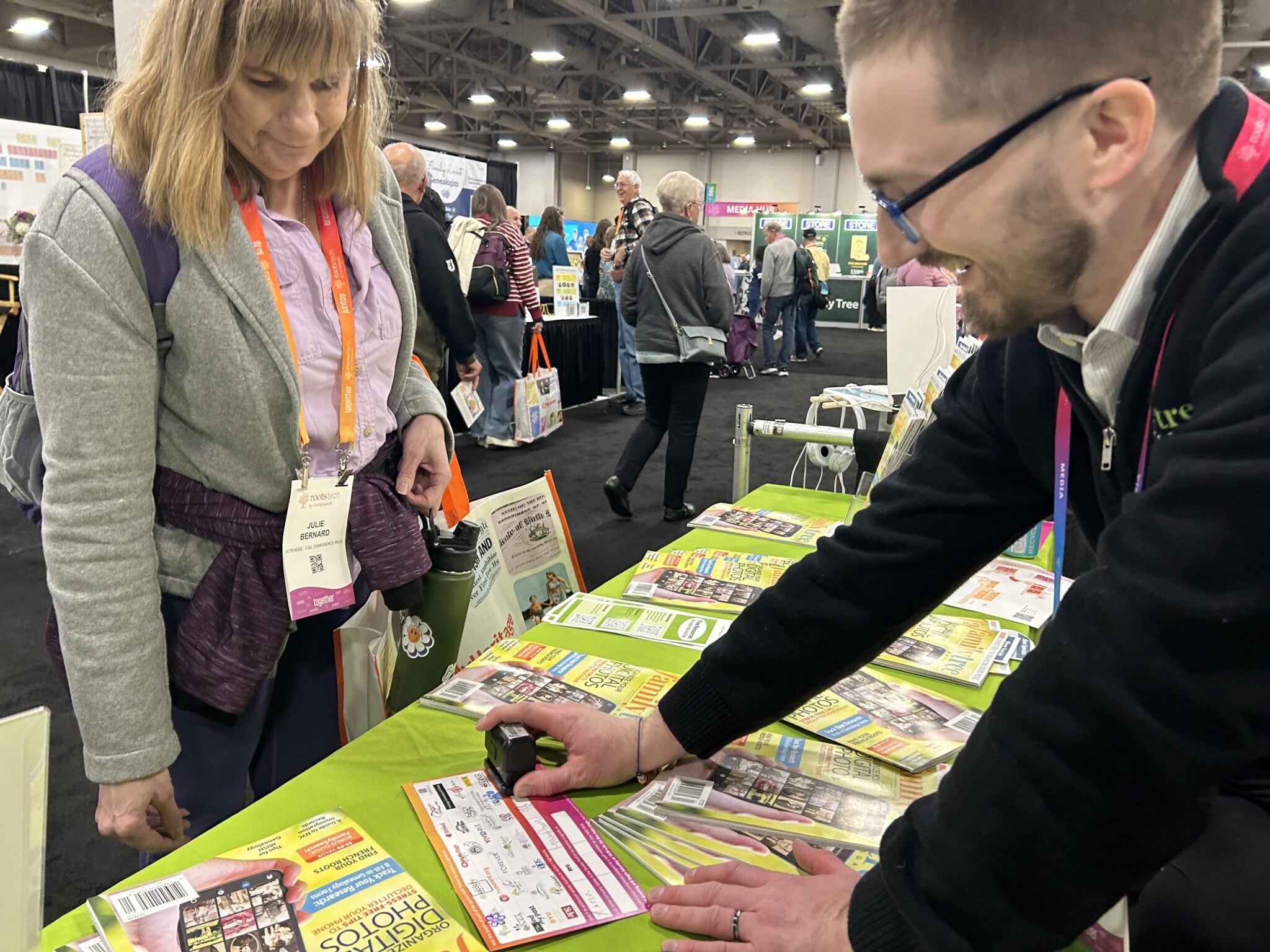
The Family Tree Magazine team was on the ground again this year at RootsTech, connecting with readers, speakers and companies across the expo hall. Our booth was very busy! We gave away nearly 1,000 copies of our latest issue and shared special deals on our magazine subscription and store products.
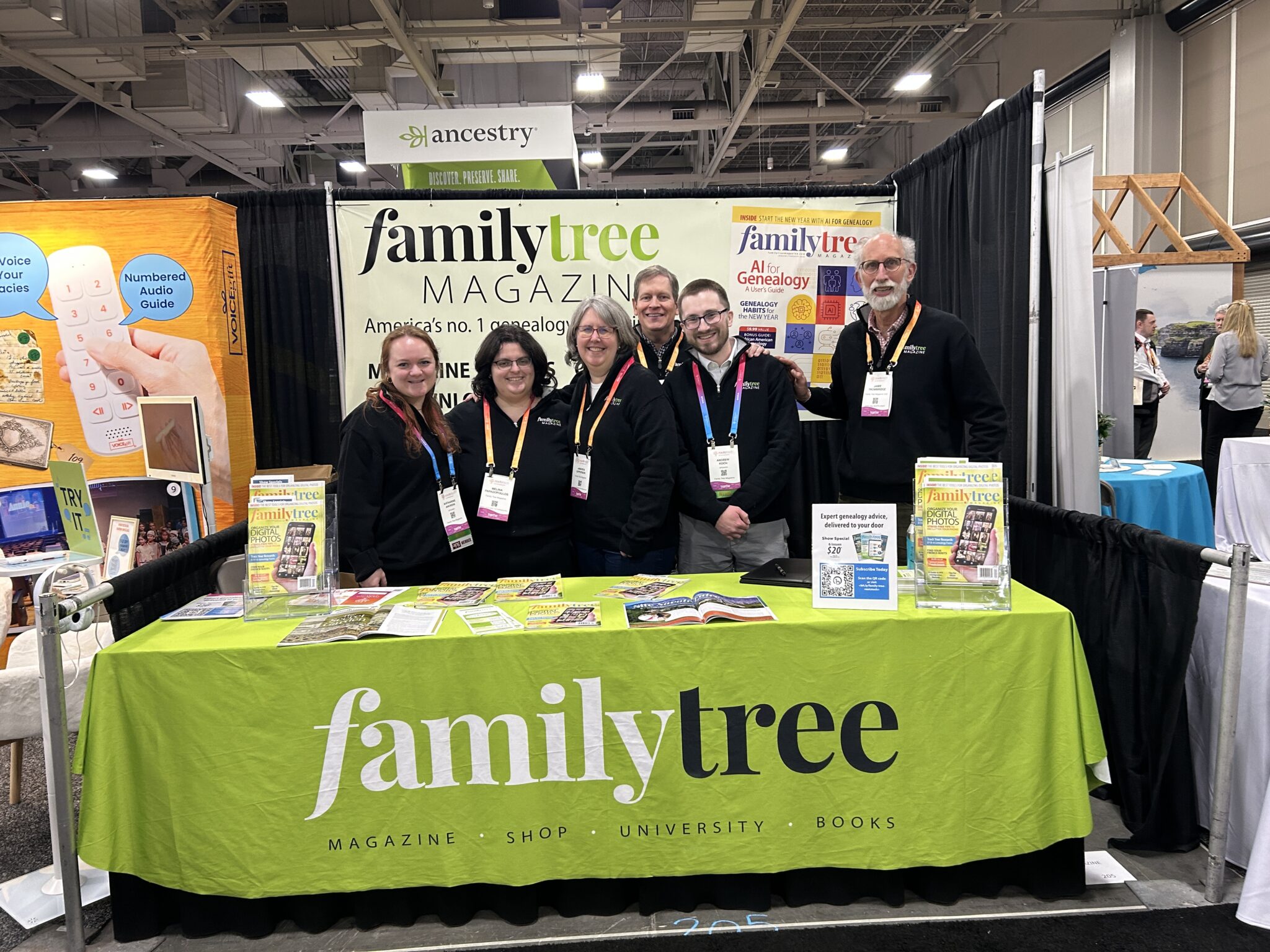
For the Family Tree staff, RootsTech is an opportunity to meet with both readers and top experts and companies in the genealogy field. Throughout the conference, our team spoke with attendees about their research challenges, explored new technologies in the field, and previewed many tools that will probably shape how we research family history in the coming years. AI-powered transcription tools to expanded newspaper archives and DNA-analysis features: The pace of innovation in genealogy continues to accelerate.
Staff Highlights
All four of our editors are RootsTech veterans. And they play many roles while in Salt Lake City: exhibitors, speakers, and members of the press. In addition to meeting with readers, they also spent time with nonprofit organizations and other vendors.
Digital Editor Katharine Andrew has spoken on a wide variety of topics at RootsTech. But there’s one in particular that she’s covered each year: “An Archivist’s Guide to Preserving Your Family Heirlooms.”
Editor Andrew Koch presented two sessions on subjects he’s written about in our magazine and on our website: managing and organizing digital photos, and using new newspaper “story” indexes at genealogy websites.
Katharine and Andrew each met with attendees after their sessions, answering questions and greeting them at the Family Tree booth.


One of the most memorable parts of RootsTech was the giant ball pit installed by FamilySearch in the expo hall. It was filled with over 50,000 balls, each containing a family history question on them. It was a funny and (un)expectedly popular centerpiece. As Rhett Dabling, the RootsTech Learning Manager, said at the Media and Speakers dinner the night before the event kicked off, “RootsTech is the ball pit of humanity.”




News and Updates
Though this year’s theme was “Together,” many advancements focused on developments in artificial intelligence (AI). In other words: The conference heavily emphasized the “tech” part of its name.
The following are just some of the announcements and updates made at RootsTech.
Ancestry.com
Ancestry.com shared several updates to its website and record collections. The most notable was to its Fold3 collection of Revolutionary War pension files, which are now fully searchable thanks to optical character recognition (OCR). You can now search for veterans and their next of kin by name, rather than relying on an index.
The new Ancestry Preserve service was heavily featured in the Expo Hall. Ancestry Preserve is a new service to help customers preserve and digitize their old media, including photographs, slides, film tapes and more.
Several AI-powered tools are also in development or being released as beta tools, including:
- AI-generated document transcripts within the Gallery
- “Discover insights” that suggest missing metadata in documents and photos (such as dates and descriptions)
- “Ask AncestryAI,” a chatbot that can generate contextual suggestions and research next-steps
- “AI Stories,” narrative-style summaries created by AncestryAI from details in your tree
Ancestry.com also announced a redesign of its “Person” page, a tab of its family tree profile. And a new beta “Ideas” feature in Person pages will generate suggestions for further research.
Still to come are “Census Compare” and “Tree Compare” features, as well as a significant update to Ancestry Hints.
Ancestry.com also shared several statistics about the platform:
- 10 million records are processed or digitized daily
- 65% of records on Ancestry.com are unique to the platform
- $450 million has been committed to record digitization and partnerships between 2026 and 2041
ArkivDigital
This Swedish genealogy website ArkivDigital announced Machine-Transcribed Text, a new feature that uses handwriting-recognition and artificial intelligence to transcribe historical records. The tool allows researchers to search directly within Swedish court records and other handwritten documents; transcripts are given in Swedish.
It also launched a Place Register feature within its family tree system, which automatically creates a register of locations that are referenced in a user’s family tree.
Association of Professional Genealogists
The Association of Professional Genealogists (APG) featured their new Readiness Assessment Readiness Assessment tool, which is designed to help aspiring genealogists evaluate their preparedness for professional research work.

BillionGraves
Tombstone database BillionGraves introduced three new features:
- Cemetery Intelligence, an upcoming tool for BillionGraves Plus subscribers that uses AI [and relevant genealogy records?] to gather information about individuals buried in a cemetery
- AI photo transcription, which works on photos taken in the BillionGraves app as well as photos and documents uploaded by the user (obituaries, death certificates, funeral programs, etc.)
- Expanded search results that include a list of genealogical and historical societies in the area where an ancestor lived or is buried
FamilySearch
The host of RootsTech, FamilySearch, featured several new tools already released and announced several updates, including:
- Full-Text Search is out of Labs and users can now attach the search results directly to the family tree
- Simple Search (in Labs) is being tested to allow users to search records using natural language
- AI Research Assistant and AI Hints are now out of Labs are available to all users to discover new insights and records
- Typed Memories in FamilySearch will now be auto-saved
FamilySearch also highlighted how it is improving its technology to help users in merging and editing profiles on the family tree with the Tree Integrity tools. The newly improved Tree Integrity tools help identify inconsistencies in the family tree, and make the Person Change History clearer with better tracking and quality scoring. They have also made enhancements to Guided Merge.
In addition, the site has enhanced compatibility with other tools, including Goldie May, Related Faces and Storied.
FamilyTreeDNA
FamilyTreeDNA launched its new Family Finder tests, which claim to analyze over 400 times the amount of genetic data (roughly 9%) compared to their previous version (just 0.02%).
They also announced upcoming Family Finder Discover reports that will have new ways for users to interpret their DNA results. These will be available to all Family Finder test takers—whether they tested recently or years ago.
The testing company also announced updated statistics on its Y-DNA haplotree (which has 100,000-plus branches) and mtDNA Tree of Humankind (which has 53,000-plus). The company remains the only major service to offer Y-DNA and mtDNA testing.
GEDmatch
GEDmatch previewed a major redesign planned for later in 2026. The upcoming update will incorporate AI-powered tools to help users interpret DNA matches and make organizing, filtering, tagging, analyzing and taking notes easier.
Geni
Geni unveiled its new feature for Geni Pro subscribers: the Geni Pro Workspace. The tool is a private, dedicated area to organize family history research, take notes, make and set to-dos, and manage projects.
Goldie May
Research assistant platform Goldie May introduced several new AI-powered tools, including a one-click transcription feature, powered by Google Gemini, that can transcribe both printed and handwritten records. Users can edit the resulting transcript and make corrections as well.
Additionally, the tool now allows enhanced syncing with FamilySearch, allowing researchers to attached records directly to the Family Tree from other websites. With the Goldie May browser extension installed, users can right click on a record page (such as one at Ancestry.com) and attach it directly to the FamilySearch Family Tree profile for a given ancestor.
The company also announced integration with Treecrossing, a new family tree-storage and -sharing platform.
LifeWeaver
Newcomer LifeWeaver made a significant splash as platinum sponsor of RootsTech 2026. The tool archives and searches through text messages, emails and other digital communication files to create a story through those files. As the company said in a short presentation as part of the conference’s keynote: “We are at a crossroads. So much of our lives is now being automatically recorded. Do we let it stay fragmented or do we build tools that let us remain the authors of our own stories?
“At LifeWeaver, we chose to build something that turns ‘someday my kids will have to sort this all out’ into ‘here’s the story I want them to have.’”
LifeWeaver also highlighted that users’ data is private; the company does not sell data or use it to train AI models.
MyHeritage
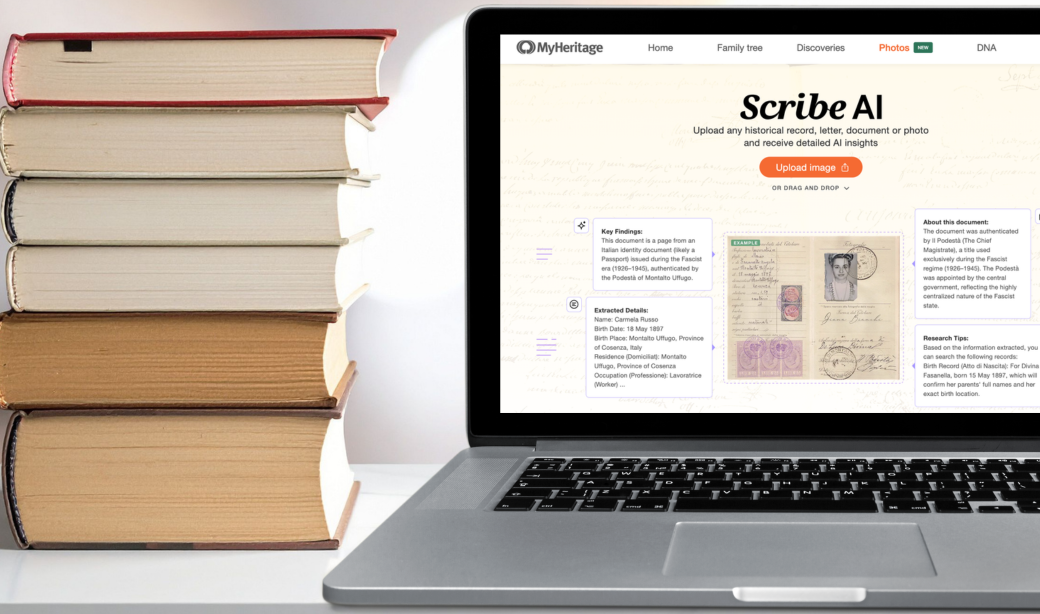
MyHeritage announced a wide range of updates across its platform, the most notable two being Scribe AI and country coding.
Read more about Scribe AI in our in-depth article.

Country coding adds flags to users’ family trees based on the locations where major events (birth, baptism, death and burial) took place. By default, the tool uses birth and baptism places, but users can adjust in the settings to use places of death and burial instead. Country Coding is available for every tree within a user’s account, but has to be enabled for each. It currently uses modern flags that represent existing countries.
When country coding is enabled, users can find a panel on the right-hand side of their tree that lists the different countries of birth, as well as how many other people in the tree were born in each country. It also shows individuals that can’t be coded by country, so users fix or add place names. Users can also adjust if and how countries are broken into small jurisdictions: US states, Canadian provinces and territories, etc.
MyHeritage also announced:
- Its historical newspaper platform OldNews has surpassed 438 million pages, making it one of, if not, the largest European newspaper archives. AI-powered search has expanded into additional languages, with German support expected to come soon.
- New record collections extracted from OldNews into MyHeritage’s Names & stories collections has grown to include more than 280 million Spanish records indexed from OldNews, along with expanded Dutch newspaper indexing. MyHeritage expects its extracted record indexes for Dutch newspapers to reach around 800 million and it will be released soon.
- GAIA, the Genealogy AI Assistant chatbot that provides guided research advice and answers to user questions. The tool will be rolled out soon.
- Family Infographics, a new Photo feature that will allow users to have AI transform family tree data into visual biographies.
On the DNA side, the company announced that it has transitioned to whole genome sequencing for all new DNA tests being processed since November, which analyzes roughly 3 billion SNPs compared to about 700,000 previously. It is the first commercial company to adopt whole genome sequencing.
Future releases include artifact DNA testing (i.e., tests that use samples beside saliva) and AI-generated life story videos.
Storied
Tree-building platform Storied can now identify and extract text directly from newspaper articles using AI. Users can now make mini-family trees directly from articles and turn newspapers into narratives and stories.
Another new feature Storied released gives users the ability to illustrate stories with AI-generated images even if they don’t have a family photo.
Storied is now also compatible with FamilySearch, so users can share their stories to FamilySearch directly from the platform. Likewise, users of FamilySearch can now click “Create a StoriedBook” under the “Memories” tab on FamilySearch to import their photos and memories into Storied.
Related Faces
Related Faces is now compatible with FamilySearch, allowing users to import photos and family information directly from FamilySearch into Related Faces.
Vivid-Pix
Vivid-Pix announces its new Memory Station Software featuring enhanced Memories story created, voice transcription and text utilization with Memory Pages. The company also announced several new partnerships:
- Enhanced integration capability with Archoral, a profile-based digital archive platform
- Collaborating with Dr. Cory Roberts, Professor of Psychology at Panola College to further its research on brain health and to create intergenerational conversations and connections between caregivers and individuals with neurodegenerative and neurodivergent cognition
- Partnering with Lauren Chrzanowski, doctoral student in the Aging and Neuropsychology Lab at the University of Louisville, to conduct board approved research to determine how the Vivid-Pix Memory Station strengthens connections between caregivers and loved ones
Read more in Vivid-Pix’s press release.
23andMe
23andMe has launched two new tools and brought back a favorite:
- DNA Relatives Clustering automatically groups DNA relatives to visualize how they are connected.
- Reconstructed Ancestors, now out of beta, uses an advanced algorithm to piece together a profile for a DNA ancestor shared by multiple matches.
- The popular chromosome browser, retired in the aftermath of a 2023 data breach, has been reinstated.
This article was published online in March 2026.
Related Reads


Author

Katharine Korte Andrew MS/LIS is a digital editor for Family Tree Magazine and professional genealogist.