
Note: The names in this story have been changed to respect privacy.
Alex Robinson was raised as the youngest of nine children. But now, thanks to a DNA discovery, he knows that he’s actually the youngest of 10 children. And he’s gotten a glimpse into a previously unknown chapter of his mother’s life.
Robinson’s AncestryDNA results showed two close family relatives: his nephew, and someone named Hal. Robinson figured Hal must be an unknown cousin. So he emailed Hal with his parents’ names and information about where they grew up.


Hal’s response came as shock. An adoptee, Hal never knew his birth parents. But according to his birth certificate, his birth mother had the same name as Robinson’s. It seemed the two were half-brothers.
“Apart from the genetic tie, I knew he was telling the truth because he added her correct middle initial, which I had not mentioned,” Robinson said. “And he was adopted out of a Catholic Charities agency that was close to where my mom was living, and she was Catholic.”
A Wartime Romance
Within an hour after their first email exchange, the two men were on the phone. Hal told Robinson how, decades earlier (just before Hal left to serve in the Vietnam War), his parents told him he was adopted. He received a copy of his birth certificate when he returned from his service. From that document, he learned his birth mother’s name—and that his birth father died before Hal’s birth.
That raised questions for Robinson. He recalled a photo of his mother from that time period, pictured having a picnic with a soldier. She wore his dress coat. “I remember asking my mom about that, maybe teasing her a little, and my sisters did, too,” Robinson says. “But as far as I can tell, she never told any of us about it. We surmise she was in a relationship with a soldier and that the soldier died during the war.” Could the soldier in that photo be Hal’s father?
Judging by his birthday, Hal was conceived around the time of the Battle of the Bulge in December 1944. A lot happened in the nine months between then and Hal’s birth. The Allies reached Germany; Italian communists captured Benito Mussolini; Adolf Hitler committed suicide; and atomic bombs fell on Hiroshima and Nagasaki. Apparently, Hal’s father perished during that time, too.
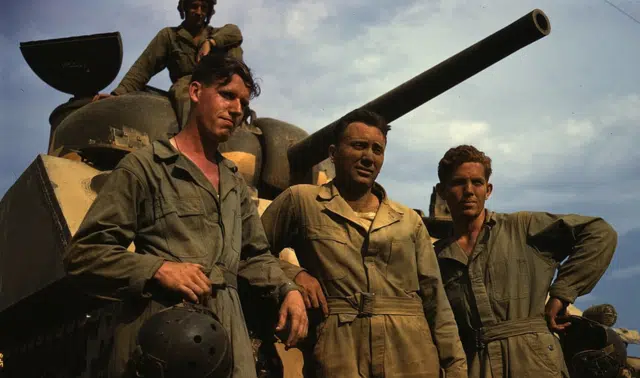
Weeks after Japan’s surrender, Hal was born in Minnesota, where his mother’s older sister lived. The adoption took place a few weeks later near her Iowa home. “She must have gone to her older sister’s house to have the baby, then come home,” says Robinson. And just a few weeks after the adoption, Robinson’s parents met at a party.
What the DNA Discovery Means
Some of Robinson’s siblings have met Hal already, and Robinson hopes to do so in person soon. “I’m looking forward to meeting him face-to-face and getting to know him better,” he says. “But this is more of a change for him than for me. I was one of nine, and now I’m one of 10. He was one of one, and now he’s one of 10.”
When asked how his perceptions of his mother have changed, Robinson reflects, “I don’t really feel like I changed my opinion of her. It just makes her life more nuanced and makes her more human.” She had a rough life. At just 12 years old, she lost both her mother and grandmothers died in the same year (1935).
“I think after the initial jubilation of finding out we had this brother, I think [my other siblings and I] felt a certain degree of sadness that she had carried this for many years and never felt she could share it,” he continues. “Things happen. Hal had a great life. His parents were good to him and he never felt like the odd child for having been adopted. I think she made a wise decision for the time.”
“It’s clear my mom had a life before she met my dad,” he concludes. Robinson doesn’t know if his father every knew about the baby. But Robinson feels confident it wouldn’t have upset his father.
“She was extremely intelligent and very hard-working and very—tough. I don’t mean that in a negative way: She was unflappable, emotionally strong,” Robinson says of his mother. “And maybe the experience of having Hal is one thing that made her as tough as she was.”
For more on DNA discoveries and how researchers handled them, read about how genealogist Patricia Walling used DNA to uncover unexpected information about her grandparents.
Related Reads


DNA testing is a powerful new tool for genealogists. And just like any other genealogical record, it’s capable of revealing secrets. For example, the results of a DNA test can reveal relationships that were either long-forgotten, or were long-held family secrets. Knowing this, what should you do when you…

A version of this article was posted in May 2019. Last updated: July 2025