

Q. I am a total novice as far as family trees go, and I need to know exactly what a “collateral descendant” is.
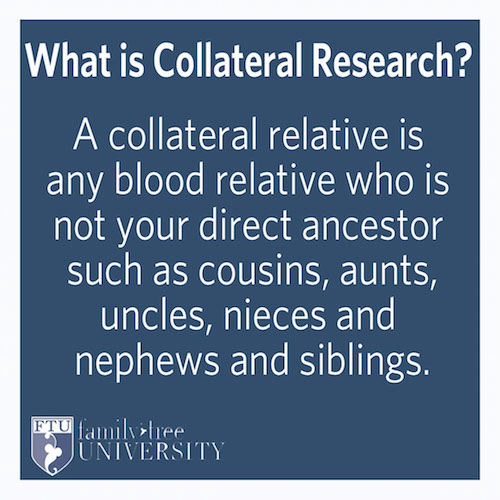
A. A collateral relative is any blood relative who is not your direct ancestor. So your ancestors are your parents, grandparents, great-grandparents, etc., and your collateral relatives are cousins, nieces, nephews, aunts, uncles, siblings, etc.
Here are three common research scenarios we may face and ways our collateral research can help solve them:
1. Where did an immigrant ancestor come from?
Say you have a great-great grandmother and you don’t know where she came from. No passenger lists or naturalization documents can be found. Eventually, you find a baptismal record for one of her children in the United States (not the record of the ancestor through whom you descend) that mentions both parents’ birthplace—including the name of the tiny town in Slovakia.
2. Who are a female ancestor’s parents?
A census record identifies an older man living with her to be her father, which reveals her maiden name. No other documentation on him can be found, but she is buried next to a man with her maiden surname. He was of age to be her brother. Researching the life of the man buried next to her reveals both of his parents’ name (in his SS-5 application). His mother’s will names all her surviving children—including that daughter.
3. What happened to my ancestor?
It’s not uncommon to have an older adult disappear from records without finding a death record to explain the disappearance. Following each child forward in the census and city directories eventually leads to her name (mis-indexed) in the household of her youngest daughter’s husband. They’re living across the state line from where you found her gravestone. That’s why you hadn’t found her death record or an obituary—she was living in an entirely different state than expected when she passed away.
Related Reads



A version of this article was published online in May 2019. Last updated: September 2025