
The American flag is not only a national symbol, it is also a surprisingly useful photo-dating tool for genealogists. Its evolving design reflects the growth of the United States, and recognizing specific versions of the flag can help date photographs, postcards, and memorabilia.
From its origins during the Revolutionary War to its current 50-star configuration, the US flag’s visual changes offer valuable chronological clues.
A Brief History of the US Flag
The Continental Congress passed the first Flag Act on June 14, 1777, declaring that “Resolved: that the flag of the United States be thirteen stripes, alternate red and white; that the union be thirteen stars, white in a blue field, representing a new constellation.” This early version, the “Betsy Ross” flag, had stars arranged in a circle, though star placement was not standardized.


As new states joined the Union, Congress periodically updated the flag. The updates didn’t follow a strict formula right away, however. For example, the number of stripes temporarily grew to 15 in 1795. But in 1818, Congress passed legislation fixing the number of stripes at 13 to honor the original colonies, while adding a star for each new state. Since then, a new star has been added on the July 4th following each state’s admission.
Star patterns were initially not standardized either. Some were arranged in circles, others in rows, or even in patterns shaped like stars themselves.
Here’s a timeline of key flag milestones:
- 1777–1795: 13 stars (the original Thirteen Colonies; Revolutionary War and early U.S. republic)
- 1795–1818: 15 stars (Vermont and Kentucky; War of 1812).
- 1818–1860s: sequence of flags growing from 20 to 33 stars, depending on the year
- 1861–1865: flags retain stars for Confederate states despite the Civil War and add two more: a 35th for West Virginia and a 36th for Nevada
- 1912: President Taft standardized proportions and star arrangement
- 1959: Alaska becomes the 49th state; the 49-star flag is used for only one year
- 1960–present: 50 stars (Hawaii)
Using the Flag as an Identification Tool for Photographs
Flags can be found in a variety of historical images: parades, school events, military scenes, political rallies, and government buildings. They might even be in the background of one of your family photographs. By identifying the version of the flag shown, you can often narrow down when a photograph was taken, especially useful when other dating clues are absent. USHistory.org and Wikipedia both have great guides that can help identify the versions of flags by both the number of stars and the arrangement of the stars.
Key Clues to Look For:
- Number of stars: Count the stars carefully.
- Star pattern: Before 1912, star arrangements were not standardized. Flags might show stars in circles, rows or staggered patterns. A unique or unusual layout may correspond to a specific time period or manufacturer.
- Flag context: Was the flag flown at half-mast? On a military base? Behind a podium during a political campaign? Context can pair with the flag design to pinpoint events or date ranges.
- Special editions or mourning flags: Commemorative flags or mourning flags (like those seen during the deaths of presidents) may differ in design, helping narrow down specific years.
Examples
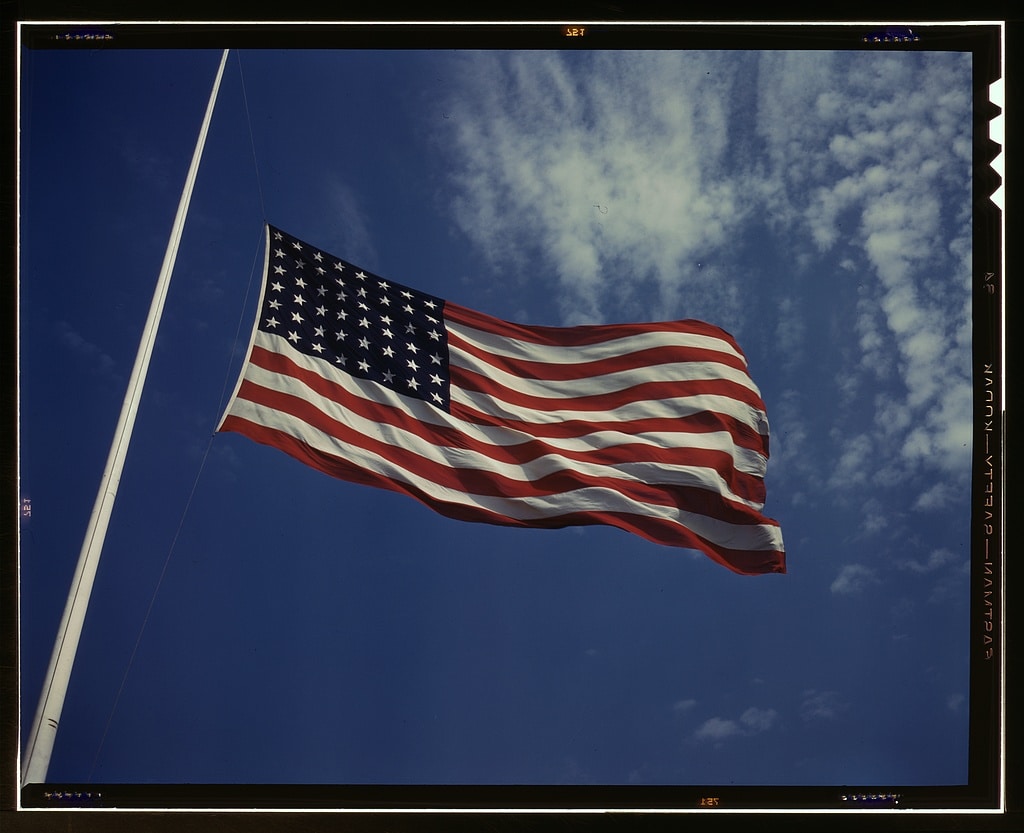
This flag from a Library of Congress photo has 48 stars. This means that the flag was manufactured between 1912 and 1959. Indeed, the LoC credits this photo to photographer Alfred T. Palmer and dates it to June of 1942.

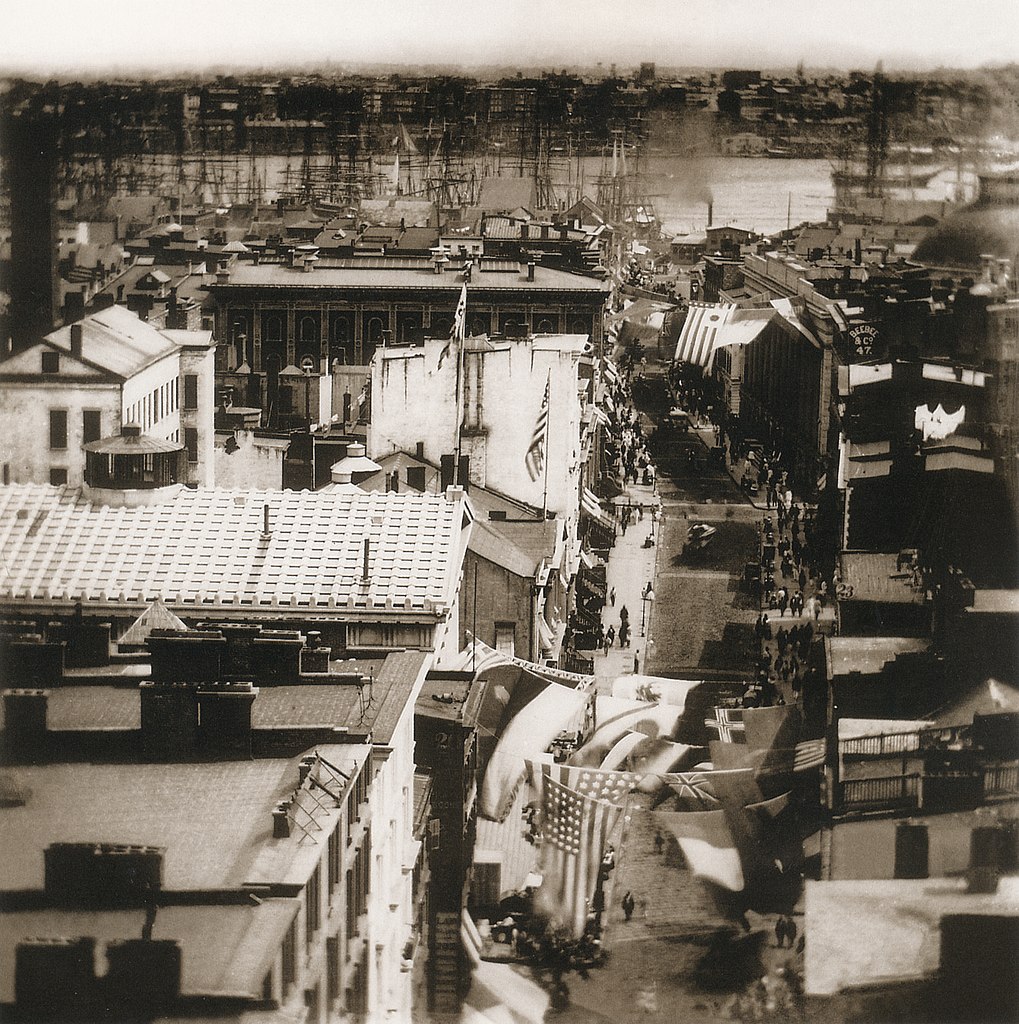
Though this photograph includes several American flags, the most useful for dating is the one in the foreground at the bottom of the image, where the stars are most visible. There are between 30 and 32 stars, narrowing the flag’s production date to one of three periods: 1848–1851 (30 stars), 1851–1858 (31 stars), or 1858–1859 (32 stars). This method of star-counting is a common tool for dating images that feature US flags. In this case, the photograph was taken by William England in 1859 and depicts Wall Street as seen from Trinity Church in New York City, as documented in Ian Jeffrey’s An American Journey – The Photography of William England.
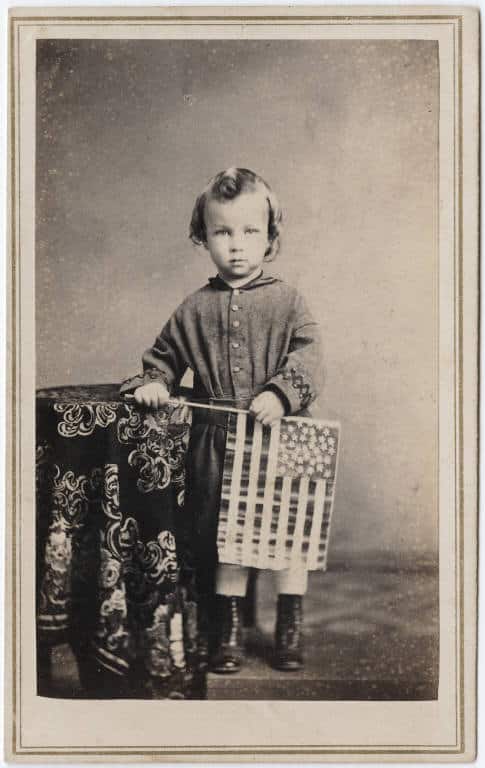
This undated photograph, part of the Carl Mautz Collection of Cartes-de-Visite Photographs Created by California Photographers at Yale, can be more precisely dated by examining the US flag in the image. The flag’s distinctive star arrangement closely resembles the “Wagon Wheel” pattern popular during the time when the US had 36 states. With careful counting, we see 36 stars, indicating the flag was likely produced between 1865 and 1867.
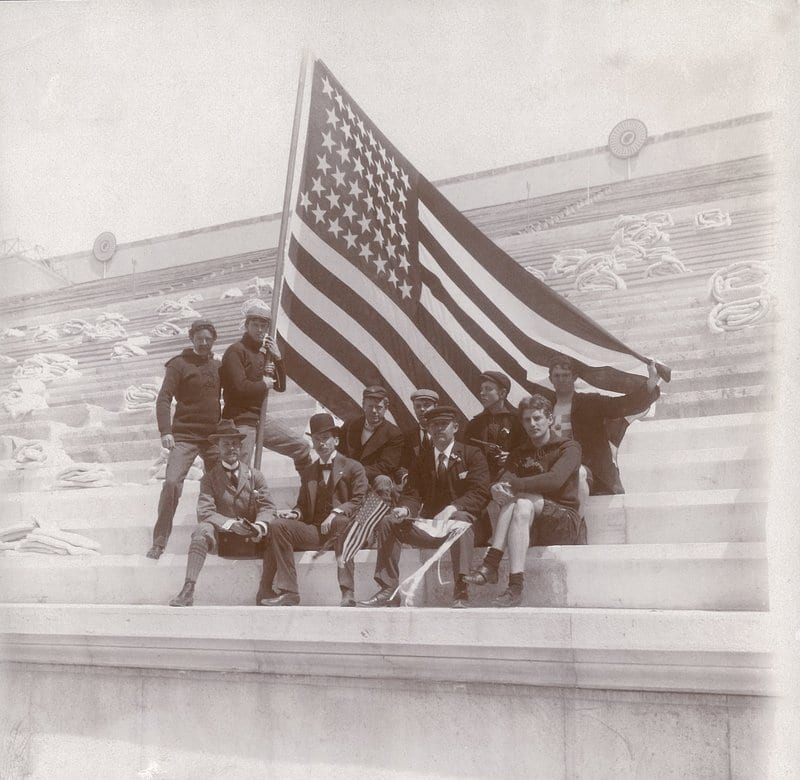
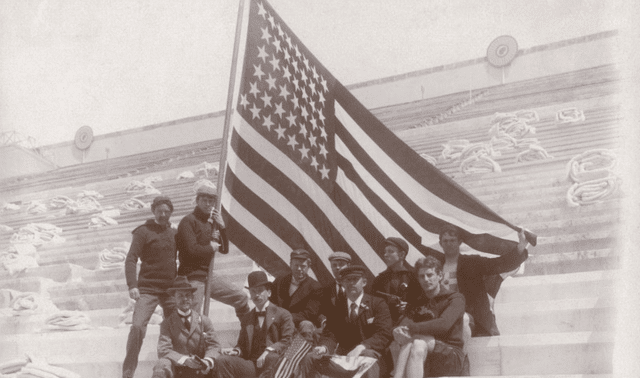
This flag is a great example of how star arrangements can help date a photograph. The 8-7-7-7-7-8 pattern points to a 44-star flag, which was in use from 1891 to 1896. Given the context—an athletic stadium and at least two men in what appear to be athletic uniforms—it’s reasonable to assume this was taken at some kind of international sporting event. And that’s exactly what it is: a photograph of the American Olympic Team at the 1896 Athens Olympics. The date lines up with the number of stars on the flag at the time. Utah had joined the Union in 1896, but the 45-star flag wasn’t adopted until July 4 of that year.
Related Reads



A version of this article was published online in June 2025. Last updated: July 2026
Author

Katharine Korte Andrew MS/LIS is a digital editor for Family Tree Magazine and professional genealogist.


