Table of Contents
According to a recent report released by the U.S. Census Bureau, more than 41 million Americans reported they have German roots. The popularization of genetic testing (e.g., with AncestryDNA), which offers some guidance as to one’s ethnic makeup, impels some family researchers to dig deeper into their past.
In addition, the ongoing digitization and availability of German records online makes German genealogy research easier than in the past.
If your German family research seems too challenging, you’re not alone. Many struggle with German history, geography, records and (especially) language.
But never fear! With the tips in this article, you can find your German ancestors with confidence.
Highlights of German History
Many Americans casually refer to their ancestors as “German.” But before 1871, that designation was more about heritage, language and descendancy than nationality. After all, what did it mean to be “German” before Germany became a unified country?
Here are some key events in German history to keep in mind:
- 800: Charlemagne is crowned emperor. His lands become the “Holy Roman Empire,” a collection of loosely affiliated city-states with varying degrees of autonomy.
- 1517: Martin Luther triggers the Protestant Reformation from Wittenberg in what is now Saxony-Anhalt.
- 1648: The Thirty Years’ War ends, having devastated German-speaking communities.
- 1806: Napoleon forces the Holy Roman Emperor to abdicate, consolidates German city-states, and forms them into the Confederation of the Rhine.
- 1815: At the Congress of Vienna, German city-states are grouped into the German Confederation.
- 1848: Political unrest sweeps Europe, driving many Germans to emigrate.
- 1871: German states unite under Prussian leadership as the German Empire.
- 1914–1918: Germany and fellow German-speaking nation Austria-Hungary form part of the Central Powers in World War I. At war’s end, the German emperor is forced to abdicate and the country becomes a republic.
- 1933–1945: Adolf Hitler and his Nazi party rule Germany, whose actions lead to World War II in Europe and the Holocaust.
- 1945–1990: The defeated Germany is divided by the Allies. West Germany is under Western influence and East Germany is under Soviet influence; they reunite after the fall of the Berlin Wall.
Finding Your Ancestral Hometown
You may have first become interested in your German ancestors to learn what life was like back in their homeland. Identifying a hometown is not only inspirational, but also key to finding records of your ancestors.
Key records
If you’re lucky, you’ll find the name of your ancestor’s hometown from family lore, a home source such as a family Bible or letter, or an online index. Other researchers will need to turn to records such as:
- Emigration or passenger arrival lists
- Naturalization documents
- Vital records, especially death certificates
- Military draft cards or service documents
- Parish registers
- Historical newspapers
- Tombstones
Remember that because of Europe’s tumultuous history, place names and boundaries will likely have changed. The same town likely has different names in multiple languages. And administrative districts crucial to finding records may no longer exist today.
In addition, many communities immigrated to the United States together. Make use of cluster research to study your ancestors’ neighbors, coworkers, and extended family. Their hometown could be a lead.
Gazetteers
A gazetteer can help you study the history of a place. These geographical dictionaries or indexes provide jurisdictional details for specific locales: place names, boundaries, landmarks, and how the places changed over time.
Meyers Gazetteer (formally, Meyers Orts- und Verkehrslexikon) is the mostly frequently cited for German genealogy. It’s helpfully been digitized and covers the German Empire era (1871–1918). Just type the name of a village or city to see what information the database holds. You can perform wildcard searches on the site if you’re not sure of the spelling—use an asterisk in place of an individual letter.
For example, my Wendt ancestors lived in a village called Damme in Germany’s northeast corner, near the Oder River and the border with Poland. I searched for Damme at Meyers Gazetteer and was able to choose from multiple results. The Entry tab excerpts the village’s text from the original gazetteer and features a breakdown of administrative districts. From the Map tab, I can toggle between historical and modern maps, allowing me to see where Damme is both today and in my ancestors’ day.
Understanding German Language for Genealogy
Based on articles by James M. Beidler
When you find records that contain vital information about your ancestors, you understandably rejoice. You may pause, however, when you realize that you cannot make out any of the words because they are all in a language you don’t understand.
This is a common obstacle for those with German heritage, but don’t worry: You don’t have to toss those records to the side. You may, in fact, be able to decipher a good amount of information from them simply by understanding a few basics about the German language as a whole. Then, you can translate just a few keywords to make sense of entire documents. Translation tools can come in handy for this process.
As you delve deeply into looking for records, you may want to keep a few things in mind about the German language and German traditions as a whole:
- Scripts and fonts: Translating common German words may be only the first step to decoding your ancestors’ records. Many old German records are written in intricate script (such as Kurrentschrift) that will likely be unfamiliar to you. Fortunately, websites like Alte Deutsche Handschriften, the FamilySearch Research Wiki and Wordmine can help you determine what specific names and locations might look like when written out. Practice reading old German scripts to better interpret them.
- German naming traditions: As you peruse German records, you may notice that many of your ancestors share the first name—which is understandably confusing. You’ll want to look more closely at the second name; that is most likely the one by which your ancestor was known. This is just one example of nuance in German naming conventions. You will want to review these conventions closely as you research your ancestors.
- German surnames: German surnames often fall into four distinct categories: occupational, patronymic, geographical and characteristic. Additionally, you may find that one surname is spelled differently from one document to the next. This is the result of record-keepers attempting to follow English spelling conventions while also taking into consideration German pronunciation.
- World War I and its effects on German language: World War I significantly influenced German-Americans’ attitude toward their language and how they used it. Once firm German-speakers at home and church, German-Americans transitioned to speaking and writing in English in an effort to demonstrate their support for the Allies. As a result, German newspapers grew much scarcer, and many churches adopted English as their primary record-keeping language.
Using German Genealogy Records
Germans were generally meticulous record-takers. And, despite devastating wars throughout German history, many of them survive.
Emigration records
We often think of immigration records being created at the port of arrival. But Germans also generated records from the port of departure. These emigration records from popular ports—Hamburg, Bremen, Antwerp, Le Havre, and Stettin—can be genealogical gems, though not all of them have survived.
Records from Hamburg, Germany, are among the most-extant. Ancestry.com has a wonderful collection of departures from 1850 to 1934, and records often list last place of residence in the home country.
My great-great-grandfather, Christian Wendt, emigrated from Prussia to the United States in 1846 when he was just 12 years old. His departure pre-dates the Hamburg passenger lists. However, he was listed in a different port-of-departure index on Ancestry.com, the discovery of which I call my “Brandenburg breakthrough.” The record gave his full name and birth date, as well as (critically) the name of his village. That information got me “across the pond.”
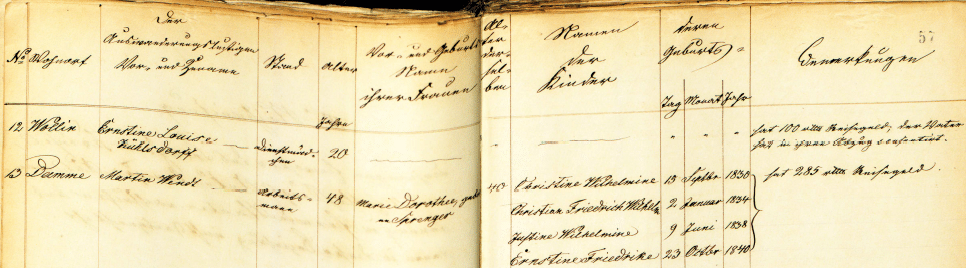
A subsequent discovery led to the Wendts’ permission-to-leave record (Auswanderung; see above), a document created by the province’s authorities to allow someone to emigrate. An Ancestry.com index led me to the microfilmed record at FamilySearch. One side of the card named Christian’s parents (Martin Wendt and Maria Dorothea Sprenger), indicated the family had four children, and gave their residence as Damme. Their departure was approved on 6 March 1846. The other side of the card listed Christian and his three siblings in chronological order, along with exact dates of birth.
I found the original record, too, from the Brandenburg archive. It validated the materials in the Ancestry.com index and FamilySearch microfilm.
Passenger lists
Germans were, of course, mentioned in records at the point of arrival as well. Many traveled through New York City or Philadelphia, immigration hubs whose records are held by the National Archives.
The United States first required passenger lists in 1820. Early documents (called “customs lists”) included only the passenger’s name, sex, occupation, nationality, and point of embarkation. Arrival forms expanded in 1891 when immigration was federalized and standardized. From that year, passengers were listed alongside those facts plus place of last residence, address of nearest relatives in the United States (if any), and personal description.
The National Archives has worked with partner websites to make passenger lists from major ports available online. Those from New York City (e.g., Castle Garden or Ellis Island arrivals) are available for free.
Pre-1820 arrivals may have been documented by individual states or local governments. Many have been compiled into published sources such as P. William Filby’s Passenger and Immigration Lists Index.
Passenger lists were filled out at the port of departure and simply verified in the U.S.; contrary to popular belief, immigrants’ names weren’t changed at points of arrival such as Ellis Island. However, immigrants still may have opted to Anglicize their names in the new country, especially during World War I when German culture and language were treated with suspicion.
Church and other religious records
Church records date back hundreds of years, making them a more-reliable record set than civil records (which didn’t begin in earnest until the mid-1870s).
Paramount to using religious records is knowing your ancestor’s denomination: Most Germans were Lutherans or Catholics, with notable minorities of other Christian denominations and Jewish sects.
The free FamilySearch has many German religious records. With just a username and password, you can potentially find your ancestor via a simple name search. Note that some records remain unindexed, and others can be viewed only at a FamilySearch Center.
The subscription site Ancestry.com also has German records, with coverage varying by place. Use the Card Catalog to drill down to your region of interest (which may be in a different country today than when your ancestor lived there). You can also search collections by title or keyword.
Those researching Lutheran ancestors should also try Archion. This subscription website holds church books from more than 20 archives across Germany—altogether, 175,000 church books. You can’t search records by name, but you can browse them by parish.
Matricula Online is a similar resource for Catholic records. Like Archion, Matricula Online doesn’t allow users to search by name. But you can Search for Places at the top of the site to see what the site has.
Civil records
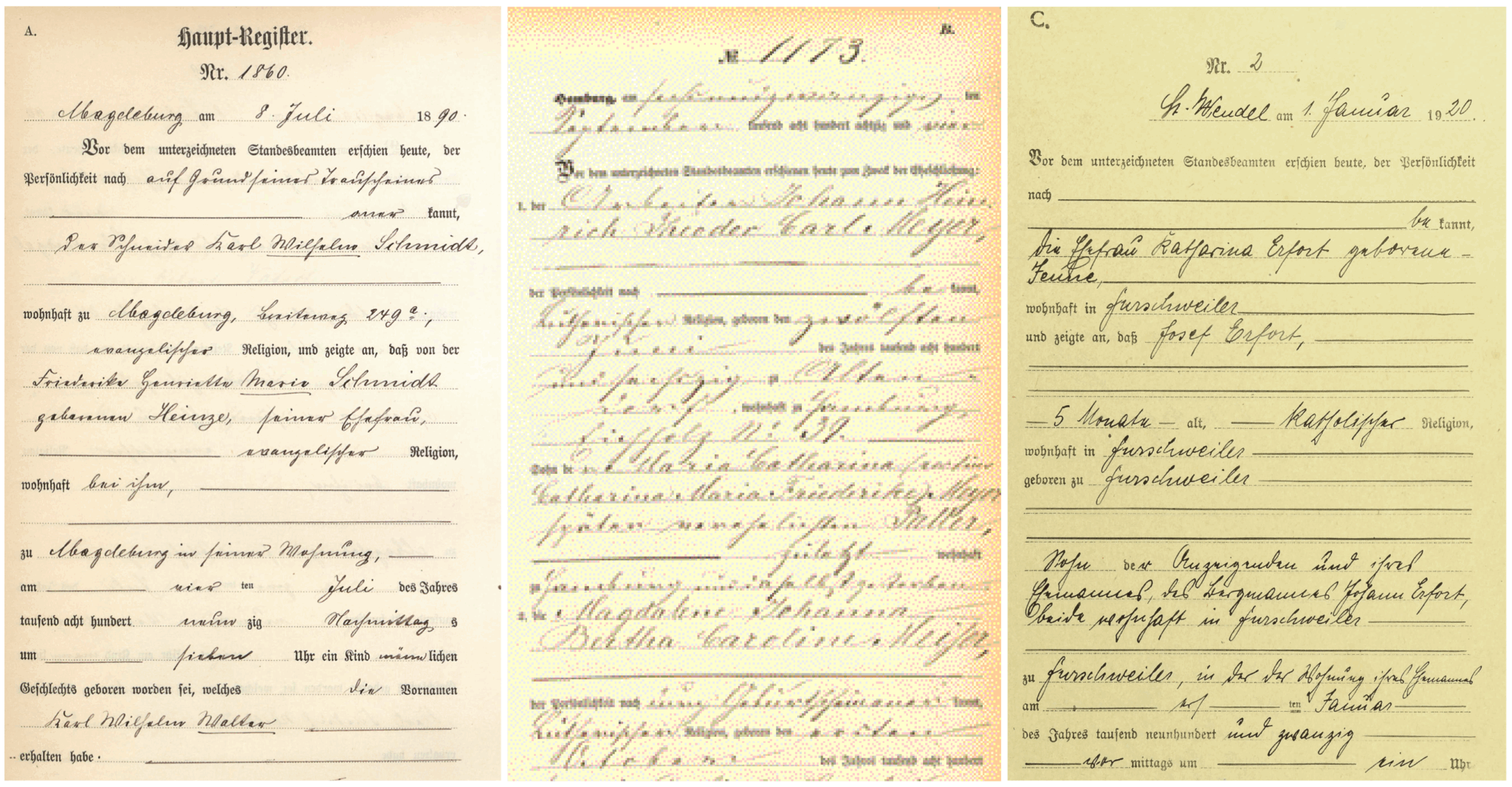
Records kept by the Prussian or German governments should be your next target, particularly if you’ve exhausted church records or realize they’ve been lost or destroyed.
Called Standesamt records, these birth, marriage and death documents were instituted at various times. Areas conquered by Napoleon adopted registration as they were incorporated into his lands; some continued record-keeping after Napoleon’s defeat, while others ceased. Prussia instituted mandatory registration in 1874, and the full German Empire followed in 1876.
Civil records are relatively templated. Here’s an overview of each kind:
- Birth records list the name and birth details of the child, plus the names, residence, and religion of the parents. They’re just one page long and are annotated with an A in the corner.
- Marriage records are longer, listing the marriage certificate number and registration date. Separate sections collect information about the bride, groom and (on the second page) the witnesses. Look for a B in the corner.
- Death records list the name, occupation and residence of both the deceased and the individual reporting the information (usually a relative). C’s denote death records. Ancestry.com published a tutorial that outlines each civil record type, with tips for finding and reading each.
Manumission records
For many, freedom from an estate and the work that came with it over resulted in a letter of manumission. Author Werner Hacker published over 10 volumes containing manumissions. You can find an English language summary with names and villages in Hacker’s Emigrants from Southwest Germany to America and Other Countries (Closson Press). Manumission records are particularly valuable for those seeking out ancestors in the 1700s to early 1800s.
Records from Nazi Germany
World War II in Nazi Germany was a dark time in human history. You may be surprised by the genealogically rich information that arose from that time. Hopeful members of the Nazi party’s military were required to submit proof of their “pure” ancestry. This resulted in unique applications complete with ancestor charts, or Ahnentafeln.
German Emigration Patterns
Based on articles by James M. Beidler and Stephen Wendt
German-speaking people tended to leave their home country in two main waves:
| First Wave (1700s) | Second Wave (1800s) |
| A majority traveled east (an estimated 80,000 US immigrants) | Large-scale US immigration, an estimated 5 million |
| Mostly came from Palatinate, Baden, Württemberg, Saarland and Alsace | Mostly came from Saxony, Pomerania, Prussia and Bavaria |
| Mostly Lutheran and Reformed Protestant | Many craftsmen and entrepreneurs |
Finding early German immigrants
If you have German ancestors who landed in Pennsylvania, you may be in luck. Passenger lists may prove to be valuable to you in your research. That’s because the colony required ship captains to keep lists of any foreign passengers on board. You can search these lists on Ancestry.com.
Germans from Prussia
Prussia was a mighty kingdom before it was absorbed by Germany. It had also undergone many dramatic territorial changes throughout its existence. This can make pinning down ancestors who lived in the region challenging.
The good news is that there are strategies you can adopt to make the research process smoother. For starters, you will want to narrow down your search to your ancestor’s place of origin. You could find this information in a number of different documents, including church and vital records, censuses and immigration records.
Germans from Russia
Germans in Russia? It may seem like a strange phrase; however, genealogists with German heritage may discover this perplexing reality it old records.
So, what’s the story? After the Seven Years’ War, Empress Catherine the Great desired to revitalize Russia. In an effort to do so, she invited European colonists to settle in some regions, with the promise of land and freedom of religion. Roughly 30,000 Germans seized the opportunity.
Russia was not always a particularly favorable place for German speakers; in the 1870s, Czar Alexander revoked the colonies’ special status, which made prospects even less certain for many, prompting significant emigration from Russia.
If you have German-speaking ancestors who migrated to Russia, you may benefit from researching the many German-speaking groups.
Germans outside Germany
Historically, Germany has spent many centuries disunited, which has led to ethically German individuals settling all across Europe. While it can be tricky to pin down very old records concerning medieval colonists, you may be able to trace colonists after 1700s back to villages in Germany. This is because church records have largely withstood the test of time.
German Genealogy Websites and Resources
Based on articles by James M. Beidler
Thanks to the internet, you can access many valuable German genealogy resources with a mere click. Several websites may even contain all you need to make meaningful discoveries about your German ancestors—or at least give you a clear path to finding them. Some of the most valuable German genealogy websites include:
- Archion.de: The result of several Lutheran church archives coming together to preserve their records online, Archion.de is a wonderful resource for finding more than 175,000 church books. Explore 25 unique archives and download the pages that you need.
- Compgen.de: Run by the Society for Computer Genealogy, Inc., the largest genealogy group in Germany, Compgen.de contains an extensive collection of documents, databases and more. Though most of the website is in German, there are several pages available in English. Even those not available in English can be incredibly valuable with a handy translation tool. You don’t need an account to enjoy many of its search functions, but you will need to create one if you wish to upload a family tree. Our guide provides a detailed breakdown of this tool and all you need to know about navigating its rich resources.
- Cyndi’s List: This expansive directory can help you find the information you desire in just a few clicks—whether that information be military records, maps or libraries. Also find plenty of sources on related topics, like the World Wars and nearby countries.
- FamilySearch Wiki – Germany: Explore various records and an interactive German map.
- Google Translate: This tool will prove useful as you peruse records in German and need help decoding certain words and phrases.
- Kartenmeister: By now, you understand just how much territorial changes can affect your genealogy research, especially when it comes to Germany and its surrounding regions. Kartenmeister is great specifically for those seeking out ancestors who lived in regions of what was once eastern Prussia. Find over 110,000 locations, plus thousands of name changes. Best of all, the website is simple to search and navigate.
- Meyers Gazetteer: Research the places your German ancestors have lived from the comfort of your living room with this handy website. Meyers Gazetteer contains a sprawling list of place names, specifically those in the Second German Empire. This time period spans several decades.
- Portal Archive in Baden-Württemburg: Use this directory to search for various archives, including state and district, towns and communities and even businesses and universities.
Books
- Ancestors in German Archives by Saskia Schier Bunting, Mirjam J, Kirkham, Nathan S. Rives and Raymond S. Wright (Genealogical Publishing Co.)
- Eighteenth Century Register of Emigrants from Southwest Germany to America and Other Countries by Werner Hacker (Closson Press)
- The Family Tree German Genealogy Guide by James M. Beidler (Family Tree Books)
- A Genealogist’s Guide to Discovering Your Germanic Ancestors by S. Chris Anderson and Ernest Thode (Betterway Books)
- The German Research Companion by Shirley J. Riemer (Lorelei Press)
- If I Can, You Can: Decipher Germanic Records by Edna M. Bentz (self-published)
- In Search of Your German Roots by Angus Baxter (Genealogical Publishing Co.)
- Master Index to the Emigrants Documented in the Published Works of Annette Kunselman Burgert by Annette K. Burgert (AKB Publications)
- The Palatine Families of New York, 1710 by Henry Z. Jones Jr. (self-published)
- Trace Your German Roots Online, second edition by James M. Beidler (Masthof)
Genealogy Groups and Archives
- Archives in Hessen
- German Genealogy Group
- Germanic Genealogical Society
- Koblenz City Archives (Staatsarchiv Koblenz)
- Mid-Atlantic Germanic Society
- Palatine Institute for History and Customs
- Palatines to America
- Pennsylvania German Society
- Sacramento German Genealogical Society
- Schleswig-Holstein Archives
- Society for German Genealogy in Eastern Europe
- Speyer City Archives
Related Reads


A version of this article was posted online in December 2024 and ran in the September/October 2025 issue of Family Tree Magazine.
FamilyTreeMagazine.com is a participant in the Amazon Services LLC Associates Program, an affiliate advertising program designed to provide a means for sites to earn advertising fees by advertising and linking to Amazon.com and affiliated websites.
Author

Stephen Wendt, MLIS, is a professional genealogist, instructor and writer. Stephen assists global clients with their diverse genealogical research needs. A specialist in Prussian/German and Scottish genealogy, he regularly speaks on a variety of genealogical topics at the international, national and at the local level. Stephen may be reached at: stephen@rootsquestgps.com.